




403
Sorry!!
Error! We're sorry, but the page you were looking for doesn't exist.
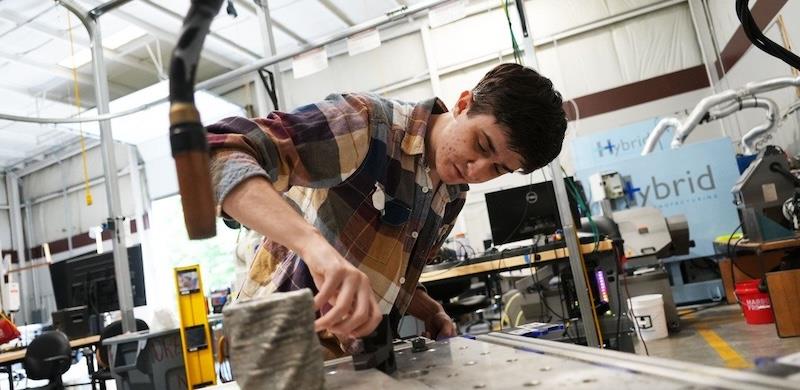
NSF Funds Virginia Tech Project Using Robotic Arms To 3D Print Stronger, Nature-Inspired Composite Materials
(MENAFN- Robotics & Automation News) National Science Foundation funding brings 'smarter and stronger' advanced manufacturing
December 4, 2025 by David Edwards
The next revolution in manufacturing might come from a robotic arm that 'prints like nature builds'
With funding from a three-year, $3.5 million National Science Foundation (NSF) Future Manufacturing Research Grant, a team at Virginia Tech is pioneering this new approach by using robotic arms to produce 3D-printed composite materials from multiple directions instead of laying them down in straight lines and flat layers.
The final printed product features engineered materials that bend and curve like the grains of wood in a tree to anticipate stresses, making them almost 10 times stronger than traditional 3D-printed material.
The three-year NSF grant funding the work is one of only seven awarded under the Future Manufacturing Research program, which supports research, education, and the training of a future workforce to create manufacturing capabilities that do not exist today.
How it's doneIn its earliest days, additive manufacturing could only 3D print in flat layers. A nozzle resembling a hot glue gun would lay down lines of a single material, which then cooled and adhered to one another to create layers that formed the final product.
This method is still widely used, but newer methods include the use of robots to print in multiple directions rather than the flat, layered lines. Combined with new printable composite materials, additive manufacturing can produce pieces not seen before.
This includes electronic pieces that are more flexible, an airplane part that's lighter and stronger, or a machine part capable of multiple distinct functions. It's the future of manufacturing, and that future is near.
“We have been exploring how robotic arms could benefit 3D printing for almost 10 years now,” said Christopher Williams, director of Virginia Tech Made: The Center for Advanced Manufacturing.
“We found that to truly leverage the flexibility of these robotic arms for improving printed part strength, we needed to combine our collective knowledge of design optimization, advanced materials, robotic controls, and additive manufacturing. Our early results of putting these pieces together are really exciting.”
Calling in the expertsTo achieve this goal requires an ensemble of experts in robotics, materials, and methods. The team assembled for the project includes four faculty from the Department of Mechanical Engineering:
-
Pinar Acar, whose group uses data to develop virtual models for parts to be created and machine learning to create the best combination of properties.
Michael Bartlett, who leads a team with rich experience in engineered materials.
Erik Komendera, a former NASA engineer who has been using that experience to drive new innovations in the lab and the classroom.
Lisa McNair, a professor in the Department of Engineering Education with a deep expertise in workforce training.
Christopher Williams, director of the Design, Research, and Education for Additive Manufacturing (DREAMS) Lab, a hub for 3D printing innovation.
A key aspect of the project is bringing these new tools into the future manufacturing workforce. Lisa McNair, professor in the Department of Engineering Education, will engage future engineers through K-12 outreach events, work with faculty to develop and incorporate a“manufacturing spine” throughout the College of Engineering's curriculum, and assess the impacts of these new approaches in preparing the manufacturing workforce.
“This project needs all of us, because any individual researcher can't make the progress needed to enable the materials, the process, the design, and the robotics,” Bartlett said.“You can't put this work in a single lab because you will not have the expertise needed to push it forward.”

Legal Disclaimer:
MENAFN provides the
information “as is” without warranty of any kind. We do not accept
any responsibility or liability for the accuracy, content, images,
videos, licenses, completeness, legality, or reliability of the information
contained in this article. If you have any complaints or copyright
issues related to this article, kindly contact the provider above.
Most popular stories
Market Research

More Story







Comments
No comment