







403
Sorry!!
Error! We're sorry, but the page you were looking for doesn't exist.
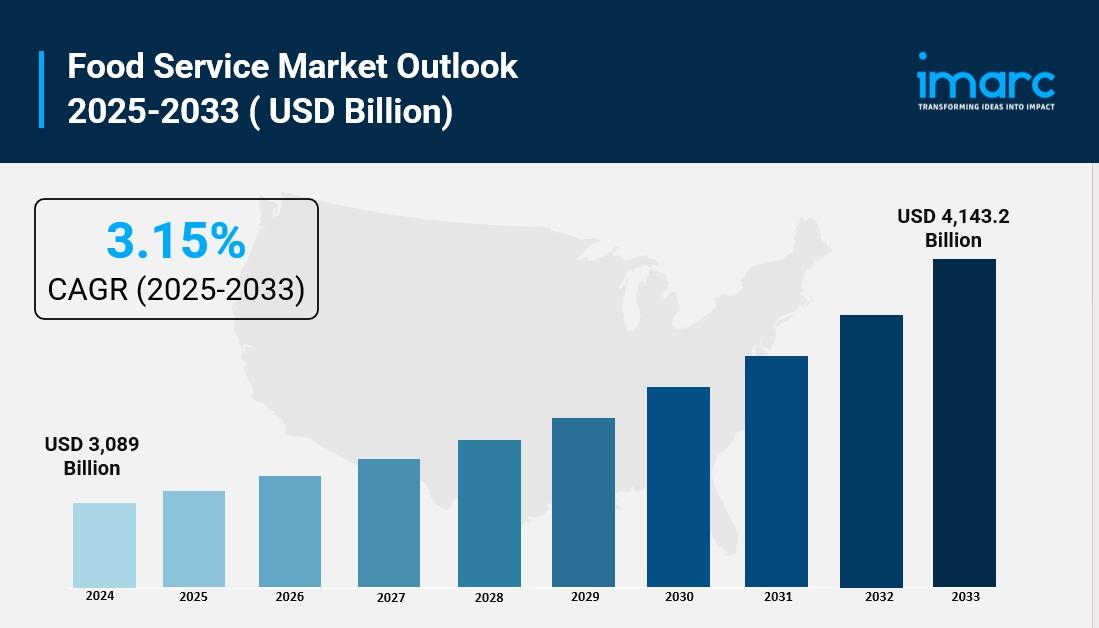
Food Service Market Is Expected To Reach USD 4,143.2 Billion By 2033 At CAGR 3.15%
(MENAFN- IMARC Group)
Food Service Market Size and Outlook 2025 to 2033
The global food service market size reached USD 3,089 Billion in 2024. Looking forward, IMARC Group expects the market to reach USD 4,143.2 Billion by 2033, exhibiting a growth rate (CAGR) of 3.15% during 2025-2033. The market is experiencing stable growth driven by the growing health-consciousness among individuals, rising number of online food delivery platforms to offer enhanced convenience, and increasing focus on health and wellness to maintain a healthy and active lifestyle.
Key Stats for Food Service Market:-
Food Service Market Value (2024): USD 3,089 Billion
Food Service Market Value (2033): USD 4,143.2 Billion
Food Service Market Forecast CAGR: 3.15%
Leading Segment in Food Service Market in 2024: Conventional Foodservice System
Key Regions in Food Service Market: Asia Pacific, Europe, North America, Latin America, Middle East and Africa
Top companies in Food Service Market: Chipotle Mexican Grill Inc., Costa Limited, Domino's Pizza, Inc., Jollibee Foods Corporation, KFC Corporation, McDonald's Corporation, Restaurant Brands International Inc., Starbucks Corporation, Subway IP LLC, Supermac's, Tim Hortons Inc, Wendy's International LLC, Yum! Brands, Inc, etc.
Request Sample Report URL: https://www.imarcgroup.com/food-service-market/requestsample
Why is the Food Service Market Growing?The food service market is growing due to several key drivers: rising urbanization and increasing disposable incomes are shifting consumer lifestyles toward dining out and ordering food delivery. Convenience, variety, and experiential dining preferences are fueling expansion, especially in quick-service restaurants (QSRs), full-service restaurants, cafes, and cloud kitchens. Digital transformation, including mobile ordering, AI-powered menu personalization, contactless payments, and online food delivery platforms, is revolutionizing how consumers access and experience food services. Additionally, sustainability initiatives such as plant-based menu options, eco-friendly packaging, and waste reduction technologies resonate strongly with eco-conscious consumers, boosting demand further. The growth of multi-brand cloud kitchen models offers scalable, low-overhead operational advantages, expanding market reach. Regional markets like South Korea, the USA, Asia-Pacific, and Latin America are emerging as significant growth hubs driven by evolving consumer preferences and technological adoption. Overall, the convergence of lifestyles, technology, and sustainability is propelling steady growth of the global food service market.
AI Impact on the Food Service Market:AI is transforming the food service market by significantly enhancing operational efficiency, customer experience, and innovation. In kitchens, AI-powered robotics are automating food preparation tasks such as flipping burgers, assembling salads, and cooking pizzas, which improves productivity, food consistency, and reduces labor costs. AI-driven tools analyze sales data, customer feedback, and seasonal trends to optimize menu offerings, helping restaurants adjust popular items, introduce new flavors, or discontinue less profitable dishes. AI also streamlines ordering and payment processes with conversational interfaces, kiosks, and mobile apps, reducing wait times and errors while enabling personalized menu recommendations based on individual preferences. In food delivery, AI optimizes route planning based on real-time traffic and weather, speeding delivery times and lowering fuel expenses. Beyond operations, AI enhances quality control by monitoring production processes to ensure safety and consistency. Overall, AI integration is revolutionizing how food service businesses operate, innovate, and engage customers, driving growth and sustainability in the industry.
Segmental Analysis:By Sector:
-
Commercial
Non-commercial
Commercial represented the largest segment due to the extensive presence of commercial establishments such as restaurants, cafes, and catering services catering to a wide range of consumers and industries, driving higher revenue and market share within this sector.
By Systems:
-
Conventional Foodservice System
Centralized Foodservice System
Ready Prepared Foodservice System
Assembly-Serve Foodservice System
Conventional foodservice system represented the largest segment due to the widespread adoption of traditional foodservice systems, characterized by their simplicity, cost-effectiveness, and familiarity among a broad spectrum of food service providers, leading to their dominance in the market.
By Types of Restaurants:
-
Fast Food Restaurants
Full-Service Restaurants
Limited Service Restaurants
Special Food Services Restaurants
Full-service restaurants represented the largest segment due to the enduring popularity and widespread presence of full-service dining establishments offering comprehensive menus, table service, and ambiance, appealing to diverse consumer preferences and occasions, thus securing a significant share of the market.
Analysis of Food Service Market by Regions:-
Asia Pacific
North America
Europe
Middle East and Africa
Latin America
Asia Pacific was the largest market due to the rapid economic development, urbanization, and burgeoning population of the Asia Pacific region, driving robust consumer demand for food service offerings across various segments, resulting in Asia Pacific emerging as the dominant market in the global food service industry.
What are the Drivers, Restraints, and Key Trends of the Food Service Market ? Market DriversThe food service market is driven by the rising demand for convenient, affordable, and diverse dining options, fueled by urbanization and changing consumer lifestyles. Increasing disposable incomes and the growing popularity of dining out, takeaway, and online food delivery services are boosting growth. Technological advancements such as digital ordering platforms, mobile apps, and AI-driven personalization are further enhancing customer experience. The expansion of quick-service restaurants (QSRs), cloud kitchens, and international food chains is also contributing to market expansion globally.
Market RestraintsThe market faces restraints due to fluctuating raw material prices, which impact food service margins. Labor shortages and high employee turnover rates remain critical challenges for operators. Rising health and safety regulations, particularly after the COVID-19 pandemic, increase operational complexities and costs. Additionally, the growing consumer shift toward healthier and home-cooked meals can limit frequent dining out or ordering habits.
Key Market TrendsKey trends shaping the food service market include the rapid adoption of online delivery platforms and third-party aggregators, making food more accessible and convenient. There is a strong shift toward healthier menus, plant-based offerings, and sustainable sourcing to cater to health-conscious and eco-aware consumers. Automation and robotics, such as self-ordering kiosks and robotic kitchen assistants, are being adopted to reduce costs and improve efficiency. Moreover, the rise of experiential dining, fusion cuisines, and personalized menu offerings is transforming customer expectations and redefining the competitive landscape.
Leading Players of Food Service Market:According to IMARC Group's latest analysis, prominent companies shaping the global Food Service landscape include:
-
Chipotle Mexican Grill Inc.
Costa Limited
Domino's Pizza, Inc.
Jollibee Foods Corporation
KFC Corporation
McDonald's Corporation
Restaurant Brands International Inc.
Starbucks Corporation
Subway IP LLC
Supermac's
Tim Hortons Inc
Wendy's International LLC
Yum! Brands, Inc
These leading providers are expanding their footprint through strategic partnerships, rich certification portfolios, and advanced digital platforms to meet growing corporate, academic, and enterprise demands in emerging technologies like cloud computing, cybersecurity, big data, and AI/ML
Ask An Analyst: https://www.imarcgroup.com/request?type=report&id=1310&flag=C
Key Developments in Food Service Market:-
In March 2025, Food Service India introduced Ramadan-special food solutions for the HoReCa sector under its Sunbay and Marimbula brands. Sunbay's Haleem Grain Base cuts Haleem preparation time from 12-14 hours to just 30-40 minutes, enhancing kitchen efficiency. Marimbula debuts Jallab Syrup, inspired by Middle Eastern flavors, and Red Velvet Syrup for desserts and beverages. These products help restaurants and cloud kitchens serve authentic, high-quality Ramadan delicacies with ease.
In February 2025, Apple News+ is launching a new Food section in iOS 18.4 and iPadOS 18.4 this April, offering subscribers access to tens of thousands of recipes, kitchen tips, restaurant reviews, and more from top publishers like Bon Appétit, Allrecipes, and Serious Eats. Users can browse, search, and filter recipes, use a full-screen Cook Mode for step-by-step guidance, and save favorites for offline access, all curated by Apple News editors.
In February 2025, Rebel Foods launched QuickiES, a standalone app offering 15-minute food deliveries, entering the ultra-fast delivery market to compete with Zomato and Swiggy. Announced by EatSure CEO Sagar Kochhar, QuickiES promises“15 minutes or free” service, making it the world's first app with such a guarantee. As a cloud kitchen giant, Rebel Foods aims to redefine quick service with this bold move in the food delivery space.
In November 2024, Swiggy introduced a kitchen equipment procurement service to help its restaurant partners access high-quality appliances like freezers, chillers, cookers, and microwaves at competitive prices. Available through the Swiggy Owner app, the service connects restaurants with trusted vendors. This follows Swiggy's recent launch of the“Swiggy Seal” label, recognizing restaurants that meet high standards in hygiene, food quality, and packaging, based on insights from over 7 million customer reviews.
If you require any specific information that is not covered currently within the scope of the report, we will provide the same as a part of the customization.
About Us:
IMARC Group is a global management consulting firm that helps the world's most ambitious changemakers to create a lasting impact. The company provides a comprehensive suite of market entry and expansion services.
IMARC offerings include thorough market assessment, feasibility studies, company incorporation assistance, factory setup support, regulatory approvals and licensing navigation, branding, marketing and sales strategies, competitive landscape and benchmarking analyses, pricing and cost research, and procurement research.
Contact US:
IMARC Group
134 N 4th St. Brooklyn, NY 11249, USA
Email:
Tel No:(D) +91 120 433 0800 United States: +1-201971-6302

Legal Disclaimer:
MENAFN provides the
information “as is” without warranty of any kind. We do not accept
any responsibility or liability for the accuracy, content, images,
videos, licenses, completeness, legality, or reliability of the information
contained in this article. If you have any complaints or copyright
issues related to this article, kindly contact the provider above.
Most popular stories
Market Research

More Story








Comments
No comment