




403
Sorry!!
Error! We're sorry, but the page you were looking for doesn't exist.
Fading Fast: The Final Years Of East Africa's Glaciers
(MENAFN- Swissinfo)
East Africa's tropical glaciers, from Kilimanjaro to Mount Kenya, are disappearing due to climate change. What does this mean for the continent's water supply?
This content was published on
July 23, 2025 - 09:00
6 minutes
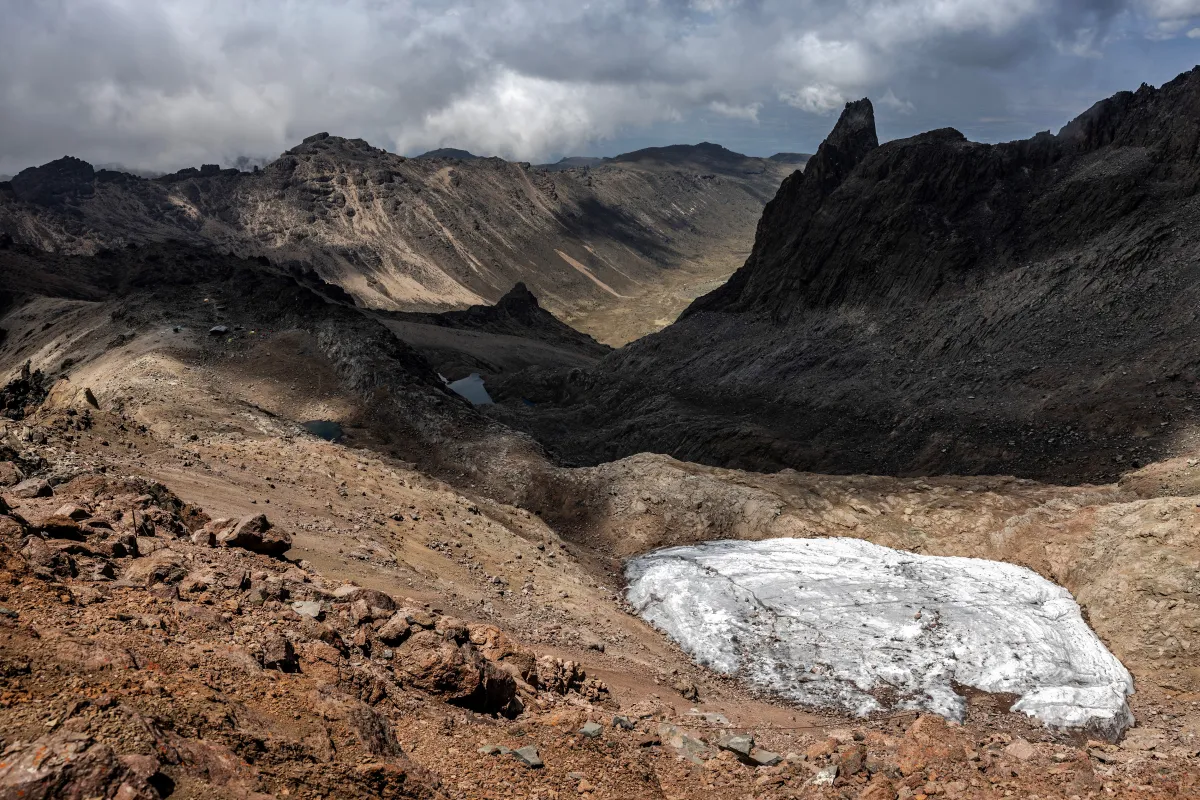
The Lewis Glacier on Mount Kenya lost 90% of its volume between 1934 and 2010. Afp Or Licensors African glaciers are melting because it is snowing less
SWI swissinfo What are the repercussions of Africa's melting glaciers?
I cover climate change and energy through reportages, articles, interviews and in-depth reports. I am interested in the impacts of global warming on everyday life and solutions for an emission-free planet. Passionate about travel and discovery, I studied biology and other natural sciences. I have been a journalist for SWI swissinfo for more than 20 years.
-
More from this auth
Italian Departme
-
Deutsch
de
Die letzten Gletscher Ostafrikas sind angezählt
Read more: Die letzten Gletscher Ostafrikas sind angezähl
Français
fr
L'existence des derniers glaciers d'Afrique de l'Est est comptée
Read more: L'existence des derniers glaciers d'Afrique de l'Est est compté
Italiano
it
Gli ultimi anni degli ultimi ghiacciai dell'Africa orientale
Original
Read more: Gli ultimi anni degli ultimi ghiacciai dell'Africa oriental
Africa is famous for its rainforests, savannas, and deserts. These ecosystems cover most of the continent. But Africa is also home to areas that are permanently covered by ice.
East Africa's glaciers are found near the equator, at elevations above 5,000 metres. The largest are in Tanzania, on Mount Kilimanjaro, the continent's highest peak. Other glaciers are found on Mount Kenya and in Uganda, on the Rwenzori Mountain range.
Like glaciers around the world, these are melting due to climate change, affecting the people who live at the foot of the mountains as well as the local tourism industry.
Local melting, global impact
The World Glacier Monitoring Service (WGMSExternal link ) collects and analyses data on the mass balance, volume, area and length of the world's glaciers. It was established in 1986 and is based at the University of Zurich. The WGMS has a network of national correspondents in more than 40 countries.
During the International Year for the Conservation of Glaciers , Swissinfo contacted some of them to find out about the state of glaciers in their region, the consequences of ice melt, and adaptation strategies.
“[African glaciers] have lost more than 90% of their area since 1900,” Rainer Prinz, a glaciologist at the University of Innsbruck, tells Swissinfo via e-mail. Prinz is the national correspondent for Kenya, Uganda and Tanzania for the Swiss-based World Glacier Monitoring Service (WGMS). He is the co-author of one of the most recent and comprehensive studies of African glaciersExternal link .
In just over a century, the area covered by glaciers in Africa has decreased from 19.5 to 1.4 square kilometres, according to the study. The remaining ice is so diminished that it would cover less than half the area of Central Park in New York City.
In the next few years, Mount Kenya, Africa's second-highest peak, could become the first mountain on the planet to lose its ice entirely due to human-caused climate change.
“Without significant changes in local climate conditions, East African glaciers are expected to disappear almost entirely by mid-century,” Prinz says.
The Lewis Glacier on Mount Kenya lost 90% of its volume between 1934 and 2010. Afp Or Licensors African glaciers are melting because it is snowing less
The retreat of African glaciers is not directly caused by rising temperatures, as is the case in the Alps. Instead, it is the result of changes in precipitation patterns, caused by climate change.
“East African glaciers, like other tropical glaciers, are less sensitive to changes in air temperature,” Prinz explains. They do, however, react to changes in humidity, cloud cover, and precipitation.
The rainy seasons in East Africa happen between October and December and between March and May. At high altitudes, the seasons bring snow, which turns into ice. Changes in the surface temperature of the Indian Ocean since the late 1800s have led to a decline in precipitation. Less and less snow falls on glaciers.
The ice masses no longer receive enough snow and are deprived of the white cover that protects them from solar radiation, Prinz says.“This is what causes the glaciers to melt.”
Cloud cover in the mountains is also decreasingExternal link . This gives glaciers more exposure to the sun's rays. Even if temperatures at high altitudes stay below freezing, the sun can transform ice directly into water vapour, promoting melting.
The year 2024 was one of the warmest on record in Africa, according to the World Meteorological Organization's latest report. The continent's average temperature was 0.87°C higher than it was from 1991-2020 (the worldwide increase was 0.72°C).
SWI swissinfo What are the repercussions of Africa's melting glaciers?
East African glaciers are iconic and have high emotional and spiritual significance, says Prinz.“The loss of glaciers might affect the cultural identity of the local population,” he says.
Local tourism could also suffer. Alfred Masereka of the Uganda Wildlife Authority, a government wildlife agency, said local communities made“a lot of money” because of the glaciers. This has allowed them to send children to school and develop their homes, he told the online newspaper MongabayExternal link .
Prinz believes that melting glaciers would have more of an impact on tourism and the iconography of the mountains than on local water supply.“[African glaciers] are much too small to act as regional water towers,” he notes.
More More Our science newsletterSwiss research in a global context. Our newsletter presents the latest developments in a bite-size format. Stay curious.
Read more: Our science newslette
Legal Disclaimer:
MENAFN provides the
information “as is” without warranty of any kind. We do not accept
any responsibility or liability for the accuracy, content, images,
videos, licenses, completeness, legality, or reliability of the information
contained in this article. If you have any complaints or copyright
issues related to this article, kindly contact the provider above.
Most popular stories
Market Research
More Story





Comments
No comment