

Venice Biennale 2026: Qatar And Arab Nations Steal The Spotlight


- By: Shaikh Ayaz
The prestigious Venice Art Biennale is all about - well, prestige - but also symbolism and soft power. Few things in Venice say 'you have arrived' more than having a space inside the much sought-after Giardini, one of the two main historic venues of the Venice Biennale where most influential national pavilions are nestled.
From here, all radical art action pushes outwards into the farther reaches of the island city of Venice. During the biennale in May (the world's oldest and biggest art carnival takes place every two years), the usually touristy La Serenissima itself becomes a living exhibition, with the Giardini as its beating heart. We live in fractured times and the biennale has always mirrored the anxieties and conflicts of the world.
Recommended For You Trump says no more Israel troops going to Beirut; Hezbollah agrees to stop shootingAgainst this backdrop, it was remarkable that Qatar opened its national pavilion at the 61st International Art Exhibition – La Biennale di Venezia recently with a rare openness and focus on friendship, generosity and community that the world probably needs badly today more than ever before.
Qatar's debut pavilion at the Venice Art Biennale is simply called untitled 2026 (a gathering of remarkable people). It is the first new national pavilion space having the honour of being included in the Giardini in over three decades - an extraordinary feat that Qatar celebrated and shared with the world at large during the biennale's vernissage, in a ceremony defined by both enormous ambition and deep humility.
In her opening remarks, Sheikha Al Mayassa bint Hamad bin Khalifa Al Thani, chairperson of Qatar Museums and commissioner of the pavilion, reminded the audience that the wonder is not perhaps that the Gulf region has arrived in the Giardini, but“why, in fact, it took us so long.”
Sheikha Al Mayassa, often recognised as one of the biggest art patrons and visionaries globally today, added,“Like the permanent pavilion designed by Lina Ghotmeh that we will soon build on this beautiful site in the Giardini, untitled 2026 (a gathering of remarkable people) celebrates Qatar's tradition of openness and hospitality while showcasing creativity not only in our nation but across the Arab world. In this time of conflicts and challenges, it is more important than ever to uphold the power of culture to bring people together and affirm our shared humanity.”
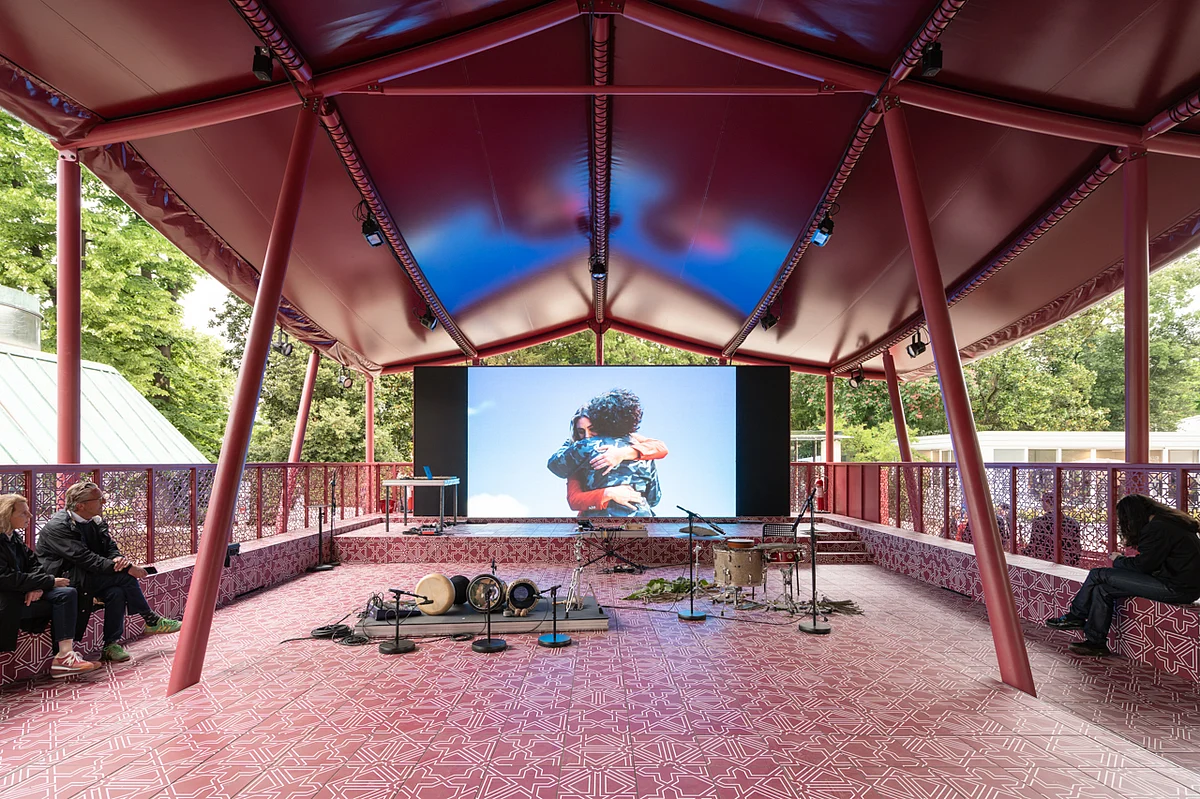
Qatar is one of 100 national participations at this year's biennale, and its compelling exhibition, conceived by Rirkrit Tiravanija and co-curated by Tom Eccles and Ruba Katrib, is already becoming one of the most standout pavilions. It occupies the future site of Qatar's permanent Giardini structure, which Lebanese-born, Paris-based architect Lina Ghotmeh is currently designing.
The pavilion's tent-like exterior, with its maroon-coloured texture proudly evoking the Qatari flag, can be seen from a distance. Together with artists like Sophia Al-Maria, Alia Farid, Fadi Kattan and Tarek Atoui, the pavilion comes alive with food, music, film and sculpture. "The pavilion is modelled after majlis, a space traditionally associated with conversation, hospitality and collective thought, so his architecture became both a literal and conceptual framework for everything else that unfolds within it," explained one of the curators, Ruba Katrib.
“It's a warm, welcoming space and a hub for social connection,” reiterated Tiravanija, a well-known contemporary Thai artist who worked on a communal art performance, untitled 2025 (no bread no ashes), last year in Doha.
Interestingly, untitled 2026 (a gathering of remarkable people) was born from that piece.“There will be performances and music curated by Tarek Atoui (a Lebanese sound artist) during the length of the exhibition and chefs lovingly working to serve you meals. Through food, art and communal gathering, we hope audiences will have an interactive experience and that these activities will continue.
As the title suggests, there are remarkable people within this exchange and remarkable friends who will bring in their remarkable friends and the social gesture continues,” Tiravanija added. Curators Tom Eccles and Ruba Katrib admitted that Tiravanija was a natural starting point for this project because his practice has always deeply invested in creating culturally informed spaces for gathering, exchange and shared experience.
"The Qatar pavilion is connected to Rubaiya Qatar's presentation in Doha, untitled 2025 (no bread no ashes), where Tiravanija created an outdoor bread oven in MIA park, which is activated regularly, so bringing his work into the pavilion felt like a natural fit," said Eccles, adding, "Instead of presenting discrete artworks, we decided to create an environment where different forms of knowledge and cultural production could coexist and continuously activate one another."
As you enter the pavilion, you are greeted by the Kuwaiti-Puerto Rican artist Alia Farid's life-sized resin sculpture Jerrican (2022–2026) which resembles vessels used to store and carry water in the Gulf. The text on it reads, "Lovely Gift. From Blessed Land."
The sculpture also features in Qatari-American artist Sophia Al-Maria's newly commissioned, dreamlike experimental film, titled DAMAR TV which plays in the pavilion. "All of the projects are in dialogue with one another," shared Eccles.
DAMAR TV highlights music from the Gulf region with incredible performances and interludes by Zeynab Marwan, Fatimah Al-Qadiri, Sulafa Elyas, Dali de Saint Paul, and Sarah Ourahmane. The dazzling Lebanese-Palestinian actress Yumna Marwan stars in the film. On the other hand, Palestinian chef Fadi Kattan's culinary programme explores cuisines at the intersection of preservation and innovation. Kattan's menus will pick up on a single ingredient to trace the cross-cultural impact of migration and trade.
"I think this year's biennale will more broadly demonstrate the extraordinary range and complexity of artistic practices emerging from the Arab world and its diasporas. Increasingly, artists and cultural workers from the region are shaping international conversations not through a single shared aesthetic or identity, but through deeply nuanced practices that respond to the complex issues of our time," noted Ruba Katrib.
The presence of Gulf pavilions at Venice this year has already created immense buzz, attracting huge crowds and leaving a lasting impression. It is all thanks to the well-curated shows and artists whose practices foreground vernacular knowledge, their own local culture, memory, history, diverse materials and lived conditions that have shaped the rich and layered Arabian regions.
The UAE national pavilion, located inside the Arsenale-Sale d'Armi, has been curated by Bana Kattan, curator and associate head of exhibitions at the Guggenheim Abu Dhabi Project. The group exhibition is titled Washwashaa - a single onomatopoeic word meaning“whispering” in Arabic - and features newly commissioned and existing works by Mays Albaik, Jawad Al Malhi, Farah Al Qasimi, Alaa Edris and others.
This time, in response to Venice's overarching musical themes of In Minor Keys (curated by the late Koyo Kouoh), Washwashaa explores the UAE's sonic history, embracing sound as a starting point to riff on some of the most urgent themes of our time: oral histories, migration, technology, language and cultural continuity.
Nearby, the Saudi Arabia pavilion, poetically titled May your tears never dry, you who weep over stones, centers the works of Dana Awartani. Referencing archaeological sites, her ambitious art features mosaic floors with patterns and motifs found in heritage sites across the Arab world.
This atmosphere of creativity, bonhomie and genuine public engagement at Venice may well prove why national presentations are important after all. While preserving the Arab world's historical legacies, they also significantly define a philosophy that puts humanity, art, society and culture at the forefront.
The 61st International Art Exhibition – La Biennale di Venezia will be on view throughout Venice until November 22, 2026.
ALSO READ- Diriyah Contemporary Art Biennale transports visitors through time Look: Sikka 2026 converts Dubai's heritage houses into spaces of deliberate discomfort

Legal Disclaimer:
MENAFN provides the
information “as is” without warranty of any kind. We do not accept any
responsibility or liability for the accuracy, content, images, videos,
licenses, completeness, legality, or reliability of the information
contained in this article. If you have any complaints or copyright issues
related to this article, kindly contact the provider above.
Comments
No comment