


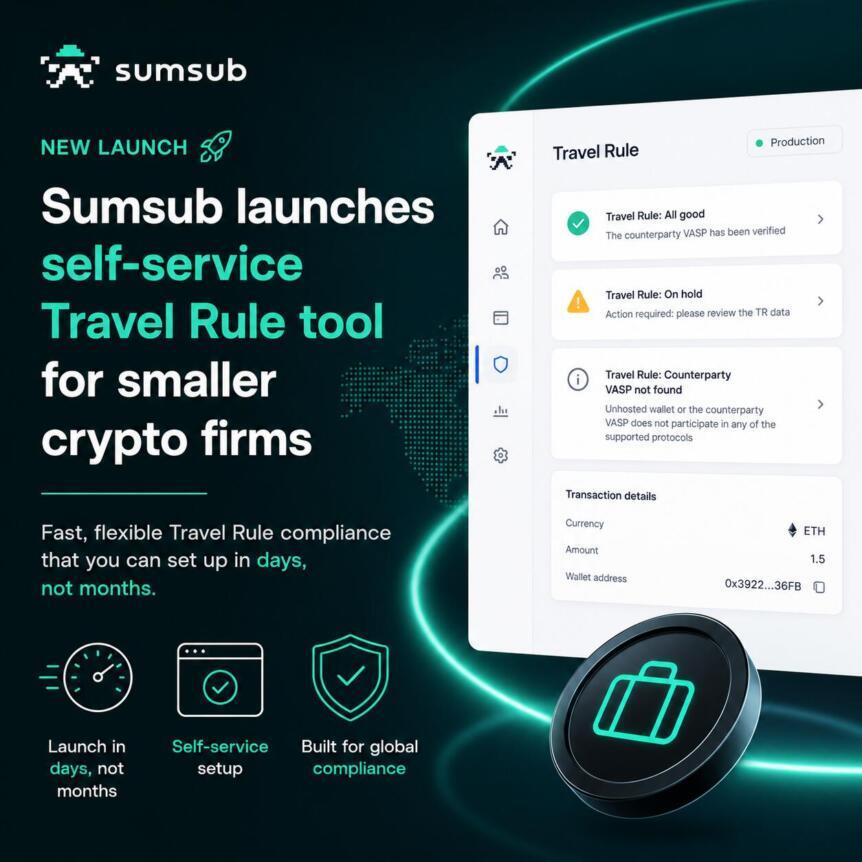
Sumsub Launches Self-Service Travel Rule Tool For Smaller Crypto Firms


Sumsub has introduced a self-service Travel Rule compliance option intended to help smaller cryptocurrency platforms implement compliant transfers with less engineering work and faster time-to-live. The offering, announced in late May, pairs preset configurations and software development kits with access to a large directory of counterparties, positioning itself as a turnkey route to satisfy cross-border information-sharing requirements that regulators increasingly enforce.
Travel Rule obligations, originally articulated by the Financial Action Task Force (FATF), require virtual asset service providers, or VASPs, to collect and transmit originator and beneficiary data during certain transfers. For larger exchanges the burden has been managed with dedicated engineering teams and bespoke integrations. Smaller exchanges and startups, however, say the work is resource-intensive and can slow market expansion.
Sumsub says the new offering removes implementation fees and shortens onboarding timelines by providing SDK-led flows, ready-made compliance logic and preset workflows. The company also highlights a directory of more than 2,100 VASPs and says its platform is already used by over 1,000 crypto businesses, including eight of the 10 largest global exchanges. Sumsub claims its SDKs can reduce user drop-offs by as much as 35 percent.
What the product promises
At a product level, the self-service package is aimed at minimising custom engineering. Preset configurations are intended to cut setup time, and SDKs let platforms embed Travel Rule checks directly into customer flows. Sumsub also frames the service as a way to achieve interoperability with wider Travel Rule messaging networks; the vendor says it has integrated with multiple orchestration channels used across the industry.
For many smaller firms the main attractions will be operational predictability and speed. Removing customised onboarding engagements and charging no initial implementation fee reduces upfront costs and reliance on vendor professional services. And by offering a managed directory of counterparties, Sumsub reduces the administrative task of establishing bilateral Travel Rule relationships, which can otherwise be time-consuming.
Industry context and why it matters
The Travel Rule has moved from guidance to enforceable expectation in several jurisdictions, and supervisory attention has increased in 2024-2026. As national regulators tighten enforcement, VASPs that cannot demonstrate reliable information-sharing processes face fines, access restrictions, or other penalties. That shift has created demand for products that can be deployed quickly while remaining adaptable to changing jurisdictional requirements.
Interoperability is a central challenge. Travel Rule schemes vary by geography and by technical implementation, and platforms often need to support multiple routing formats or directory schemas to transact with global counterparties. Solutions that offer pre-built integrations with existing Travel Rule networks can lower the friction of connecting to international partners.
Potential limitations and open questions
While the self-service approach reduces the need for bespoke engineering, it does not entirely remove compliance responsibilities from VASPs. Firms remain accountable for meeting local regulatory standards, assessing the adequacy of counterparties' controls, and retaining audit trails. Using a third-party orchestration layer can streamline operations, but it also concentrates operational risk in a vendor and requires careful contracting and oversight.
Data protection and cross-border transfer rules are another consideration. Sharing originator and beneficiary details across jurisdictions may trigger privacy obligations or export restrictions, so platforms must ensure their chosen provider's practices align with applicable law. Finally, the degree to which a plug-and-play solution can cover every regulator's specific reporting or recordkeeping nuance is limited; some operators may still need targeted customisation.
Implications for small and mid-size VASPs
Sumsub's offering speaks to a broader market need: simplifying regulatory compliance without requiring deep internal engineering resources. For startups and medium-sized platforms, the ability to reach a first compliant transfer quickly reduces time-to-market and may enable faster geographic expansion.
However, the commercial trade-offs should be evaluated. Firms must weigh cost savings and speed against reliance on an external provider for a core compliance function. Regulators are also increasingly scrutinising not just whether Travel Rule messages are exchanged, but whether the underlying anti-money laundering programmes and transaction monitoring are robust.
As Travel Rule enforcement becomes more uniform, vendors that can combine lightweight implementation with demonstrable interoperability and strong data governance will be in demand. Third-party orchestration providers that maintain up-to-date mappings to networks and can adapt to evolving regulatory expectations will likely see continued uptake among resource-constrained VASPs.
Sumsub's self-service product is the latest example of compliance vendors shifting toward modular, developer-friendly offerings that prioritise speed and integration. Whether the approach will become the default model for smaller VASPs will depend on how well these products balance convenience with regulatory assurance and operational resilience.
Risk & affiliate notice: Crypto assets are volatile and capital is at risk. This article may contain affiliate links.
Legal Disclaimer:
MENAFN provides the
information “as is” without warranty of any kind. We do not accept
any responsibility or liability for the accuracy, content, images,
videos, licenses, completeness, legality, or reliability of the information
contained in this article. If you have any complaints or copyright
issues related to this article, kindly contact the provider above.


Comments
No comment