(MENAFN- Quintile Reports)
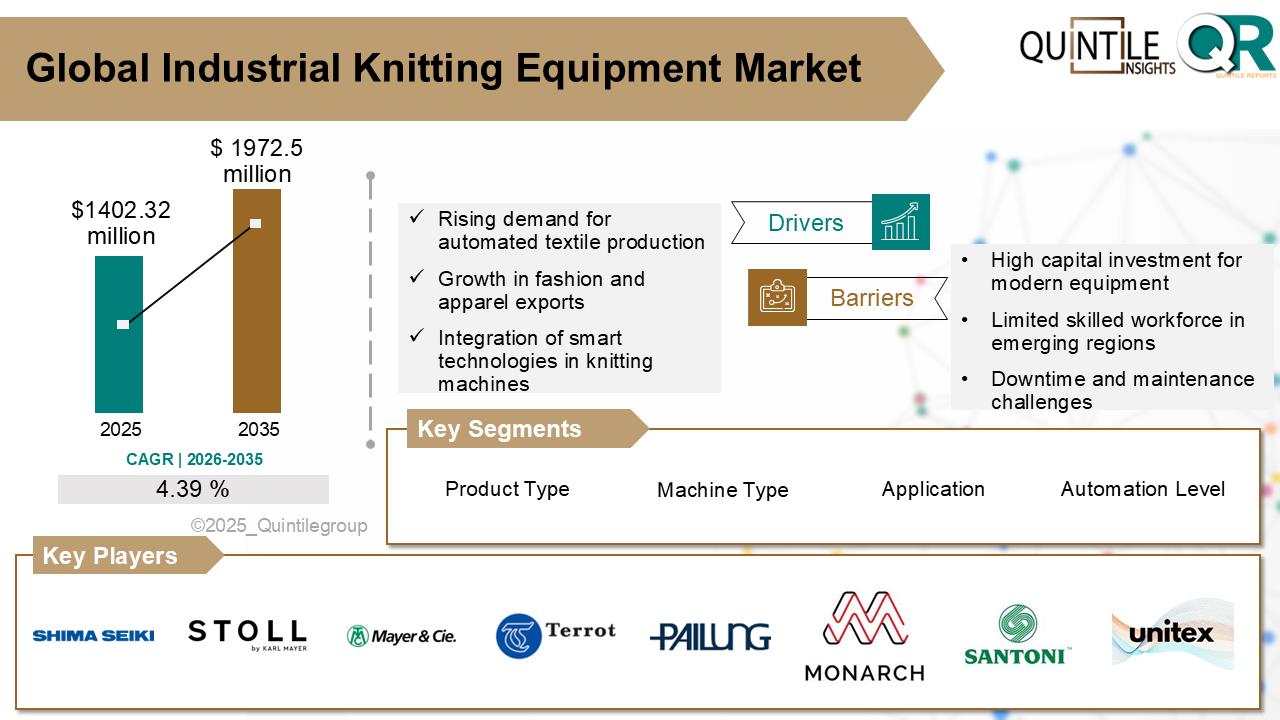
Industrial Knitting Equipment Overview The Global Industrial Knitting Equipment Market was valued at USD 1402.32 million in 2025 and is anticipated to reach USD 1972.5 million by 2035, growing at a robust CAGR of 4.39% during the forecast period from 2026 to 2035. The Industrial Knitting Equipment market report presents a comprehensive overview of the industry by assessing macroeconomic conditions, emerging technologies, regulatory frameworks, and shifting consumer behavior to provide a clear outlook on future market expansion.
The industrial knitting equipment market includes machinery used for producing knitted fabrics in large volumes. These machines are designed for high-speed operation, producing various knit types such as circular, flat, warp, and weft knits. They are used in the textile and apparel sectors to manufacture garments, upholstery, technical textiles, and medical fabrics.
With 2025 serving as the base year, the Industrial Knitting Equipment market is experiencing stable growth supported by rising demand across key end-use industries and continuous technological innovation. Companies operating in the market are enhancing their go-to-market (GTM) strategies to capture emerging opportunities and navigate evolving competitive dynamics effectively.
By 2035, the market is expected to demonstrate strong growth potential, driven by sustained investments in innovation, increasing strategic partnerships, and growing merger and acquisition activities. Organizations that prioritize customer-centric solutions, innovation, and agile GTM execution are likely to strengthen their market presence and achieve long-term success. The report provides detailed insights into major market drivers, restraints, opportunities, and challenges across segments, regions, and countries, supported by extensive qualitative and quantitative analysis from 2017 to 2035.
Market Size & Forecast: 2025 Market Size: USD 1402.32 million 2035 Projected Market Size: USD 1972.5 million CAGR (2026-2035): 4.39%
Key Insights Covered in the Report: Historical Analysis (2017 - 2024): Evaluates past market trends, performance indicators, and growth patterns to identify factors influencing current and future market behavior. Forecast and Projections (2026 - 2035): Offers forward-looking market estimates, highlighting emerging trends, growth opportunities, and regional developments. Compound Annual Growth Rate (CAGR): Provides a clear CAGR assessment for the 2026 - 2035 period, enabling stakeholders to evaluate long-term market growth potential.
Industrial Knitting Equipment MarketKnitting equipment plays a critical role in automating textile production by reducing manual labour and increasing consistency. As fashion cycles shorten and demand rises for stretchable, breathable, and customized textiles, manufacturers are turning to advanced knitting systems to boost productivity and flexibility while minimizing waste.
Industrial Knitting Equipment Market Drivers The demand for knitted fabrics in both fashion and functional wear is growing. Activewear, sportswear, and casual clothing rely heavily on knitted textiles for their stretch and comfort. With rising health and fitness awareness worldwide, demand for such clothing is increasing, pushing manufacturers to invest in faster and more precise knitting machines.
Automation in textile manufacturing is accelerating, with smart knitting machines offering programmable controls, defect detection, and faster yarn changeovers. These features reduce downtime and labour costs while improving production quality. Manufacturers looking to modernize or expand are replacing older mechanical units with computerized models.
Sustainability is another important factor. Knitting is more material-efficient than weaving, producing less waste. Machines that support recycled yarns and biodegradable materials are increasingly preferred. Environmental regulations and pressure from eco-conscious consumers are prompting textile mills to upgrade to greener, more efficient equipment.
The growth of technical textiles is expanding knitting machine applications. Industries such as automotive, medical, construction, and aerospace are using knitted materials for filters, seat covers, bandages, reinforcement layers, and insulation. This diversification beyond fashion creates new opportunities for industrial knitting equipment suppliers.
What are the challenges and restraining factors of industrial knitting equipment market? High capital costs remain a significant barrier in the industrial knitting equipment market. Advanced knitting machines equipped with automation systems, digital controls, and precision needle technologies require substantial investment. This can be challenging for small and medium-sized textile manufacturers, particularly in developing countries where access to financing and modern infrastructure is limited.
Maintaining and operating these machines requires trained technicians. Without proper handling, issues such as needle breakage, yarn tension problems, or programming errors can interrupt production. A shortage of skilled labour in the textile industry affects both machine uptime and product quality.
Frequent fashion changes and low-margin production cycles increase pressure on manufacturers to stay flexible. However, switching product types on older or less modular machines can be time-consuming and inefficient. This creates challenges for firms that serve fast fashion brands or handle varied client orders.
Supply chain disruptions in electronic components and machine parts can affect production schedules. Delays in receiving spare parts or new units may slow operations, especially for companies that rely on imported equipment or centralized maintenance facilities.
What are the regional trends of industrial knitting equipment market? North America is modernizing its textile base, with U.S. manufacturers investing in automated knitting for sportswear and technical applications. Demand is driven by reshoring trends and innovations in wearable textiles and military gear.
Europe has a mature textile industry focused on high-end fashion and technical textiles. Germany and Italy are investing in smart knitting systems to meet eco-design standards and small-batch customization for luxury brands.
Asia Pacific leads the global market due to large-scale apparel production. China, India, Bangladesh, and Vietnam are major buyers of circular and flat knitting machines. Government support for textile automation in these countries is driving further growth.
Brazil, Colombia, and Peru are growing markets for knitting equipment in sportswear and denim applications. Local production demand is rising due to high import costs and regional brand expansion.
The Middle East is seeing demand from growing apparel zones in Turkey and Egypt. In Africa, countries like Ethiopia and Kenya are developing textile parks, increasing interest in basic and mid-range knitting equipment for local garment production.
Country-Wise Outlook: United States invests in smart textile production for military and wearables: The United States is investing in industrial knitting machines for high-performance textiles used in defense, healthcare, and smart garments. Research institutions and textile hubs are upgrading their equipment to support domestic innovation and reduce reliance on imports. Flexible flat knitting machines are favoured for prototyping and short runs.
The National Network for Manufacturing Innovation (NNMI), now known as Manufacturing USA, plays a crucial role in modernizing the industrial knitting equipment market. It fosters public-private partnerships to bridge the gap between research and commercialization. Companies like Sensoria Inc, Volt Smart Yarns, etc. in the U.S. are also integrating sensors and conductive yarns into knitted fabrics for wearable technology applications, pushing demand for precision-controlled machinery.
Germany develops precision machinery for fashion and technical textiles: Germany is a leading manufacturer and user of high-speed knitting machines. Local textile firms focus on premium fashion fabrics, automotive upholstery, and industrial mesh. German engineering firms also export knitting machines to other European and global markets.
Environmental efficiency and precision engineering are priorities. Germany's textile industry works closely with machine builders to co-develop systems that reduce material waste and support quick product changeovers. The country also leads in advanced control software for knitting machine automation.
Japan focuses on compact and energy-efficient knitting systems: Japan uses knitting equipment in the production of functional apparel, innerwear, and high-precision fabrics. Manufacturers such as Fukuhara Group and Shima Seiki prioritize compact machines suited to space-limited factories. Innovations in seamless knitting and ultra-fine gauge systems are key areas of investment.
With a shrinking workforce and rising labour costs, Japanese firms adopt machines with lower energy use and automated maintenance features. The government supports textile R&D and digitalization under its smart factory initiatives, helping firms stay competitive in specialized markets.
Competitive Analysis: The industrial knitting equipment market is highly competitive and driven by technological innovation, automation capabilities, and machine efficiency. Leading manufacturers focus on developing high-speed knitting systems with digital control interfaces, energy-efficient motors, and advanced needle technologies to improve productivity and reduce operational costs.
Companies are increasingly integrating smart manufacturing technologies such as IoT-enabled monitoring, predictive maintenance software, and data-driven production optimization. These technologies allow textile manufacturers to reduce downtime, improve fabric quality, and achieve higher operational efficiency.
Strategic collaborations between machine manufacturers and textile producers are also becoming common. These partnerships help develop specialized knitting equipment tailored for applications such as technical textiles, medical fabrics, sportswear, and automotive interiors.
An additional differentiator is the ability to scale-up production. Companies that are investing in automated supply chain, high-through-put lines will better manage demand for bulk, without compromising on quality. The geographical footprint of production locations is also becoming diversified, as manufacturers seek to adapt to regional regulations and reduce logistics expenses.
Machine customization and digital integration are becoming key differentiators among industrial knitting equipment manufacturers. Companies are increasingly offering modular knitting machines that enable textile producers to switch between fabric types efficiently while maintaining production speed and quality. Advanced control software, precision needle technologies, and improved energy efficiency are helping equipment manufacturers strengthen their competitive position in the global market.
Key players in the market are Shima Seiki Mfg., Ltd., Stoll (Karl Mayer Group), Mayer & Cie. GmbH & Co. KG, Terrot GmbH, Santoni S.p.A., Fukuhara Industrial & Trading Co., Ltd., Quanzhou Baiyuan Machinery Science & Technology Co., Ltd., Orizio S.r.l., Pailung Machinery Mill Co., Ltd., Monarch Knitting Machinery Corp., Wellknit, Unitex Textile Machinery., and other players.
Recent Development: In May 2025, Mayer & Cie. has launched its Control 5.0 machine control system, designed to make their circular knitting machines Internet- and knitlink-ready. This upgrade positions their machinery for the digital future of textile production by enabling connectivity and access to knitlink, Mayer & Cie.'s dedicated digital platform. Control 5.0 is also available as an upgrade kit for existing machines, allowing current users to modernize their equipment. In September 2023, Santoni Shanghai Knitting Machinery Co., Ltd. has strategically acquired Terrot GmbH, a prominent circular knitting machine manufacturer based in Germany. This acquisition aligns with Santoni Shanghai's overarching goal of establishing an ecosystem to reshape and consolidate the circular knitting industry, indicating a move towards greater integration and control within the sector.
Study Period of the Industrial Knitting Equipment Market

Industrial Knitting Equipment MarketReport HighlightsOur team of experienced researchers has meticulously gathered and analyzed data to deliver a thorough examination of market dynamics, competitive landscape, and emerging technologies. With a focus on delivering actionable intelligence, this report aims to empower decision-makers with the information needed to make informed choices and stay ahead of the competition. Whether you are a seasoned industry player or a new entrant, our market research report serves as a strategic tool to navigate the complexities of the market, aiding in successful business planning and growth strategies.
Key Chapters Covered in the Industrial Knitting Equipment Market ReportMarket Dynamics, Key Variables, and Industry AnalysisThis chapter of our Industrial Knitting Equipment market report provides an in-depth examination of the factors shaping the industry landscape. This section typically encompasses several key elements to offer a comprehensive understanding of the industry landscape such as market drivers & restraints analysis, market opportunities & trend analysis, market size & growth analysis, competitive analysis, SWOT analysis, business environment tools such as Porter's five forces & PESTEL analysis, Ansoff Matrix analysis, penetration & growth prospect analysis, regulatory framework & reimbursement scenario analysis, impact of macro & micro economic factors analysis such as Covid-19 impact, GDP growth, market inflation, U.S.- China trade war, Russia-Ukraine war impact, and supply chain analysis.
Segment Analysis and Forecast Through 2035The segment analysis chapter of Industrial Knitting Equipment market report is a critical section that delves into a detailed examination of the market's various segments. Segmentation involves dividing the market into distinct categories based on certain criteria to better understand and address the diverse needs of consumers. This chapter typically follows the introduction and provides a more granular view of the market, offering valuable insights for businesses and stakeholders. The components of the chapter include segment definitions to understand the inclusions and exclusions of the study, assumptions, market size estimates and growth trend analysis of each segment, qualitative analysis of the segment, technological advancements, market penetration rate, market adoption rate, market share examination by each segment, segment growth drivers and restraint barriers, consumer behaviour and challenge analysis.
Regional Market Analysis and Forecast Through 2035The chapter in Industrial Knitting Equipment market research report is a pivotal section that examines and predicts the market dynamics and trends specific to different geographical regions. This chapter is crucial for businesses and stakeholders seeking a comprehensive understanding of how the market behaves across various locations, enabling them to tailor strategies and make informed decisions based on regional variations. The regional analysis chapter of our Industrial Knitting Equipment market report is classified into regions & country-level. The chapter consists of North America (U.S., Canada), Europe (UK, Germany, France, Italy, Spain, Russia, Sweden, Denmark, Norway, Rest of Europe), Asia Pacific (Japan, China, India, Australia, South Korea, Thailand, Rest of Asia Pacific), Latin America (Brazil, Mexico, Argentina, Colombia, Rest of Latin America), Middle East & Africa (South Africa, Saudi Arabia, UAE, Kuwait, Rest of Middle East & Africa).

Industrial Knitting Equipment MarketCompetitive Analysis and Company ProfilesThis section of a Industrial Knitting Equipment market report is a crucial segment that provides a comprehensive overview of the competitive landscape within the market. This section is vital for businesses, investors, and stakeholders seeking insights into key players, their market positioning, strengths, weaknesses, strategies, and potential impacts on the overall market dynamics. The chapter includes research methodology used to analyse the market competition, list of key players operating in the market, detailed company profile section which includes company overview, business verticals, financial performance, product/services benchmarking, geographical presence, and strategic initiatives.
Key Players Operating in the Industrial Knitting Equipment Market Include: Shima Seiki Mfg., Ltd. Stoll (Karl Mayer Group) Mayer & Cie. GmbH & Co. KG Terrot GmbH Santoni S.p.A. Fukuhara Industrial & Trading Co., Ltd. Quanzhou Baiyuan Machinery Science & Technology Co., Ltd. Orizio S.r.l. Pailung Machinery Mill Co., Ltd. Monarch Knitting Machinery Corp. Wellknit Unitex Textile Machinery

Industrial Knitting Equipment MarketReport ScopeQuintile Reports has segmented the Industrial Knitting Equipment market into the following segments:Based on Type, the Industrial Knitting Equipment market is segmented into: Weft Knitting Machine Warp Knitting Machine
Based on Machine Type, the Industrial Knitting Equipment market is segmented into: Flat Bed Knitting Machine Circular Knitting Machine Jacquard Knitting Machine
Based on Application, the Industrial Knitting Equipment market is segmented into: Apparel Home Textiles Technical Textiles Medical Automotive
Based on Automation Level, the Industrial Knitting Equipment market is segmented into: Semi-Automatic Fully Automatic
Based on End Use Industry, the Industrial Knitting Equipment market is segmented into: Textile Industry Fashion & Clothing Industrial Fabric Sportswear
| Report Scope | Details |
| Report Version | 2026 |
| Growth Rate | CAGR of 4.39 from 2026 to 2035 |
| Base Year | 2025 |
| Actual Estimates / Historical Data | 2017 - 2024 |
| Forecast Period | 2026 - 2035 |
| Quantitative Units | Revenue in USD million/billion & CAGR from 2026 to 2035 |
| Country Scope | North America (U.S., Canada), Europe (UK, Germany, France, Italy, Spain, Russia, Sweden, Denmark, Norway, Rest of Europe), Asia Pacific (Japan, China, India, Australia, South Korea, Thailand, Rest of Asia Pacific), Latin America (Brazil, Mexico, Argentina, Colombia, Rest of Latin America), Middle East & Africa (South Africa, Saudi Arabia, UAE, Kuwait, Rest of Middle East & Africa). |
| The Segment Covered by Type | Weft Knitting Machine Warp Knitting Machine |
| The Segment Covered by Machine Type | Flat Bed Knitting Machine Circular Knitting Machine Jacquard Knitting Machine |
| Companies Covered | Shima Seiki Mfg., Ltd. Stoll (Karl Mayer Group) Mayer & Cie. GmbH & Co. KG Terrot GmbH Santoni S.p.A. Fukuhara Industrial & Trading Co., Ltd. Quanzhou Baiyuan Machinery Science & Technology Co., Ltd. Orizio S.r.l. Pailung Machinery Mill Co., Ltd. Monarch Knitting Machinery Corp. Wellknit Unitex Textile Machinery | Report Coverage | Revenue forecast, company share, competitive landscape, growth factors, and trends | | Free Customization Scope (Equivalent to 5 Analyst Working Days) | If you need specific information, which is not currently within the scope of the report, we will provide it to you as a part of the customization | Key Reasons to Purchase the Industrial Knitting Equipment Market Research Report This report offers a comprehensive analysis of the Industrial Knitting Equipment market from 2017 to 2035, including market segments, current trends, estimations, and dynamics It also provides information on key drivers, restraints, and opportunities Porter's five forces analysis is used to assess the potency of buyers and suppliers, helping stakeholders make profit-oriented business decisions and strengthen their supplier-buyer network The report includes an in-depth analysis of the Industrial Knitting Equipment market segmentation to identify prevailing market opportunities Major countries in each region are mapped according to their revenue contribution to the global market Market player positioning is also analyzed to facilitate benchmarking and provide a clear understanding of the present position of the market players The report includes an analysis of the regional and global Industrial Knitting Equipment market trends, key players, market segments, application areas, and market growth strategies

Industrial Knitting Equipment Market |














Comments
No comment