

403
Sorry!!
Error! We're sorry, but the page you were looking for doesn't exist.
Composite Materials Based On Barium Titanate For The Development And Production Of Microelectronic Components


(MENAFN- RCTT)
The Institute of Technical Acoustics offers consumers barium titanate-based composite materials for the development and production of microelectronic components under a manufacturing agreement and is looking for partners interested in a distribution services agreement.
Description
Barium titanate (BaTiO3) is an important material widely used in the production of ceramic capacitors, piezoelectric devices, thermistors, and other electronic components. Major barium titanate producers are concentrated in countries with developed chemical and electronic industries, such as Japan, China, the United States, and Europe.
1. Ferro Corporation (USA)
- Features: Manufactures barium titanate-based materials for electronics and other high-tech applications. The company specializes in high-quality materials for the ceramic industry.
2. Fuji Titanium Industry Co., Ltd. (Japan)
- Features: Manufactures high-quality titanium-based materials, including barium titanate, for various applications.
3. Shandong Sinocera Functional Material Co., Ltd. (China)
- Features: One of the leading manufacturers of functional materials in China, including barium titanate for ceramic and electronic components.
4. Solvay (Belgium)
- Specialties: Global manufacturer of chemical materials, including electronic components such as barium titanate.
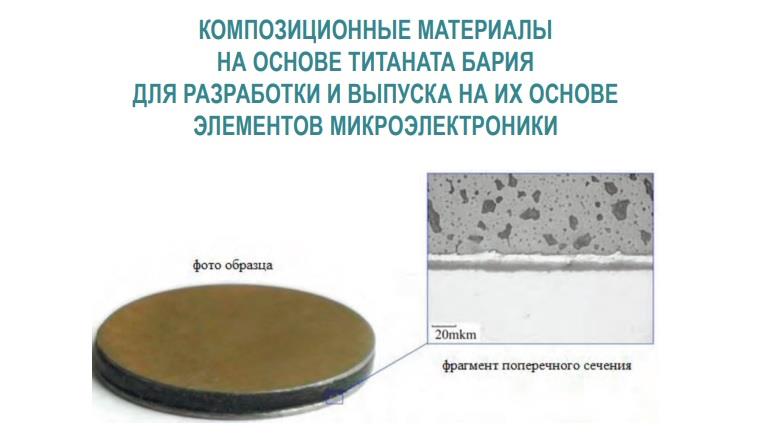
The composite material, produced by the Institute of Technical Acoustics, features a piezoelectric and magnetostrictive component capable of inducing an electric field of 0.5 V under a magnetic field of 300 Oe. Composites can be made from composite ceramics of barium titanate modified with nickel ferrite, sintered using conventional ceramic technology with magnetostrictive nickel layers deposited on the surface by electrochemical deposition or using a polymer compound. The linear dimensions of the composite materials do not exceed 9 × 9 × 0.5 mm.
The information is published in the Catalog "Advanced Developments of the National Academy of Sciences of Belarus 2024, pp. 74-75. (in Russian) Advantages and Innovations Composites with linear dimensions not exceeding 9 x 9 x 0.5 mm enable the use of generated voltage to replace circuits that convert magnetic field strength into an electrical signal by exploiting the magnetoelectric effect. Galvanic isolation of the circuit is also possible, and the proposed materials do not require a constant power source.
The parameters of the developed materials are unmatched in the CIS countries. Stage of development Already on the market Comments regarding stage of development Composites with magnetoelectric properties can be used to implement circuit on/off sensors, rotational speed sensors, gyrators, and electronic access cards based on magnetoelectric composite Funding source State budged
Internal
IPR status Exclusive rights
Secret know-how
Sector group Aeronautics, Space and Dual-Use Technologies
Agrofood
Materials
Mobility
Client information Type R&D institution Year established 1975 NACE keywords C.28.99 - Manufacture of other special-purpose machinery n.e.c.
C.32.50 - Manufacture of medical and dental instruments and supplies
M.72.19 - Other research and experimental development on natural sciences and engineering
M.74.90 - Other professional, scientific and technical activities n.e.c.
Turnover (in EUR) 10-20M Already engaged in transnational cooperation Yes Additional comments The Institute of Technical Acoustics is a leading organization in the field of new areas of ultrasound physics and technology and the scientific foundations of using high-power ultrasound in materials processing.
Currently, the Institute's activities align with the priority areas of scientific, technical, and socioeconomic development of the country and the Vitebsk region. The Institute conducts fundamental and applied research, as well as scientific and technical developments within the framework of state scientific research programs (SRRP), the regional scientific and technical program (RSTP), national and international projects of the Belarusian Foundation for Basic Research (BRFFR), and individual projects and grants in the fields of semiconductor physics, magnetoelectric phenomena, ultrasonic vibrations, thermoelastic phase transformations, and others.
The Institute's research areas include:
- research into the effects of concentrated energy flows on condensed matter and physical processes;
- development of methods and technologies for producing functional and special-purpose materials.
A branch of the Republican Center for Technology Transfer has been established at the Institute of Technical Acoustics of the National Academy of Sciences of Belarus. Its main activities are:
- Supporting innovation and technology transfer in the use of concentrated energy flows (ultrasound, laser radiation, high-frequency electromagnetic fields, ion-plasma flows, and high-temperature synthesis) to influence the structure and properties of condensed matter; synthesizing new composite, structural, and ceramic materials with specified physical and mechanical properties in an ultrasonic field; processing metals using thermal methods, pressure, and high-power ultrasound; developing new instruments and equipment, and creating new information technologies;
- Promoting the development of innovative entrepreneurship and expanding international partnerships in the field of innovative scientific research;
- Assisting in the implementation of state policy for small and medium-sized innovative businesses in the creation of new technologies and the development of new instruments and equipment.
The Republican Center for Ultrasound Technologies, an interdisciplinary scientific and technical center (cluster) for advanced scientific research, has been established at the Institute of Technical Acoustics of the National Academy of Sciences of Belarus. The center was created to develop new, highly efficient processes and devices for materials processing, create new functional materials to improve product quality, reduce costs, and enhance safety in production using high-power ultrasound. The center's anticipated scientific results are aimed at gaining new scientific knowledge about the influence of acoustic influences on:
- structure formation and properties of materials;
- technological processes;
- thermoelastic phase transformations in shape-memory materials.
The expected practical results are aimed at mastering new technologies and developing unique equipment with high export potential.
Official website of the Institute of Technical Acoustics. Languages spoken English
Russian
Information about partnership Type of partnership considered Distribution services agreement
Manufacturing agreement
Type and role of partner sought Consumers interested in purchasing barium titanate-based composite materials for the development and production of microelectronic components under a manufacturing agreement.
Partners interested in purchasing barium titanate-based composite materials for the development and production of microelectronic components under a distribution services agreement. Type and size of partner sought > 500 MNE
> 500
251-500
SME 51-250
SME 11-50
SME <= 10
R&D Institution
University
Sole proprietor
1. Ferro Corporation (USA)
- Features: Manufactures barium titanate-based materials for electronics and other high-tech applications. The company specializes in high-quality materials for the ceramic industry.
2. Fuji Titanium Industry Co., Ltd. (Japan)
- Features: Manufactures high-quality titanium-based materials, including barium titanate, for various applications.
3. Shandong Sinocera Functional Material Co., Ltd. (China)
- Features: One of the leading manufacturers of functional materials in China, including barium titanate for ceramic and electronic components.
4. Solvay (Belgium)
- Specialties: Global manufacturer of chemical materials, including electronic components such as barium titanate.
The composite material, produced by the Institute of Technical Acoustics, features a piezoelectric and magnetostrictive component capable of inducing an electric field of 0.5 V under a magnetic field of 300 Oe. Composites can be made from composite ceramics of barium titanate modified with nickel ferrite, sintered using conventional ceramic technology with magnetostrictive nickel layers deposited on the surface by electrochemical deposition or using a polymer compound. The linear dimensions of the composite materials do not exceed 9 × 9 × 0.5 mm.
The information is published in the Catalog "Advanced Developments of the National Academy of Sciences of Belarus 2024, pp. 74-75. (in Russian) Advantages and Innovations Composites with linear dimensions not exceeding 9 x 9 x 0.5 mm enable the use of generated voltage to replace circuits that convert magnetic field strength into an electrical signal by exploiting the magnetoelectric effect. Galvanic isolation of the circuit is also possible, and the proposed materials do not require a constant power source.
The parameters of the developed materials are unmatched in the CIS countries. Stage of development Already on the market Comments regarding stage of development Composites with magnetoelectric properties can be used to implement circuit on/off sensors, rotational speed sensors, gyrators, and electronic access cards based on magnetoelectric composite Funding source State budged
Internal
IPR status Exclusive rights
Secret know-how
Sector group Aeronautics, Space and Dual-Use Technologies
Agrofood
Materials
Mobility
Client information Type R&D institution Year established 1975 NACE keywords C.28.99 - Manufacture of other special-purpose machinery n.e.c.
C.32.50 - Manufacture of medical and dental instruments and supplies
M.72.19 - Other research and experimental development on natural sciences and engineering
M.74.90 - Other professional, scientific and technical activities n.e.c.
Turnover (in EUR) 10-20M Already engaged in transnational cooperation Yes Additional comments The Institute of Technical Acoustics is a leading organization in the field of new areas of ultrasound physics and technology and the scientific foundations of using high-power ultrasound in materials processing.
Currently, the Institute's activities align with the priority areas of scientific, technical, and socioeconomic development of the country and the Vitebsk region. The Institute conducts fundamental and applied research, as well as scientific and technical developments within the framework of state scientific research programs (SRRP), the regional scientific and technical program (RSTP), national and international projects of the Belarusian Foundation for Basic Research (BRFFR), and individual projects and grants in the fields of semiconductor physics, magnetoelectric phenomena, ultrasonic vibrations, thermoelastic phase transformations, and others.
The Institute's research areas include:
- research into the effects of concentrated energy flows on condensed matter and physical processes;
- development of methods and technologies for producing functional and special-purpose materials.
A branch of the Republican Center for Technology Transfer has been established at the Institute of Technical Acoustics of the National Academy of Sciences of Belarus. Its main activities are:
- Supporting innovation and technology transfer in the use of concentrated energy flows (ultrasound, laser radiation, high-frequency electromagnetic fields, ion-plasma flows, and high-temperature synthesis) to influence the structure and properties of condensed matter; synthesizing new composite, structural, and ceramic materials with specified physical and mechanical properties in an ultrasonic field; processing metals using thermal methods, pressure, and high-power ultrasound; developing new instruments and equipment, and creating new information technologies;
- Promoting the development of innovative entrepreneurship and expanding international partnerships in the field of innovative scientific research;
- Assisting in the implementation of state policy for small and medium-sized innovative businesses in the creation of new technologies and the development of new instruments and equipment.
The Republican Center for Ultrasound Technologies, an interdisciplinary scientific and technical center (cluster) for advanced scientific research, has been established at the Institute of Technical Acoustics of the National Academy of Sciences of Belarus. The center was created to develop new, highly efficient processes and devices for materials processing, create new functional materials to improve product quality, reduce costs, and enhance safety in production using high-power ultrasound. The center's anticipated scientific results are aimed at gaining new scientific knowledge about the influence of acoustic influences on:
- structure formation and properties of materials;
- technological processes;
- thermoelastic phase transformations in shape-memory materials.
The expected practical results are aimed at mastering new technologies and developing unique equipment with high export potential.
Official website of the Institute of Technical Acoustics. Languages spoken English
Russian
Information about partnership Type of partnership considered Distribution services agreement
Manufacturing agreement
Type and role of partner sought Consumers interested in purchasing barium titanate-based composite materials for the development and production of microelectronic components under a manufacturing agreement.
Partners interested in purchasing barium titanate-based composite materials for the development and production of microelectronic components under a distribution services agreement. Type and size of partner sought > 500 MNE
> 500
251-500
SME 51-250
SME 11-50
SME <= 10
R&D Institution
University
Sole proprietor

Legal Disclaimer:
MENAFN provides the
information “as is” without warranty of any kind. We do not accept any
responsibility or liability for the accuracy, content, images, videos,
licenses, completeness, legality, or reliability of the information
contained in this article. If you have any complaints or copyright issues
related to this article, kindly contact the provider above.
Comments
No comment