




403
Sorry!!
Error! We're sorry, but the page you were looking for doesn't exist.
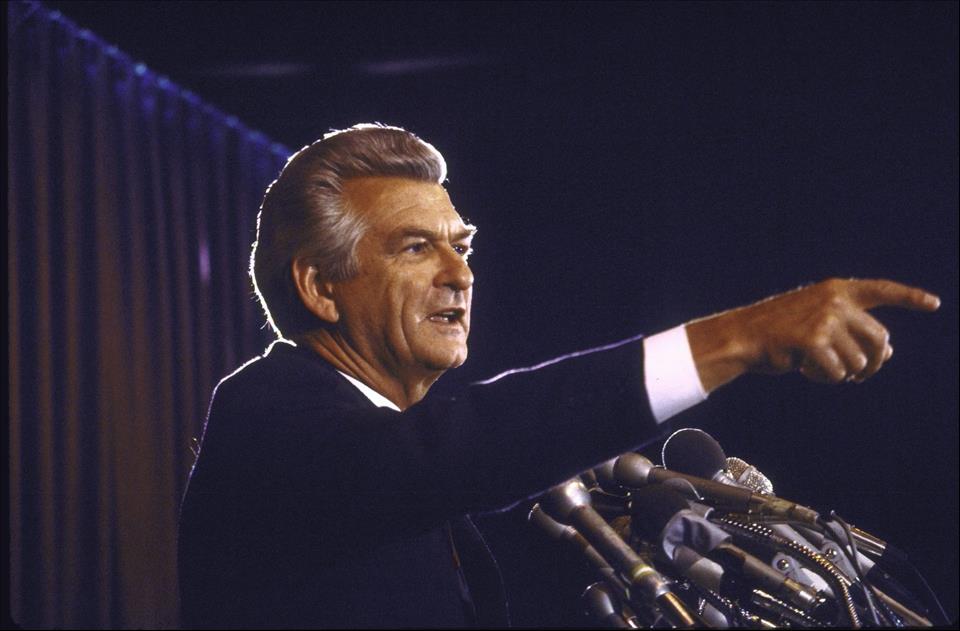
Was The Hawke Government Really The 'Gold Standard' For Reform?
Author: John Hawkins
(MENAFN- The Conversation) Journalism is sometimes called the first draft of history. Near contemporary works, such as the University of Canberra's long running series of books on Australian governments, going back to the Hawke government (1983-1991), might be viewed as the second draft.

Gold Standard? Remembering the Hawke Government differs from both. The book is timely. Edited by eminent academics Frank Bongiorno, Carolyn Holbrook and Joshua Black, it has been produced while it is still possible to have many chapters written by authors who observed the government in action, and some by those who worked in or for it.
But it can also assess the actions of the Hawke government from a distance, knowing its longer term consequences. It can compare the government to its successors, not just its predecessors.
Review: Gold Standard? Remembering the Hawke Government – edited by Frank Bongiorno, Carolyn Holbrook and Joshua Black (NewSouth)
Gareth Evans, who served as minister for foreign affairs, was the first to apply the term“gold standard” to the Hawke government. The book's title adds a question mark, but most of the contributors seem to agree that the Hawke government was indeed the“gold standard”. Glyn Davis, in his preface, wonders whether“nostalgia has softened judgement”.
Gold Standard? is certainly less critical than some evaluations, such as those by political historians Graham Maddox and Dean Jaensch, both of whom criticise the government for its alleged betrayal of Labor traditions.
The book is nevertheless a more objective account than Hawke's 1994 autobiography, which the editors describe as“the product of the overgrown ego of an embittered former leader”.
Hawke, his cabinet and his opponentsHawke is the Australian Labor Party's most electorally successful leader. Ian McPhee, a Liberal contemporary, recalls him as“intelligent, practical and charming”. But Hawke was an unusual mix as a person.
His interests were sporting, rather than cultural or intellectual. He could be quick-tempered. He was a womaniser and a heavy drinker (though he abstained while serving as prime minister). And he had a competitive streak. Michelle Grattan relates the story of Hawke signing up Australian cricketing great Rod Marsh as a special advisor, just so Marsh could play in the prime minister's team in an exhibition match against the press gallery.
Hawke had undoubted strengths as a leader. Grattan, whose time in the press gallery predates the Hawke era, recalls it as a time when television was supreme as the public's source of information on political events. This was a medium in which Hawke was very much at home.
He was not only popular; he possessed what the 19th century English journalist Walter Bagehot referred to as the desirable attributes of a statesperson:“common opinions and uncommon abilities”.
He was an accomplished chair of cabinet. Journalist Troy Bramston – Hawke biographer and co-editor of an earlier book on the government – explains how Hawke ably managed his government by not micromanaging it.“I allowed ministers their heads,” Hawke is quoted as saying,“not least because they had good heads.”
Hawke learned lessons from observing the unwieldy 27-member cabinet of Gough Whitlam. When Whitlam's ministers lost an argument in cabinet, they would sometimes try to have the decision overruled by caucus. Hawke had a cabinet of 13 senior ministers, assisted by 14 junior ministers, and they were much more disciplined.
He inherited a strong ministerial team from Bill Hayden, who had picked up 13 seats at the 1980 election, putting Labor within striking distance of government. Hayden's political and policy contribution has been underestimated.
Hawke was luckier than previous Labor prime ministers in the external environment. Andrew Fisher faced the first world war. James Scullin had to deal with the Great Depression. John Curtin and Ben Chifley governed during the second world war. Whitlam was prime minister during the OPEC oil shock. Hawke benefited from the breaking of a drought and a generally benign global economy.
Like Robert Menzies in the 1950s and Anthony Albanese now, Hawke was also lucky to face an opposition in disarray and riven by leadership rivalry. The Liberal Party had been in government with their coalition partners the Country/National Party from 1949 to 1972, and again from 1975 to 1983. Academic Marija Taflaga shows just how unprepared Hawke's opponents were for their wilderness years.
Opposition leader Andrew Peacock campaigned well in 1984, but the swing he gained was not enough to bring him to government. The campaign of his rival John Howard in 1987 was derailed by the ludicrous“Joh for PM” campaign by Queensland premier Joh Bjelke-Petersen. In 1990, Peacock again increased the coalition's two-party vote to just over 50%, but was thwarted by Labor's astute preference-attracting strategy.
Holbrook and Bongiorno both suggest that the coalition's opposition to Medicare contributed to its losses.
Assessing the policy recordAndrew Podger, a former public servant, describes the Hawke government's reforms to the public service. Most of these were pragmatic and incremental. They made government more responsive, open and efficient. Podger laments, however, that there came to be“unduly high expectations of responsiveness”. With less secure tenure, senior public servants may tell ministers what they want to hear rather than what they need to hear,
Economist Bruce Chapman, with some help from former ACTU secretary Bill Kelty, examines the Hawke government's macroeconomic record, explaining the role of the accord with the trade union movement. Developed by Hawke's minister for industrial relations Ralph Willis, this involved wage restraint in exchange for improvements in the social wage. Chapman's judgement is that it significantly lowered the unemployment rate.
Poltical historian Liam Byrne further discusses the accord. While the unions have influenced subsequent Labor governments, there has been no repeat of the accord. One reason may be that the share of the workforce belonging to a union has dropped from around half in 1983 to only around one in eight now.
This is largely a matter of structural change. The heavily unionised manufacturing sector is now a smaller proportion of the economy. But the reduced role of unions in winning wage rises under the accord may also have contributed.
Chapman was the designer of the Higher Education Contribution Scheme (HECS), an income-contingent loan scheme by which students contributed to the cost of their university education, without being deterred by upfront fees. This Hawke government policy was internationally influential. But as former Labor leader turned university vice-chancellor Bill Shorten recently commented,“the higher education system has moved from a situation in 1990 where the government would pay 90% of a student's course to now, on average, below 50%”.
Taflaga calls out the“mythology of bipartisan economic reform”. Evans also describes this as a“fantasy”. Whatever the coalition said later, it opposed many of the Hawke government's reforms at the time, including the establishment of Medicare, compulsory superannuation and tax reforms, such as the introduction of fringe benefits tax and capital gains tax.
The task of economic reform was, however, made easier by a more serious media. Grattan observes that, during the Hawke era, senior public servants would give the media“background briefings” to explain how policy worked. Treasurer Paul Keating“was able to weave policy into a story”, accompanied by diagrams on a whiteboard.
Many reforms, dramatic at the time, now seem uncontroversial. As the editors comment,“no one today advocates for fixed exchange rates and few support a return to high tariffs”. But in some areas, such as education, corporatisation may have gone too far. The editors voice concern about“the galloping wealth inequality that took off in the 1980s”, which market reforms may have exacerbated:“nobody on the Labor side of politics today – not even Paul Keating himself – would argue as enthusiastically for the role of market forces as Keating did during the mid-1980s heyday of reformist energy”.
Economist Meredith Edwards emphasises that innovative social reforms were implemented in a context of fiscal restraint. Ministers wanting to spend more, or introduce new programs, had to find equivalent savings in others. Edwards regards the government's child support scheme, like HECS, as world leading. It used the tax office to collect payments from non-custodial parents. She commends the government for its implementation of evidence-based policy. Political scientist Marian Sawer similarly attributes a good record on women's policy to preparatory work by minister Susan Ryan.
Academic and Yawuru man Peter Yu, on the other hand, assesses that the Hawke government delivered little for First Nations Australians, other than establishing ATSIC.
OmissionsWhile Gold Standard? covers many areas, there are some lacunae. It surprised me there was no chapter on foreign policy. Hayden and Evans made important contributions as foreign ministers. The foreign affairs department was merged with the trade department. A ban on mining in Antarctica was implemented. Asia Pacific Economic Co-Operation (APEC) –“four adjectives in search of a noun”, as Evans quipped at the time – and the Cairns Group of trading nations were established.
Australia developed closer relations with Asia. Its role as a middle power, something of great contemporary resonance, blossomed.
Gold Standard? also gives less attention to some missteps. Davis refers briefly to the Australia Card as“an idea whose time swiftly came and went”. The 1990s recession and the MX missile crisis are barely mentioned.
The concluding chapter is contributed by Evans. He attributes the government's success to the leadership and communication skills of Hawke and Keating, and the clear policy direction. The government was, he argues,“very dry in our economic policy, very compassionately moist in our social policy and very liberal internationalist in our foreign policy”.
Evans judges that the subsequent Labor governments of Kevin Rudd and Julia Gillard“struggled to recreate anything as compelling”. The government of Anthony Albanese, who has cited Hawke as a role model, is still a work in progress.
Institution:University of Canberra

Legal Disclaimer:
MENAFN provides the
information “as is” without warranty of any kind. We do not accept
any responsibility or liability for the accuracy, content, images,
videos, licenses, completeness, legality, or reliability of the information
contained in this article. If you have any complaints or copyright
issues related to this article, kindly contact the provider above.
Most popular stories
Market Research

More Story





Comments
No comment