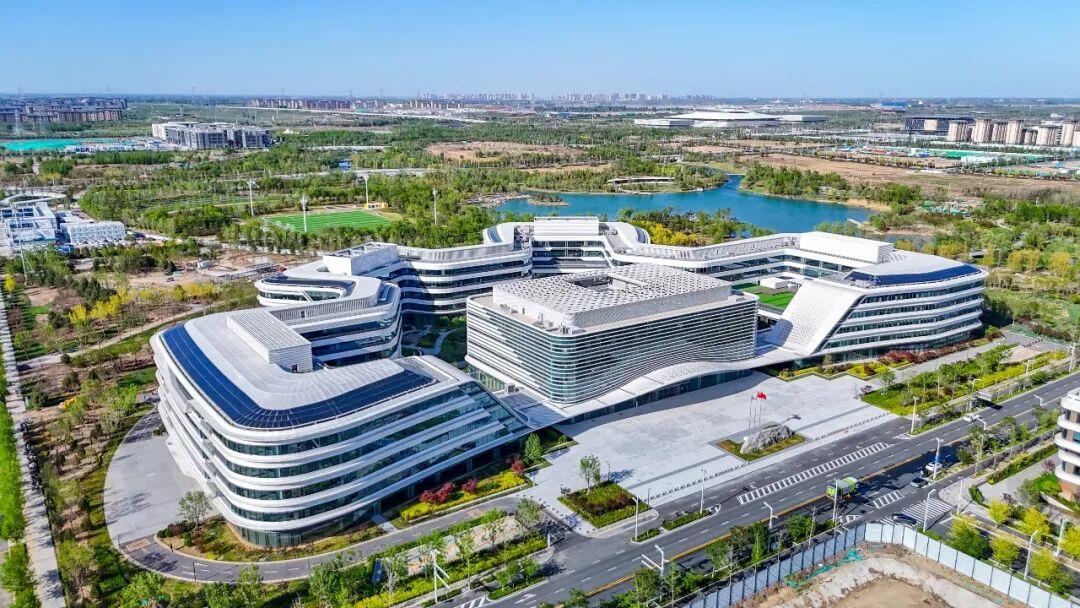
Launched in 2017 under the personal directive of President Xi
Jinping, the Xiong'an New Area is a national mega-project of
strategic significance, akin to the roles of Shenzhen and Pudong in
China's urban development. Situated approximately 100 km southwest
of Beijing in Hebei Province, the Xiong'an New Area is envisioned
as a "city of the future," underpinned by four core principles:
innovation, sustainability (green development), intelligence (smart
technologies), and low carbon emissions. Its overarching objective
is to drive regional development in the Beijing-Tianjin-Hebei area
while presenting a new paradigm for urbanization.
As of April 2026, Xiong'an has developed approximately 215 km2
of land, with over 5,300 buildings constructed, and total
investment surpassing 1 trillion yuan (roughly $140 billion).
Alongside its urban expansion, a high-tech cluster is taking shape,
with more than 200 advanced technology companies already
operational in the area, covering fields such as artificial
intelligence, satellite internet, and aerospace data. The area is
projected to house over 5 million residents by 2035, with ambitions
to evolve into a world-class modern city by 2050. The district has
also demonstrated remarkable economic growth, with an average
annual GDP growth rate of 17.1% from 2021 to 2025.
While previous major Chinese urban projects like Shenzhen and
Pudong were emblematic of market-driven expansion and
export-oriented growth, Xiong'an signals a departure from this
model, focusing instead on a distinct approach to urbanization. Its
primary objective is to alleviate congestion in Beijing by
relocating the city's most overburdened sectors, including
corporate headquarters, universities, and hospitals. To date, over
4,000 companies and branches of central state-owned enterprises
have already been relocated from the capital.
The financing for Xiong'an is predominantly state-driven, with
key financial support provided through budgets, loans from the
China Development Bank, and investments from central state-owned
enterprises (SOEs). The China Xiong'an Group serves as the
principal operator of the project. The development has attracted a
range of major entities, including China Satellite Network Group,
Sinochem, China Huaneng, and at least eight other corporate
headquarters. For the time being, the private sector's
participation is largely restricted to high-tech industries.
Although the presence of foreign corporations in Xiong'an
remains limited, the high-tech zone was granted national status in
February 2026 to specifically attract foreign investment in sectors
such as artificial intelligence (AI), biotechnology, and green
technologies. Officially, the area is now open to international
companies, and business associations have already expressed
interest in the development.
In this context, the World Urban Forum (WUF13) in Baku emerges
as a crucial platform for China. With an anticipated 13,000–15,000
delegates from over 166 countries, the forum provides Beijing with
an opportunity to present Xiong'an as a viable alternative model
for urbanization.
The forum offers China a multifaceted opportunity. It enables
the promotion of the "city of the future" model within the global
conversation on affordable and safe housing, while simultaneously
enhancing China's "soft power" through the demonstration of
effective urban governance. Furthermore, it facilitates the
exchange of knowledge and practical solutions for sustainable
development. It also presents a unique opportunity to establish
partnerships with foreign entities that have yet to enter the
Xiong'an project.
WUF13 may become an external accelerator for Xiong'an. It will
act not as a source of traditional capital, but as a channel for
legitimizing the project, generating ideas, and building future
partnerships - allowing China to transform this domestic experiment
into an international benchmark for a new kind of urban
development.














Comments
No comment