




403
Sorry!!
Error! We're sorry, but the page you were looking for doesn't exist.
The US Commission On International Religious Freedoms: Sudanese RSF Militias In The Bad List
(MENAFN- Sudanow Magazine)
By: Mohamed Osman Adam
Port Sudan, Report (Sudanow) - - The United States Commission on International Religious Freedom published its 2026 annual report on March 4, 2026. This report covers the previous year. However, what stands out in this report, as far as the Sudan is concerned, is absence of any condemnation of Sudan-its government, army, security apparatus, or popular entities-which confirms that the state of religious freedoms is continuously improving.
The second point is that Sudan's name was not mentioned negatively for seven years (2018-2025) until this year, when the Rapid Support Forces (RSF) were cited in the negative list and included in the report's recommendations for possible sanction in by the us administration.
Apart from this, the 2025 report did not include Sudan as a government, state, or army. Until 2018, Sudan was listed on one of four lists of countries with poor reputations regarding religious freedom, but since then it has been gradually removed from these lists since 2019. This year, it did not appear as a country on any of the three main lists in the 2026 annual report.
Possible reasons why Sudan is not citied negatively in any of the four lists of the commission
- The efforts made by various government institutions and ministries, which contributed to providing a clear record of the government and its official bodies regarding any violations or abuses, despite the ongoing war in the country.
- The areas where Christian minorities reside are under the control of the Sudan People's Liberation Movement-North (SPLM-N), and condemning them might not be politically or religiously acceptable to the report's authors.
- The areas in Khartoum, western, central, and northern Sudan that witnessed religious violations were perpetrated by the RSF, a militia group. These forces attacked churches in Omdurman and Khartoum, looted churches and the homes of pastors, and also attacked religious figures, Muslims and Christians alike, Mosques and churches were targeted, some converted into warehouses, others completely demolished, and senior religious figures humiliated, as seen in their own videos. Therefore, the RSF was held responsible for all the violations.
- The opposition failed to exploit a purely organizational incident related to informal housing in Haj Youssef, which it attempted to transform into a major issue, but it failed.
Sudan's previous classification
In this widely covered report, Sudan was mentioned six times across one hundred pages. Almost all related to the RSF.
The last time Sudan was designated a“Country of Particular Concern” (CPC) – the highest designation for countries that do not respect religious freedom – by the U.S. State Department was in November 2018. The country was then moved to the“Special Watch List” (SWL) in 2019 due to improvements made by the transitional government, before being formally removed from all religious freedom restriction lists in December 2020. Rapid Support Forces Militia Designation
Why now?
The report stated that the Rapid Support Forces launched a brutal drone strike on a mosque in El Fasher, Sudan, in September 2025, killing more than 70 people. In fact, religious violence in Darfur and other parts of Sudan-where one of the world's worst humanitarian disasters continues-led the United States Commission on International Religious Freedom (USCIRF) to designate the Rapid Support Forces (RSF) in 2026 as an“Entity of Particular Concern” (EPC). EPCs are non-state actors-such as terrorist groups-that commit gross and systematic violations of religious freedom. The State Department designated them based on USCIRF recommendations, and they include groups like al-Shabaab, Boko Haram, the Houthis, and ISIS.
This mosque bombing and the killing of worshippers during dawn prayers was the culmination of repeated and documented violations committed by the RSF in Omdurman, Khartoum, Bahri, and other areas. Churches and places of worship have been raided, and clergy, including priests and bishops, have been subjected to harsh treatment, beatings, and theft of their property, particularly in Omdurman.
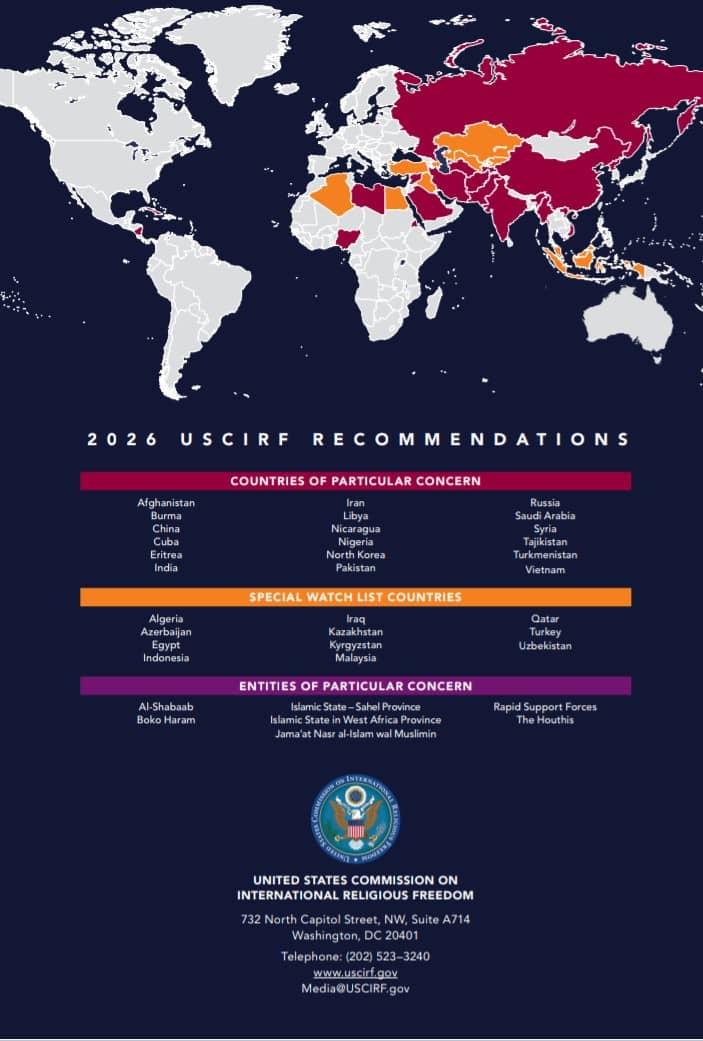
It is noteworthy that the Rapid Support Forces (RSF) are classified alongside African and global terrorist groups, including: the Islamic State – Sahel Province; the Islamic State in the Greater Sahara (ISGS) in the Sahel and Lake Chad regions; the Islamic State West Africa Province (ISWAP); the Islamic State West Africa Province (ISWAP) in Nigeria, Niger, Cameroon, and Chad; Jama'at Nusrat al-Islam wal-Muslimin (JNIM) in Mali, Burkina Faso, and Niger; Jama'atu Ahlis Sunna Lidda'awati wal-Jihad (JISWAP); Boko Haram in Nigeria, Cameroon, Chad, and Niger; the Sudanese Rapid Support Forces; and the Houthis (Ansar Allah) in Yemen.
The report added that the RSF is a paramilitary group that was formerly under the command of the Sudanese Armed Forces until the outbreak of hostilities between the two sides in April 2023. Following this, the RSF consolidated its control over the El Fasher area and expanded its influence into Darfur and parts of Kordofan in 2025. The group has committed mass atrocities and widespread human rights violations, severely damaging religious freedom and religious and ethnic diversity in the country.
The US State Department noted that reports from survivors, aid organizations, and international investigators describe summary executions of unarmed civilians, targeted killings of non-Arabs, widespread arbitrary arrests, abductions, and widespread sexual violence.
Rapid Support Forces (RSF) fighters also looted and destroyed civilian infrastructure, including places of worship such as churches and mosques, as well as hospitals and markets. They also imposed sieges on civilian areas, cutting off food, medicine, and humanitarian aid, and disrupting communications to isolate survivors and prevent independent reporting.
The RSF's control of El Fasher has left tens of thousands of civilians under its control, exposing them to the risk of famine, disease, and ongoing bombardment. The ongoing violence in Sudan between the Sudanese Armed Forces and the RSF since 2023 has exacerbated displacement, food insecurity, and widespread insecurity, with religious minorities facing particular hardship.
The risks are increasing amid the fragmentation of state authority. In many contested areas, there have been reports of places of worship being looted or repurposed, clergy and religious leaders being threatened or displaced, religious minorities being arbitrarily detained, and local authorities failing to provide effective protection for places of worship.
The general issues covered by the report
Other issues addressed in the report and the negative effects of Trump's policies: The report addressed the efforts made, and the shortcomings and their causes, by the Trump administration.
It noted that, throughout the year, the Trump administration made several policy changes affecting agencies and programs that have long played a pivotal role in promoting international religious freedom. For example, the administration merged the United States Agency for International Development (USAID) into the State Department in July, impacting key foreign assistance for religious and humanitarian programs and other related programs in Burma, Iraq, Nigeria, Sudan, and other contexts where religious persecution has claimed millions of lives.
It explained that the Treasury Department imposed sanctions on Sudanese entities under Executive Order 14098 "to limit the impact of efforts to impose a singular interpretation of Islamic law."
It noted the shortcomings in meeting the humanitarian needs of large numbers of people displaced by religious persecution, including those in refugee and internally displaced persons camps in countries such as Bangladesh, Iraq, Nigeria, and Sudan, including funding for education, healthcare, and other life-saving initiatives.
It recommended limiting U.S. foreign assistance to countries designated by the U.S. Commission on International Religious Freedom (USCIRF) as countries of religious significance, countries of special religious significance, or countries where the Commission operates, including but not limited to Nigeria and Sudan, to determine whether such assistance supports or hinders efforts to promote religious freedom.
It noted that Congress has held several hearings on international religious freedom issues or related matters, including House Foreign Affairs Committee hearings on Nigeria, Burma, and Sudan, as well as Senate Foreign Relations Committee hearings on Hong Kong and Syria. The United States Commission on International Religious Freedom (USCIRF) recommends that the State Department designate or re-designate seven non-state actors as Religiously Concerned States of Particular Concern in 2025, based on their egregious violations of religious freedom.
Committee's Recommendation
For the first time, the Commission recommends designating the Rapid Support Forces (RSF) in Sudan as an Entity of Particular Concern. Additionally, USCIRF does not recommend designating Hayat Tahrir al-Sham (HTS) as a leading terrorist organization in 2026, as the Syrian transitional authorities, led by HTS, announced their intention to dissolve the organization earlier this year. As a result, HTS no longer controls the areas it once held.
The report also notes that in July, Sudanese security forces demolished the Pentecostal Church in Haj Youssef, Khartoum, without warning, claiming it was an unlicensed building.
In September, the RSF reportedly carried out a drone strike in El Fasher, destroying a mosque and killing more than 70 civilians. Country classifications according to the US Commission on International Responsibility for the Status of Persons with Disaster Risk Reduction:
Countries recommended for designation as "Countries of Particular Concern": Afghanistan, Burma, China, Cuba, Eritrea, Iran, Libya, Nicaragua, Nigeria, North Korea, Pakistan, Saudi Arabia, Syria, Tajikistan, Turkmenistan, and Vietnam.
Countries recommended for inclusion on the US Department of State's "Special Watch List": Algeria, Azerbaijan, Egypt, Indonesia, Iraq, Kazakhstan, Kyrgyzstan, Malaysia, Qatar, and Türkiye, Uzbekistan.

Legal Disclaimer:
MENAFN provides the
information “as is” without warranty of any kind. We do not accept
any responsibility or liability for the accuracy, content, images,
videos, licenses, completeness, legality, or reliability of the information
contained in this article. If you have any complaints or copyright
issues related to this article, kindly contact the provider above.
Most popular stories
Market Research

More Story




Comments
No comment