


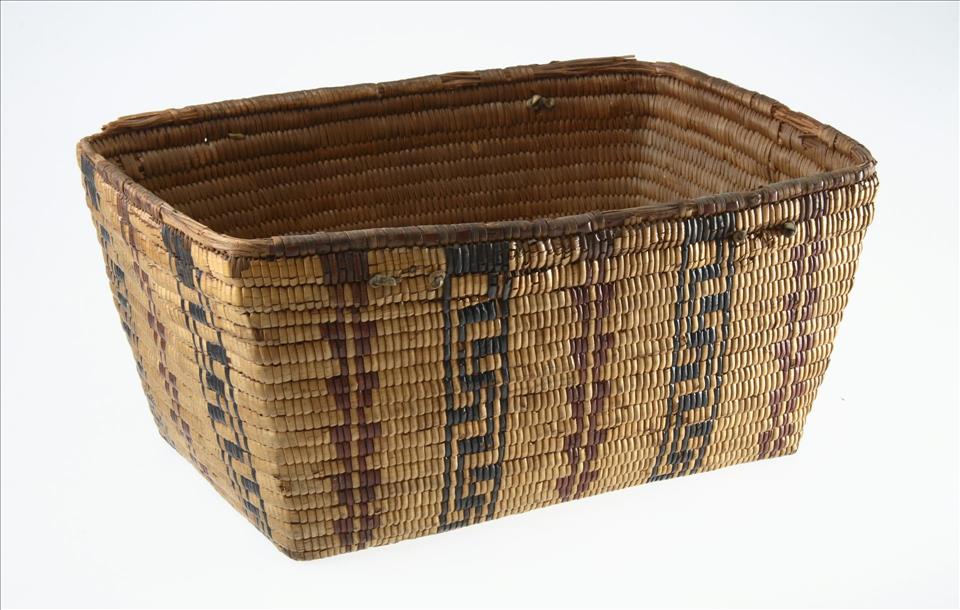
Actually, Doug Ford, Basket-Weaving Is Innovative And In-Demand


Student response to this has been largely negative. Speaking to the media, Ontario Premier Doug Ford said that he received“thousands of calls” from students expressing concerns. Ford's response: telling them to invest in education that leads to in-demand jobs.
At a February news conference responding to OSAP cuts, Ford relayed that he told frustrated students:“You're picking basket-weaving courses, and there's not too many baskets being sold out there.” He said, instead, students should invest in their future through their program decisions - insinuating that craft curriculums hold no value in the job market. Ford mentioned trades, STEM and health-care fields as ones that would provide post-graduation employment.
As a researcher that engages with scholars specialized in the history of craft practices in Canada, alongside teaching art history courses that highlight the social, political and economic importance of fibre arts, Ford's response is troubling and unsurprising.
Basket-weavers push backFord's rhetoric demonstrates a misunderstanding of Canada's cultural sector, basket weaving and the purpose of higher education.
In response to Ford's comments, basket-weavers and craft organizations across the country noted the lucrative nature of their practice alongside the widely applicable skills learned through craft education.
Basket-maker Spencer Lunham Jr., of the Chippewas of Kettle and Stony Point First Nation, for example, told CBC that he sells a couple hundred baskets per year for around $150 to $3,000 each.
The prosperity of Canada's cultural sector is backed by data from the Canadian chamber of Commerce, whose business data lab reported in October 2025 that the arts and culture sector's GDP has grown nearly eight per cent, outpacing an overall economic growth of four per cent. In addition, the sector supports“13 jobs for every million in output, which is more than oil and gas, manufacturing or agriculture.”
Ontario is one of the provinces to see the highest economic impact from the sector, according to the report.
Winner of Sobey Art AwardFord's emphasis on the uselessness of craft practices is also challenged by recent winners of the Sobey Art Award, one of the most prestigious art awards in the country.
Many of the recent winners incorporate craft or craft-like practices into their work. This includes the 2017 winner of the award, Ursula Johnson, an artist from the Eskasoni First Nation, in Cape Breton, Nova Scotia, who has an innovative basket-making practice. It seems that, at the very least, gallerists are buying baskets.
Johnson's practice in particular highlights that - despite craft's common framing as traditional, overly indulgent and frozen in time - basket-weaving is an innovative, adaptive and in-demand field.
As curator Heather Anderson argues in her 2021 writing on Johnson's work: the artist utilizes weaving practices to highlight Canada's ongoing role in colonization, and to question the contemporary museum's implication in it.
Craft and technological innovationCraft practices have always been at the centre of technological innovation.
Some scholars contend that the inventor of the computer, Charles Babbage, was likely inspired by the Jacquard loom: a weaving machine whose invention had a profound impact on the industrial revolution in Europe.
Other writers, like journalist Brian Merchant, have recently argued that those opposed to artificial intelligence can take inspiration from the first rebellions against big tech: the 19th century Luddites who opposed the mass industrialization of weaving practices.
From AI to the clothes we wear, weaving has shaped the contemporary global economy.
While weaving can be lucrative, members of the Toronto Guild of Spinners and Weavers noted that basket-weaving courses do not emphasize their monetary value, but rather their educational value.
Purpose of learningThis is where Ford's real misunderstanding of education is revealed: the purpose of learning is not simply to remember and regurgitate facts, it is to problem solve, to expand our horizons and to think critically. These skills can be developed in basket-weaving courses just as well as math courses.
Read more: Ada Lovelace's skills with language, music and needlepoint contributed to her pioneering work in computing
Johnson, for example, says that her grandmother taught her that the maker does not manipulate the wood they use to weave, but instead the wood guides the maker. Basket weaving teaches us to listen, to collaborate and build from a strong foundation and work our way up.
College admissions expert and counsellor Scott White, writing for Forbes Magazine, wrote in 2025 that“we need a system that prioritizes critical thinking, emotional intelligence and practical skills over rote memorization.”
He and many others who are invested in supporting young people and helping our systems change to support our society through turbulent times note that current education systems still reflects outdated ideas about the future of workers: of those in factories, rather than creative thinkers.
Pipeline to a job?The Ford government's approach to higher education seems to be the same - funding a system that put us on a pipeline to a job and where programs that demand critical and creative thinking are undervalued, and also, underfunded: Recent reports note that funding for Ontario's post-secondary sector is low compared to support in other provinces.
Author Ursula K. Le Guin argued in 1986 that rather than a weapon for killing, the first human tool was likely a container: a basket or a woven net. She writes that the basket - and craft practices - are not supplemental to human survival: rather, they enable it.
Craft practices allow us to carry our culture, our belongings and our sustenance. If we focus only on the money-making schemes in society, then we lose a part of ourselves.
This is the real power of craft education: when we engage hands-on craft, we learn about our past and build problem-solving skills.


Legal Disclaimer:
MENAFN provides the
information “as is” without warranty of any kind. We do not accept
any responsibility or liability for the accuracy, content, images,
videos, licenses, completeness, legality, or reliability of the information
contained in this article. If you have any complaints or copyright
issues related to this article, kindly contact the provider above.


Comments
No comment