




403
Sorry!!
Error! We're sorry, but the page you were looking for doesn't exist.
Around 1.13 Million Bangladeshis Fly Abroad For Jobs In 2025
(MENAFN- Bangladesh Monitor)
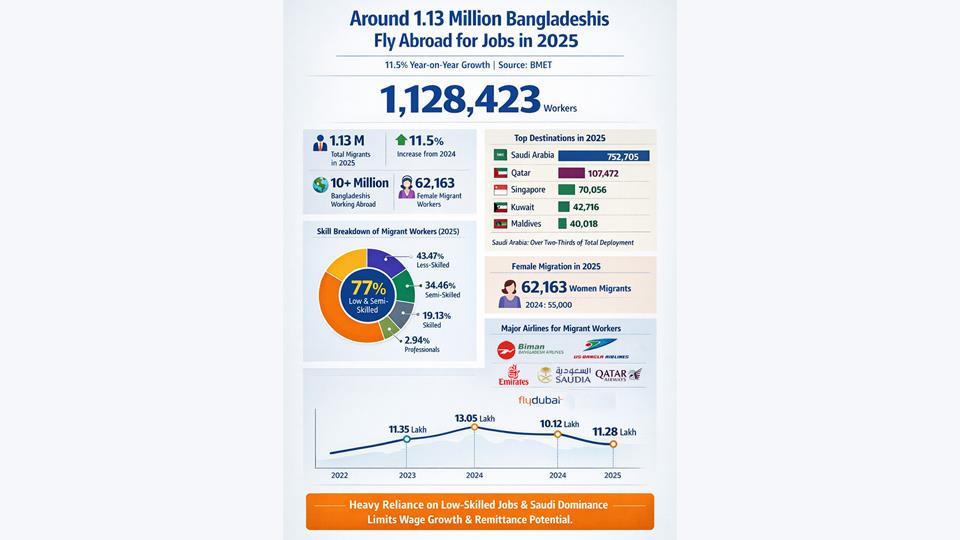
Around 11,28,423 Bangladeshis flew abroad for employment in 2025, marking an 11.50 percent increase compared to the previous year, according to data from the Bureau of Manpower, Employment and Training (BMET).
The figure surpasses the 1,011,856 workers sent overseas in 2024. However, migration experts note that the latest data highlights persistent structural weaknesses-particularly the continued dominance of low-skilled migration and heavy dependence on a single destination.
Saudi Arabia remained the largest destination for Bangladeshi migrant workers in 2025, employing 752,705 workers, accounting for more than two-thirds of total overseas deployment.
Qatar followed with 107472 workers, while Singapore (70,056), Kuwait (42,716), and the Maldives (40,018) rounded out the top five destinations.
Other notable destinations included the United Arab Emirates (13,713), Jordan (12,268), Cambodia (12,168), Italy (9,316), and Kyrgyzstan (6,650).
Bangladeshi workers mostly traveled through major local carriers such as Biman Bangladesh Airlines and US-Bangla Airlines, alongside foreign airlines including Emirates, Saudia, Qatar Airways, Flydubai, Singapore Airlines, Oman Air, and Jazeera Airways.
Currently, over 10 million Bangladeshis are working abroad, according to unofficial estimates.
Limited Progress in Skill Composition
Despite repeated policy commitments to promote skilled migration, low-value employment continues to dominate overseas deployment.
As of 27 December 2025, the skill breakdown was as follows: less-skilled workers accounted for 43.47 percent, semi-skilled 34.46 percent, skilled 19.13 percent, and professionals 2.94 percent. This means more than 77 percent of deployed workers fell into the unskilled and semi-skilled categories.
A similar trend was observed in 2024, when 54.23 percent of migrant workers were low-skilled, up from 50 percent the previous year. Skilled workers accounted for 23.62 percent, slightly down from 24.76 percent in 2023, while 4.59 percent were professionals and 17.56 percent semi-skilled.
Experts say the 2025 figures indicate limited progress in upgrading workforce skills, despite growing global demand for trained and certified labour.
Female Migration Sees Modest Growth
Female participation in overseas employment saw a modest increase in 2025. A total of 62,163 women migrated for work this year, up from 55,000 in 2024.
While the increase is notable, women still represent a small share of total migrant workers, reflecting ongoing barriers related to skills training, job diversification, and destination-country restrictions.
Bangladesh sent a record 13.05 lakh workers abroad in 2023, following 11.35 lakh in 2022. The upward trend continued in 2024 and 2025, placing Bangladesh among the world's largest labour-exporting countries.
However, labour market specialists warn that growth in numbers has not translated into qualitative transformation. The continued emphasis on low-skilled migration limits wage growth, reduces remittance potential per worker, and exposes migrants to higher risks abroad.

Legal Disclaimer:
MENAFN provides the
information “as is” without warranty of any kind. We do not accept
any responsibility or liability for the accuracy, content, images,
videos, licenses, completeness, legality, or reliability of the information
contained in this article. If you have any complaints or copyright
issues related to this article, kindly contact the provider above.
Most popular stories
Market Research

More Story








Comments
No comment