




403
Sorry!!
Error! We're sorry, but the page you were looking for doesn't exist.
What Lies Ahead For Switzerland: The Major Political Issues Of 2026
(MENAFN- Swissinfo)
The coming year promises to be a landmark one for Swiss politics. It will be decisive for the future of relations between Switzerland and its European neighbours. And Swiss citizens will have an exceptionally busy voting schedule.
This content was published on
December 28, 2025 - 10:00
8 minutes
For the right-wing Swiss People's Party, the halberds now symbolise the fight against the agreements with the EU. Keystone / Christian Beutler The referendum battle
Where does Switzerland stand in the world? And where is it heading? I focus on current and possible future developments. After completing my studies (history, law and European studies), I worked for a time at the Swiss embassy in Athens. I have journalistic experience at home and abroad, at the local and national levels, as a freelancer and as a staff journalist. Today, it's with an international focus.
-
More from this aut
German Departm
As a correspondent at the Federal Palace for SWI swissinfo, I report on federal politics for the Swiss Abroad. After studying at the Academy of Journalism and Media at the University of Neuchâtel, my career path initially took me to various regional media, working in the editorial offices of Journal du Jura, Canal 3 and Radio Jura bernois. Since 2015, I have been working in the multilingual editorial department of SWI swissinfo, where I continue to practise my profession with passion.
-
More from this aut
French Departm
-
Português
pt
2026 será decisivo: Suíça, UE e um novo pacote de relações bilaterais
Read more: 2026 será decisivo: Suíça, UE e um novo pacote de relações bilat
日本語
ja
スイス政治展望2026 EU協定を審議 多数の国民投票も
Read more: スイス政治展望2026 EU協定を審議 多数の
العربية
ar
سويسرا 2026: عام الاستحقاقات السياسية الكبرى
Read more: سويسرا 2026: عام الاستحقاقات السياسية ا
中文
zh
2026年瑞士政治展望:瑞欧关系关键年
Read more: 2026年瑞士政治展望:瑞欧
Русский
ru
Что ждёт Швейцарию: ключевые политические темы 2026 года
Read more: Что ждёт Швейцарию: ключевые политические темы 2026
The year 2026 will be a moment of truth for relations between Switzerland and the European Union. The Swiss and European parliaments are set to vote on a new package of agreements to stabilise and develop their ties.
This issue has already dominated the political scene this year. A consultation phase ended in October, allowing political parties, associations, and cantons to define their positions. After analysing the results, the government plans to adjust certain points and is expected to submit a proposal to parliament in March.
The federal parliament will start debating it in spring. These discussions promise to be heated and will undoubtedly enliven parliamentary sessions. Only the right-wing Swiss People's Party is categorically opposed to what is known as Bilateral III.
For the other political parties, it's a“yes”, but with various“buts”. The left-wing Social Democrats want protection against dismissal for labour union representatives. The Centre Party has made demands related to immigration. The centre-right Radical-Liberals criticise automatic adoption of European law. And farmers say they will fight to retain their autonomy in food matters.
The process does not stop in Bern. The agreements will also have to be ratified by the Council of the EU and then by the European Parliament in autumn. In Brussels, political groups have begun analysing the 1,800-page package under the leadership of Christophe Grudler, rapporteur for relations with Switzerland.“There is some criticism, but a majority of MEPs now want good and lasting relations with Switzerland,” he says.
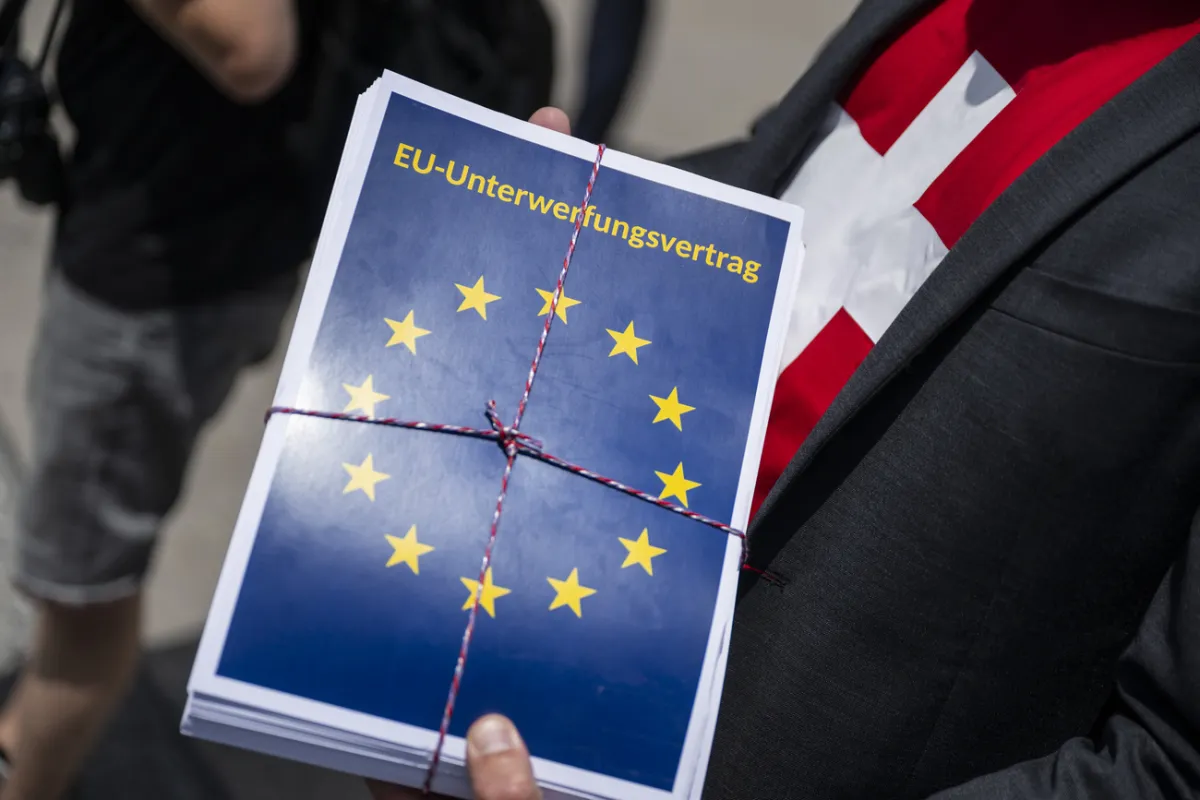
For the right-wing Swiss People's Party, the halberds now symbolise the fight against the agreements with the EU. Keystone / Christian Beutler The referendum battle
If the treaty is approved by Swiss and European MPs, the final step will be the most delicate: convincing the Swiss people. A popular vote is scheduled for 2027, before the federal elections in October. But 2026 will be marked by another battle: the form of the vote.
The federal government wants to submit the agreement package to an optional referendum, which means that it would only need to be adopted by most of the people. However, the Swiss People's Party plans to fight for a mandatory referendum, requiring a double majority of the people and the cantons. The aim is to make it more difficult for the treaty to be adopted.
Parliament will have to decide, but the question could also be put to the people with a popular initiative known as“Compass”, backed by three billionaire entrepreneurs. If passed, this would require a double majority for any agreement with Brussels.
Another initiative that may be put to the people in June could also jeopardise the new treaties with the EU: the People's Party's“No 10 million Swiss” initiative. The text calls for strict immigration controls and for measures to be introduced as soon as the population exceeds 9.5 million.
If it passes, Switzerland will have to limit the free movement of people, which could lead to termination of other bilateral agreements with the EU via the“guillotine clause”. In this context, the EU could decide not to finalise the new package.
An avalanche of popular votesThese two texts related to the European issue will not be the only ones submitted to Swiss voters this year. Nearly 20 initiativesExternal link recently obtained enough valid signatures and could be put to a popular vote in the near future.
The first Sunday of voting sets the tone: on March 8, four items will be put to the vote. The people will decide on the“200 francs is enough!” initiative. This text, supported by the People's Party, the Swiss Union of Crafts and Small Businesses (USAM) and the Young Liberals (youth wing of the Radical-Liberals), proposes to reduce the radio and television license fee from CHF335 ($421) to CHF200 per year and to exempt all businesses. Revenue from the licence fee funds programmes of the Swiss Broadcasting Corporation, Swissinfo's parent company.
On the same day, citizens will also vote on the introduction of individual taxation, intended to correct the“penalisation of married couples”. Two other items are also on the agenda: an initiative to guarantee the maintenance of cash in Switzerland by enshrining it in the Constitution; and a text calling for the creation of a climate fund.
Other busy voting Sundays will follow. Among the texts expected is the so-called“neutrality” initiative, supported by circles close to the People's Party and the Pro Suisse association. It aims to exclude Switzerland from any membership of a military or defence alliance, except in the event of a direct attack, and limit Swiss participation in international sanctions to those decided by the United Nations.
>>Our article on the neutrality initiative:
More More Neutrality How the neutrality initiative could affect Swiss policyThis content was published on Nov 18, 2025 The neutrality initiative seeks to incorporate a strict interpretation of Swiss neutrality in the federal constitution. What would this mean for Switzerland's foreign and security policy?
Read more: How the neutrality initiative could affect Swiss p
Legal Disclaimer:
MENAFN provides the
information “as is” without warranty of any kind. We do not accept
any responsibility or liability for the accuracy, content, images,
videos, licenses, completeness, legality, or reliability of the information
contained in this article. If you have any complaints or copyright
issues related to this article, kindly contact the provider above.
Most popular stories
Market Research

More Story




Comments
No comment