




403
Sorry!!
Error! We're sorry, but the page you were looking for doesn't exist.

Delhi Air Pollution: GRAP Is A 'Reactive Measure', Not A Solution
(MENAFN- AsiaNet News)
GRAP Criticised as 'Reactive Measure'
Environmentalist Bhavreen Kandhari on Sunday criticised the Graded Response Action Plan (GRAP), calling it a "reactive measure" rather than a long-term solution, following the imposition of Stage-IV restrictions in the national capital amid worsening air pollution.
"GRAP, as we know, is a reactive measure. After seeing terrible numbers, GRAP-IV is invoked. What has been done over the years, the decisions taken by the policymakers, is the result we are seeing; it is not an overnight situation... After a few days, when the AQI numbers drop, GRAP will be revoked. This is not the solution...," Kandhari told ANI.
CAQM Invokes Stage-IV GRAP
On Saturday, the Commission for Air Quality Management (CAQM) invoked Stage IV of the Graded Response Action Plan after Delhi's Air Quality Index (AQI) approached the 'Severe Plus' mark of 450.
According to the order released by CAQM, the AQI of Delhi, which was recorded as 431 today at 4 PM, exhibited an increasing trend and has been recorded as 446 at 6 PM on the date owing to slow wind speed, stable atmosphere, unfavourable weather parameters and meteorological conditions and lack of dispersal of pollutants.
"Keeping in view the prevailing trend of air quality and in an effort to prevent further deterioration of air quality in the region, the CAQM Sub-Committee on GRAP decides to invoke all actions as envisaged under Stage-IV of the extant GRAP - 'Severe+' Air Quality (DELH 1AQl > 450 ), with immediate effect, in the entire NCR. This is in addition to the actions under Stages I, II & III of extant GRAP already in force in NCR," the order stated.
Further, the NCR Pollution Control Boards/Committee and other concerned agencies have been asked to intensify preventive measures to prevent further deterioration of air quality in the region, the order stated.
Delhi Wakes Up to Dense Smog
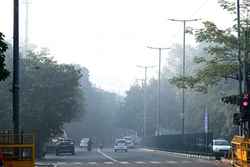
This morning, the national capital woke up to dense smog as the average Air Quality Index (AQI) stood at 461 at 7 am, falling in the 'severe' category despite the Graded Response Action Plan (GRAP)-IV in effect across Delhi and the National Capital Region (NCR), according to the Central Pollution Control Board (CPCB).
A thick haze was reported in areas including Ghazipur, the ITO area, and Anand Vihar, where visibility remained severely low.
According to the CPCB, several localities across the city continued to register "severe" air quality. Bawana recorded the highest AQI of 497 at 7 am, placing it in the 'severe' category. Narela is recording an AQI of 492, and Okhla Phase 2 is recording an AQI of 474. In contrast, NSIT Dwarka recorded the lowest AQI of 411, according to the data by the Central Pollution Control Board (CPCB). (ANI)
(Except for the headline, this story has not been edited by Asianet Newsable English staff and is published from a syndicated feed.)
Legal Disclaimer:
MENAFN provides the
information “as is” without warranty of any kind. We do not accept
any responsibility or liability for the accuracy, content, images,
videos, licenses, completeness, legality, or reliability of the information
contained in this article. If you have any complaints or copyright
issues related to this article, kindly contact the provider above.
Most popular stories
Market Research

More Story





Comments
No comment