







403
Sorry!!
Error! We're sorry, but the page you were looking for doesn't exist.

Eleanor The Great: A Tonally Uncertain Holocaust Drama With A Wonderful Central Performance
Author: Matt Jacobsen
(MENAFN- The Conversation) Despite a wonderful central performance from June Squibb, Scarlett Johansson's directorial debut is a sentimental, tonally uncertain drama about grief and holocaust survival
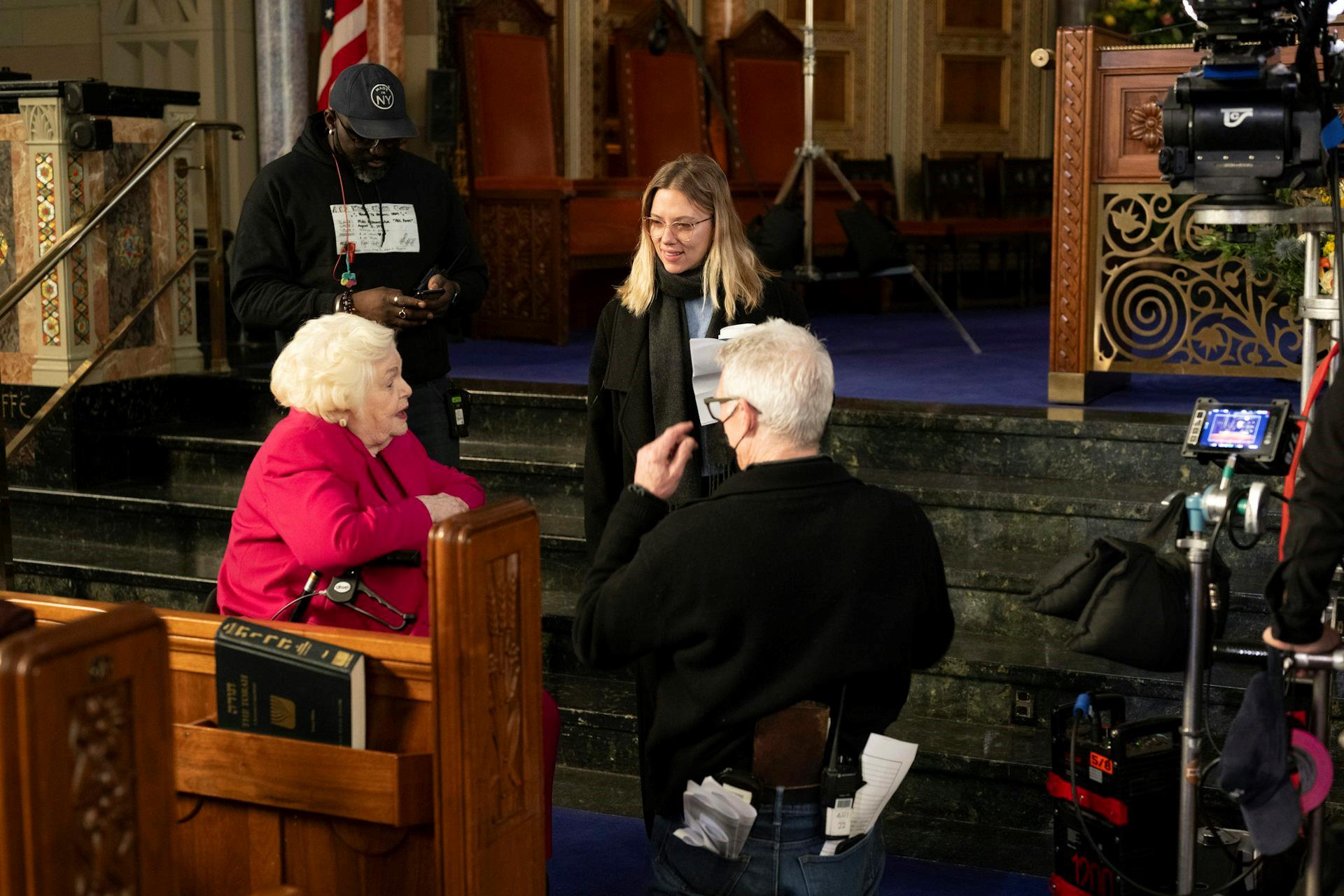
Scarlett Johansson directing June Squibb. Studio Canal![]()

Eleanor Morgenstein, a 94-year-old Midwesterner living in Florida, moves to New York after the death of her close friend and roommate Bessie, a Holocaust survivor. She joins a Jewish seniors group and accidentally finds herself part of a meeting of Holocaust survivors.
Eleanor, at first buoyed by the prospect of new friends, fabricates past experiences based on the Bessie's stories, claiming harrowing recollections as her own.
Nina (Erin Kellyman), a journalism student writing a piece on Holocaust survivors, attends the meetings and is moved by Eleanor's stories. Having recently lost her mother she connects with Eleanor through shared grief.
Eleanor starts out with ambiguously good intentions of preserving the memory of a dear friend. However, she is soon out of her depth when Nina's article is taken up by Nina's news anchor father (Chiwetel Ejiofor) as a human interest story for his show.
Early in the film, a comic exchange in a supermarket aisle telegraphs the film's central theme. An acquaintance in his 90s tells Eleanor crossly:“You were born in New York. You can't feel bad about the Holocaust. You weren't there.”
The film wants to probe the ways in which grief is processed individually and collectively, asking us to consider what drives Eleanor to appropriate her friend's traumatic life history.
At the centre of the film is the wonderful performance by Squibb, then 94 but now 96, who had a sturdy but unspectacular stage and screen career for more than 60 years before her breakthrough performance in Alexander Payne's superb Nebraska in 2013.
Eleanor the Great is not a film specifically concerned with ageing and we are not so conscious of the vivacious Squibb's age until a care home subplot is shoehorned in.
Scarlett Johansson was motivated to direct this film after her own investigations into her family's history of Holocaust survival. She may have the highest grossing body of work in Hollywood for action films like The Avengers series, but she has a considerable track record of excellent low key independent films – from her breakthrough in Ghost World to Noam Baumbach's powerful Marriage Story. Eleanor the Great most clearly takes its inspiration from that kind of American character drama.
There is little technical flair or stylistic character to distinguish Johansson as a director in this first feature. The gently sentimental scenes of New York City, its diners, crosswalks and ranks of yellow taxis are clearly inspired by the work of Baumbach as well as Woody Allen, Johansson's director in two films (Vicky Cristina Barcelona, Match Point).
The film is at its strongest in the Allen-esque day-to-day moments in the city that let Squibb embody her character with gentle acidity and likeable crankiness. Johansson, like many actors-turned-directors, has a strength when it comes to allowing performers space to breathe and inhabit their characters. Scenes unfold quietly and unhurriedly.
The script, by Tory Kamen, could be wittier, sharper and more engaging, as there is a promise in character interactions that never quite take flight. When the film reaches what should be its narrative peak with the unravelling of Eleanor's fabrications it is neither emotional nor funny.
Instead the climax's tone is uncertain, sentimental and lands flat. What follows is a series of fraught conversations where the actors gamely try to mine emotional heft from a dreary screenplay.
Scarlett Johansson directing June Squibb. Studio Canal
The cultural memory of the Holocaust and the enormity of its legacy on Jewish descendants has been probed with considerably more success elsewhere. Jesse Eisenberg's impressive, Bafta-winning and Oscar-nominated A Real Pain featured a pair of cousins on a tour of Jewish Poland, confronting its young characters with the memory of the Holocaust.
That film takes a well-executed midway tonal turn from broad character comedy to unexpected powerful poignancy. This happens in a scene where the usually motor-mouthed, bickering men are silenced in the face of a visit to the Majdanek concentration camp. Eleanor the Great doesn't possess a moment like this that would drive its well-intentioned message home.
The film attempts to sidestep the callousness of Eleanor's appropriation of Bessie's stories by switching to flashbacks. In these memories we see Eleanor hear these stories for the first time in the middle of a sleepless night. These scenes, where the words come directly from Bessie, are well acted and moving, especially in a longer, emotional monologue towards the film's climax.
When the film's attention turns in the final third to the issue of whether Eleanor should be placed in a retirement home, the tone similarly skirts between humour and pathos – neither of which connect.
The film has admirable intentions but its script and plotting are not worthy of the excellent performance at the film's heart. It also can't quite bear the seriousness or the potential power of its central themes, leading to a disappointingly hollow experience.
Looking for something good? Cut through the noise with a carefully curated selection of the latest releases, live events and exhibitions, straight to your inbox every fortnight, on Fridays. Sign up here.
Institution:Queen Mary University of London

Legal Disclaimer:
MENAFN provides the
information “as is” without warranty of any kind. We do not accept
any responsibility or liability for the accuracy, content, images,
videos, licenses, completeness, legality, or reliability of the information
contained in this article. If you have any complaints or copyright
issues related to this article, kindly contact the provider above.
Most popular stories
Market Research

More Story








Comments
No comment