






403
Sorry!!
Error! We're sorry, but the page you were looking for doesn't exist.
Did Donald Trump Order Piracy On The High Seas?
Author: Jonathan Este
(MENAFN- The Conversation) This newsletter was first published in The Conversation UK's World Affairs Briefing email. Sign up to receive weekly analysis of the latest developments in international relations, direct to your inbox.
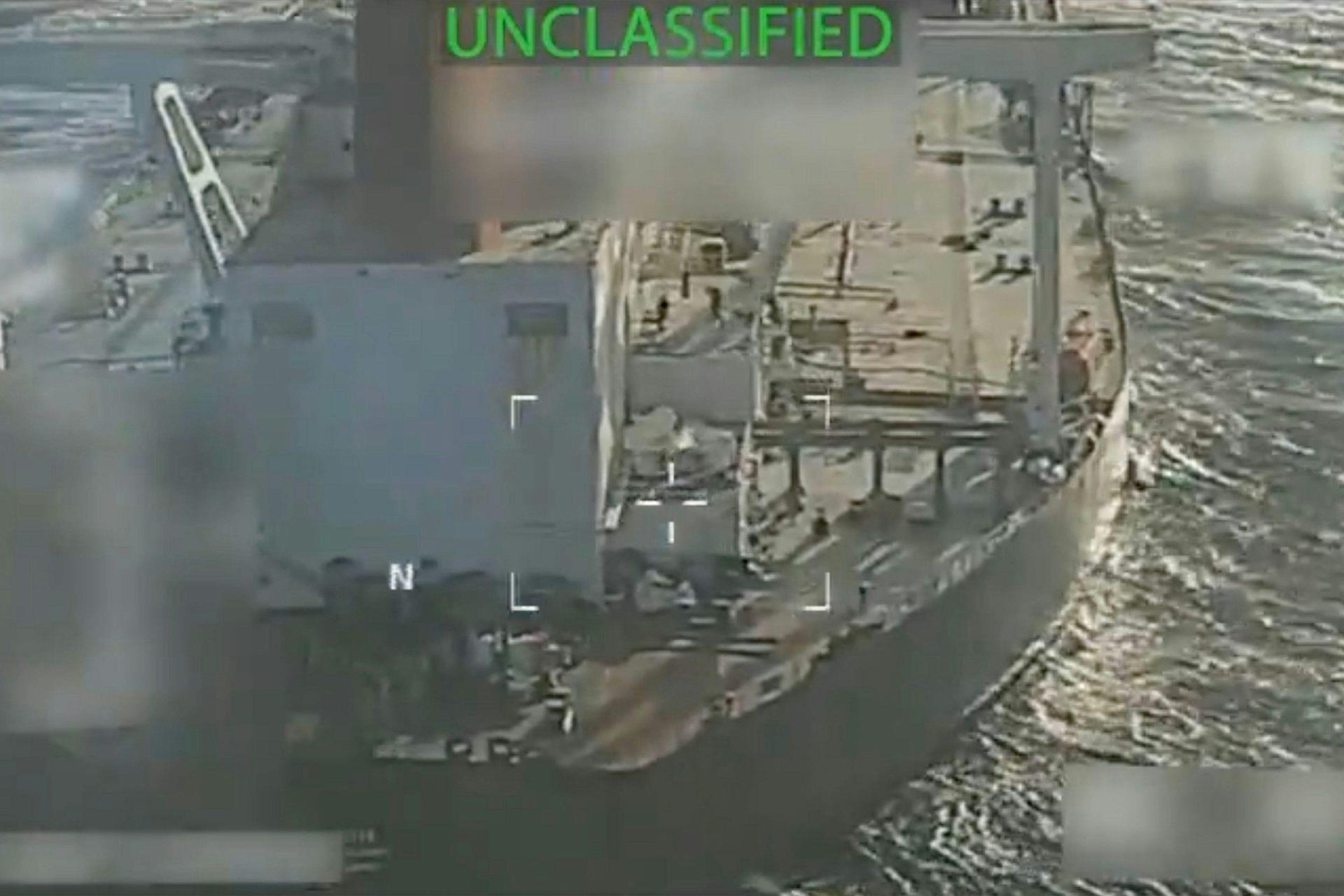
A screengrab of US footage showing the tanker, Skipper, about to be boarded by US troops. Screengrab via U.S. Attorney General/UPI Credit: UPI/Alamy Live News![The hard copy of the US national seucrity strategy for 2025.]()
The US national security strategy for 2025: 33 pages, plenty to digest. AP Photo/Jon Elswick![]()

Venezuelan Nobel peace laureate, María Corina Machado, plans to return home with her accolade“at the correct moment”. You have to presume the correct moment will be at such a time as her bitter political foe Nicolás Maduro is on holiday or otherwise unavoidably detained, or she certainly risks arrest as soon as she sets foot in her home country.
She told the Times of reports from a local NGO that young people were being detained for simply having the news of the Nobel prize in their phone. So she'd be well aware that the crime of being one of the most prominent opposition figureheads might place her in considerable legal jeopardy.
Perhaps that's the point. It's not up to us to speculate, but it's not hard to imagine news of her arrest going down extremely badly in Washington right now. Having conducted 22 strikes on boats in the Caribbean alleged to be carrying what the US president has designed as“narcoterrorists” with the deaths of at least 87 people, closed the airspace above the country and, on December 10, intercepted and boarded an oil tanker off the coast (more of which anon), one wonders what the Trump administration's next step might be.
Will there be a“Gulf of Tonkin incident?” The equivalent of the now-infamous confrontation between North Vietnamese and US naval forces which precipitated the Vietnam War – an episode which turned out to be wholly cooked-up by the Americans. Announcing the seizure of the oil tanker, Donald Trump told reporters, cryptically:“Other things are happening.” He did not go into details, but we'll be watching closely as this develops.
A screengrab of US footage showing the tanker, Skipper, about to be boarded by US troops. Screengrab via U.S. Attorney General/UPI Credit: UPI/Alamy Live News
Understandably the Venezuelans are not amused by the incident, which a government spokesman said was“barefaced robbery and an act of international piracy”. We asked Mark Chadwick, an expert in international law at Nottingham Trent University, who has written a book on piracy, for his opinion on the matter.
Read more: What does international law tell us about the US seizure of an oil tanker off the coast of Venezuela?
Let's avoid, for now at least, the irony of Trump's decision to pardon a man convicted in a US court for“flooding the US with cocaine”, while instructing his military to target boats piloted by people he has designated as“narcoterrorists”.
It has been interesting to follow the coverage of these attacks and their legality, or lack of it. For the record, and in case you have missed our expert analysis, these attacks appear very risky, legally.
But it's not as if the US – and her allies, including the UK – have't sailed pretty close to the legal wind with“targeted killings” across the Middle East and elsewhere over past decades. Elisabeth Schweiger is an expert on international law and the use of force at the University of Stirling. She writes that the fact that there has not been more of an international outcry at these killings has created a situation where these extrajudicial killings have been almost normalised. Indeed the discussion is“beginning to shift from whether such strikes should occur to how they should be conducted, focusing on issues like target identification”.
Read more: Donald Trump's strikes against narcoterrorists are new but the logic behind them isn't
One country where they will be watching what's going on in Venezuela with close interest is China, writes Tom Harper. Harper, an expert in Chinese foreign policy at the University of East London, says that Beijing reacted to news of the closure by the US of Venezuelan airspace with an admonitory message that China“opposes external interference in Venezuela's domestic affairs under any pretext”.
As Harper notes, Beijing has worked hard over decades to develop relations and influence with a range of Latin American countries, partly for trade reasons, partly as a counterweight to US influence. China is also one of the largest buyers of its oil. In turn, Venezuela buys Chinese arms.
But now, in its new national security strategy, the Trump administration has invoked the Monroe doctrine. This policy originating from the 19th century essentially claimed that Latin America was America's backyard to mess around in and that any outside interference in the region would be seen as a hostile act towards US interests. It was discontinued in 2013 by the Obama administration, as the then secretary of state John Kerry declared that“the era of the Monroe doctrine is over”.
Now it's back, in what the White House is calling the“Trump corollary”, which states that“the American people – not foreign nations nor globalist institutions – will always control their own destiny in our hemisphere”. How Beijing reacts to this remains to be seen.
Read more: Why China is watching Trump's Venezuela campaign closely
National security strategyThe Chinese aren't the only people who will have read Trump's 2025 national security statement with interest, although in the case of most of us in Europe, it's more a case of bemusement and horror. While barely mentioning Russia and not mentioning North Korea at all, the 33-page document describes Europe's shortcomings in lavish detail.
Europe, we read, has become weakened by allowing immigration to get out of control to the extent that it now risks“civilizational erasure”. Meanwhile Europe's politicians have undermined free speech and suppressed democratic opposition. Ominously, the national security strategy talks of“cultivating resistance to Europe's current trajectory within European nations”. He doubled down on that theme in an interview with the US, hinting that he might consider endorsing candidates who align better with his geopolitical vision.
Reading between the lines of the document, David Dunn and Stefan Wolff, experts in international security at the University of Birmingham, conclude that“the transatlantic alliance that was the cornerstone of European security and underpinned the liberal international order has ceased to exist”.
It's a worrying time for Nato's European members, they believe. Trump and some of his most senior officials have signalled that the US is no longer prepared to act as the security backstop – the principle around which the alliance was originally built. If any silver lining to this is to be found it's that the US president's insistence that all Nato members must increase their defence spending has already got them scrambling to adjust their budgets. And Trump's perceived unreliability around the Ukraine war has led them to form a Europe-oriented“coalition of the willing”.
The US national security strategy for 2025: 33 pages, plenty to digest. AP Photo/Jon Elswick
As our authors conclude:“If Nato founders, which is not now inconceivable, [this coalition] may be Europe's best hope of surviving in a world where it is no longer one of, or aligned with, the dominant great powers of the day. But for that to become a reality, the coalition of the willing needs to become a coalition of the able. And this is a test it has yet to pass.”
Read more: Donald Trump's national security strategy puts America first and leaves its allies to fend for themselves
That Washington has often viewed the unwillingness of some European powers to join in with America's foreign policy adventures as a sign of weakness is well known. When France and Germany declined to join George W. Bush's invasion of Iraq, there were quips about“Euroweenies” and“EU-nuchs”. So it's not surprising that the new US national security strategy focuses on this perceived shortcoming.
But, the document's focus on the risk of“civilizational erasure” in Europe came as a surprise to many. It feels for all the world like a reheated version of the“great replacement theory” – namely the idea that indigenous Europeans are being outbred by immigrants, to the extent that“will be unrecognizable in 20 years orless”.
The fact is, writes Roman Birke, an expert in modern European history at Dublin City University, that this has become something of an obsession for some thinkers in the US and parts of Europe. Leaders that Trump admires, such as Hungary's Viktor Orbán, have promoted policies to get women having more children.“We Hungarians have a different way of thinking,” Orban is quoted as saying.“Instead of just numbers, we want Hungarian children. Migration for us is surrender.”
Birke believes that Trump and his Maga movement's suspicion of Europe focuses on these issues which to them mean the Europe has become weak and decadent.
Read more: America's anti-European attitudes are centred on perceptions of military weakness and the decline of native populations
But you'd be mistaken if you believe Trump's national security strategy to reveal him as an isolationist, writes Andrew Gawthorpe. Far from it. Gawthorpe, whose research has focused on the changing views of civilisation inherent in Trump's foreign policy when contrasted with that of the great liberal US president Woodrow Wilson, thinks that Trump sees himself as“the protector of a racially and culturally defined civilisation that covers both the US and Europe”.
Gawthorpe picks out three broad themes from the national security strategy which illustrate how the US president and his top aides see the world and America's place astride it.
Read more: What the US national security strategy tells us about how Trump views the world
Sign up to receive our weekly World Affairs Briefing newsletter from The Conversation UK. Every Thursday we'll bring you expert analysis of the big stories in international relations.
Institution:

Legal Disclaimer:
MENAFN provides the
information “as is” without warranty of any kind. We do not accept
any responsibility or liability for the accuracy, content, images,
videos, licenses, completeness, legality, or reliability of the information
contained in this article. If you have any complaints or copyright
issues related to this article, kindly contact the provider above.
Most popular stories
Market Research

More Story






Comments
No comment