




403
Sorry!!
Error! We're sorry, but the page you were looking for doesn't exist.
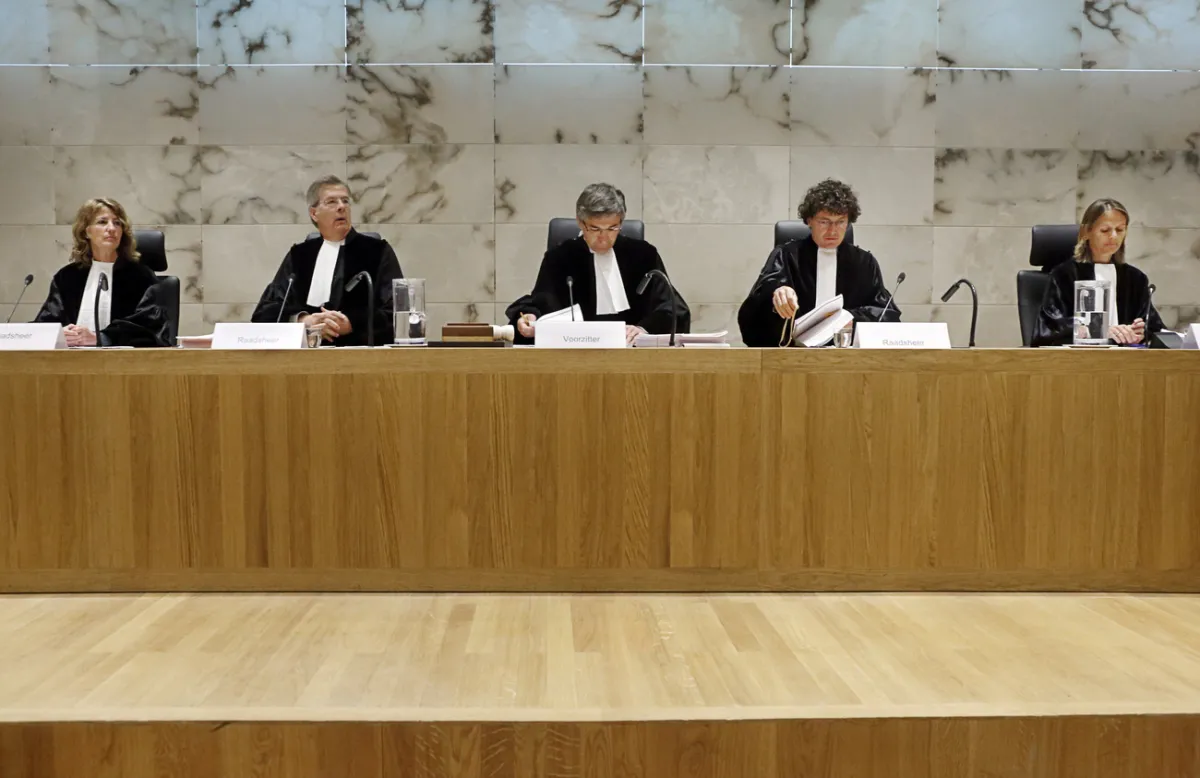
'We Cannot Rely Only On Judges To Drive The Ecological Transition'
(MENAFN- Swissinfo)
More people are turning to courts to push states and companies to do more for the climate. What's been the result? We asked one of the world's leading experts in environmental law and climate litigation.
This content was published on
December 12, 2025 - 09:00
8 minutes
Christina Voigt, 53, is a professor of law at the University of Oslo. Rune Hammerstad Fotorune
I cover climate change and energy through reportages, articles, interviews and in-depth reports. I am interested in the impacts of global warming on everyday life and solutions for an emission-free planet. Passionate about travel and discovery, I studied biology and other natural sciences. I have been a journalist for SWI swissinfo for more than 20 years.
-
More from this aut
Italian Departm
Christina VoigtExternal link is a professor of law at the University of Oslo, Norway. She specialises in international environmental law, with a particular focus on legal issues related to climate change, and she contributed to drafting the landmark Paris Agreement on climate change a decade ago. This year, she received the Hans Sigrist scientific prizeExternal link from the University of Bern in Switzerland.
Swissinfo: In recent years, climate lawsuits against governments and companies have increased significantly. What factors explain this growth?
Christina Voigt: There are several factors. One is the success in 2019 of the climate case brought by the Urgenda association against the Dutch governmentExternal link. It showed that it is possible to use the courts to compel a country to raise its climate ambition and encouraged others around the world to do the same.
Another element is the 2015 Paris Agreement. It set a clear direction and made it possible to assess whether government policies were aligned with climate goals. In addition, many organisations such as ClientEarth, WWF, and Greenpeace realised that legal action, alongside campaigns, can be part of their strategy to protect the climate.
Finally, there is science: data is increasingly precise and concrete, allowing us to quantify what is needed to limit global warming.
External ContentSwissinfo: How can court decisions push countries to adopt more ambitious climate policies?
C.V.: Court rulings can have different effects. In some cases, courts order specific measures. This happened in the Netherlands, where the Supreme Court required the government to further reduce emissions. In other cases, judges may also refrain from prescribing specific actions and instead leave it to governments, which are then called upon to comply with or revise their laws.
This happened, for example, in Germany in 2021, when the Federal Constitutional Court declared the climate law partially unconstitutional. The government responded by introducing more concrete measures to achieve climate neutrality by 2050.
Swissinfo: Global commitments to reduce emissions are not enough to meet the Paris Agreement goals. What role can courts play in filling the gap left by politics?
C.V.: Their role is limited. Courts do not create laws; they apply them. Everything depends on the existing legal framework. For example, if a constitutional article guarantees the right to a healthy environment, courts can use that provision in the context of climate change and compel the country to act.
Where clear laws exist, judges can intervene and hold governments accountable. But in countries lacking climate legislation or constitutional provisions on the matter, the scope for judicial action is very limited.
Christina Voigt, 53, is a professor of law at the University of Oslo. Rune Hammerstad Fotorune
Swissinfo: You have participated as a negotiator for Norway in international climate conferences. How much weight do court rulings or advisory opinions from international courts carry during these negotiations?
C.V.: The answer is simple: so far none. Courts and UN climate conferences are two separate worlds. What happens outside the UN climate regime – which is vast and operates according to its own dynamics – is often considered largely irrelevant.
Even important reports, such as those from the International Energy Agency (IEA) or scientific institutes, do not automatically enter the discussions. A country or group of countries must explicitly bring them to the negotiating table.
Swissinfo: In 2024, the European Court of Human Rights (ECHR) condemned Switzerland for failing to take sufficient measures to protect the most vulnerable people from the impacts of climate change. Nevertheless, national climate policy has remained largely unchanged. Are climate lawsuits truly accelerating climate action, or are they mostly symbolic?
C.V.: It depends. I wouldn't call them symbolic, but strategic. Climate lawsuits are initiated to resolve a specific issue, but they may also aim to have broader effects, pushing other governments and actors to change course.
In Switzerland's case, I wouldn't say the ECHR ruling had no impact. The country has begun revising some laws, although the process is not yet complete. The Committee of Ministers of the Council of Europe acknowledged these efforts and requested further measures to comply with the verdict.
Swissinfo: What are the main challenges in implementing climate rulings?
C.V.: One of the main difficulties concerns the practical feasibility of enforcement, which is not always guaranteed. Added to this are political will and economic considerations.
A significant example is the Urgenda ruling in the Netherlands, which led the government to eliminate coal from its energy mix. Two international companies that had invested in coal reacted by claiming $3.5 billion in compensation. In the end, the Dutch government paid about $500 million.
This highlights an often-overlooked aspect: the economic consequences for governments that must react quickly to a climate ruling. There can also be resistance in parliament or, in the case of coalition governments, among the ruling parties.
However, the existence of political and economic limits to implementing a ruling should not be an excuse for inaction. If a government receives a clear ruling requiring intervention, it has a duty to enforce it.
Swissinfo: A group of Indonesians has sued Swiss cement giant Holcim, accusing it of being co-responsible for climate damage that threatens their existence. What are the main legal challenges in proving a company's responsibility in the climate crisis?
C.V.: Recently, there was a case involving a Peruvian farmer and a German energy company. German courts recognised the general principle that companies contributing to climate change can be required to pay compensation. However, they dismissed the case because the farmer failed to provide sufficient evidence that his property was damaged.
In the Indonesian case, if the plaintiffs prove harm to their livelihood, property, or home, it is now possible to assign Holcim responsibility proportional to its contribution to climate change.
Courts are already moving in this direction, and in the future we will see more cases of this kind, thanks also to advances in attribution science, which links specific events-such as droughts, landslides, or floods-to climate change and human emissions. However, it is still not possible to establish with precision the causal link between the emissions of a single company and a local event.
>> Find out why inhabitants of Indonesia's Pulau Pari island have denounced Swiss cement giant Holcim:
More More Climate solutions Indonesians vs Swiss company Holcim: 'We want to save our island'This content was published on Sep 2, 2025 Inhabitants of Indonesia's Pulau Pari island accuse Swiss cement giant Holcim of contributing to the climate crisis that threatens their existence.
Read more: Indonesians vs Swiss company Holcim: 'We want to save our is
Legal Disclaimer:
MENAFN provides the
information “as is” without warranty of any kind. We do not accept
any responsibility or liability for the accuracy, content, images,
videos, licenses, completeness, legality, or reliability of the information
contained in this article. If you have any complaints or copyright
issues related to this article, kindly contact the provider above.
Most popular stories
Market Research

More Story







Comments
No comment