







403
Sorry!!
Error! We're sorry, but the page you were looking for doesn't exist.
CERN Turns Spotlight On Exotic Particles Structures
(MENAFN- Swissinfo)
The European Organization for Nuclear Research (CERN) has shed light on the structure of "exotic" particles.
This content was published on
December 3, 2025 - 17:29
3 minutes
Keystone-SDA
-
Français
fr
CERN: coup de projecteur sur la structure de particules“exotiques”
Original
Read more: CERN: coup de projecteur sur la structure de particules“exoti
These particles have four quarks, whereas protons and neutrons, for example, only have three.
For a long time, the existence of these exotic particles was only theoretical. It is only recently that physicists have accumulated evidence of their reality. However, the true nature of their structure remained a mystery. Research carried out at CERN is now revealing more.
+ Switzerland risks exclusion from European 'CERN for AI'
Scientists at CERN have analysed the traces left by proton collisions produced by the Large Hadron Collider (LHC), the world's most powerful particle accelerator. The data was collected between 2016 and 2018.
According to an article published in the journal Nature, the physicists examined the structure of exotic particles composed of two“charm” quarks and two“charm” antiquarks. The physicists studied the properties of these particles, in particular their spin, their symmetry and the way in which their quarks and antiquarks are linked.
Quarks are the elementary building blocks of matter. They are the building blocks of protons and neutrons. There are six types, including the charm quark. There are also antiquarks, which have the same mass as quarks but opposite charges. Mesons, which are highly unstable, are made up of a quark and an antiquark.
Strong linksExperiments on these“alluring tetraquarks” have shown that these exotic particles have a solid internal structure, similar to the links that bind quarks together in protons and neutrons, and not a looser structure like that which binds protons and neutrons together in the atomic nucleus.
The study of these exotic particles should lead to a better understanding of the structure of the matter that surrounds us, according to the Nature article.
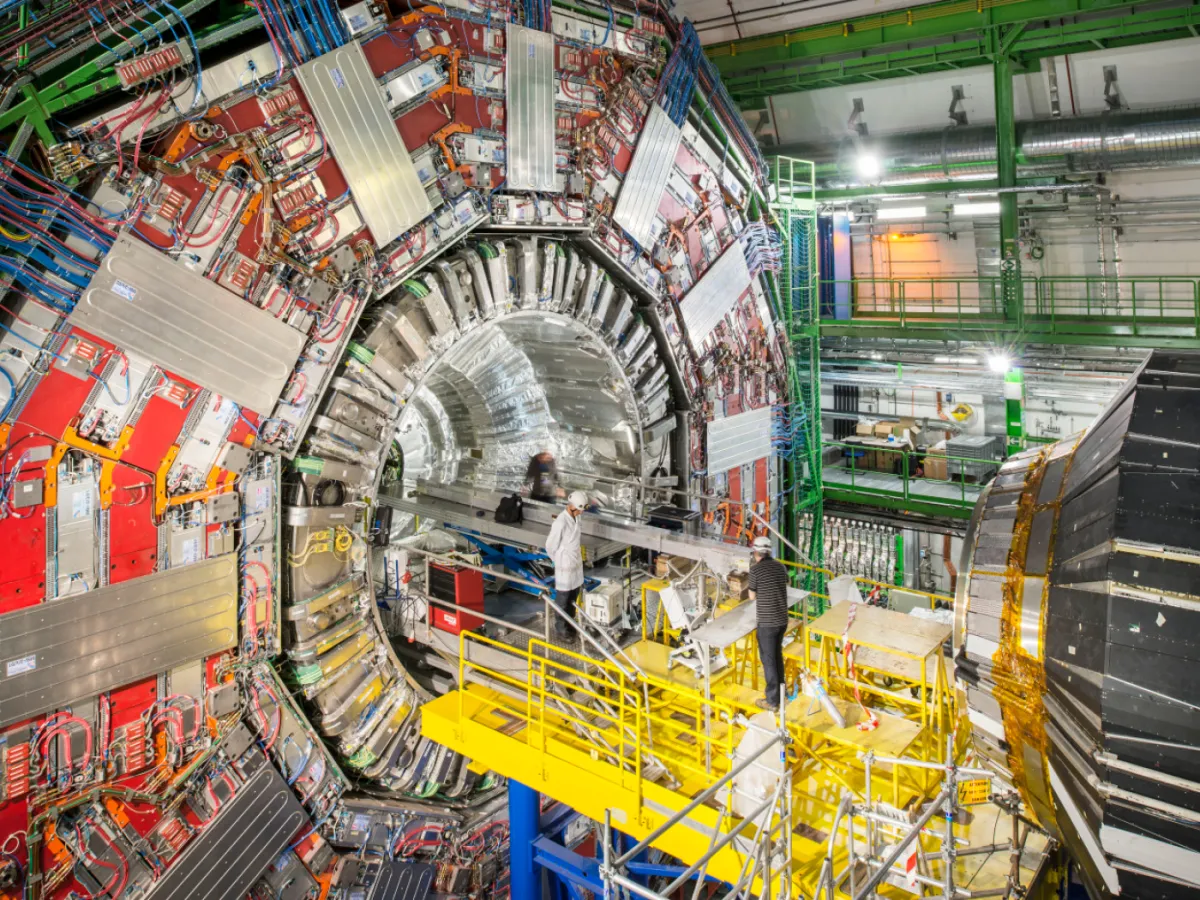
CERN's research into these exotic particles, made up of quarks and“charm” antiquarks, has been carried out as part of the CMS experiment at the heart of the LHC. It involved the participation of some 200 scientific institutions from all over the world.
More More Plans materialise for new particle accelerator in GenevaThis content was published on Apr 1, 2025 Preparations for a huge new particle accelerator in Geneva have reached a milestone. After several years of work, a feasibility study for the project has now been finalised.
Read more: Plans materialise for new particle accelerator in G
Legal Disclaimer:
MENAFN provides the
information “as is” without warranty of any kind. We do not accept
any responsibility or liability for the accuracy, content, images,
videos, licenses, completeness, legality, or reliability of the information
contained in this article. If you have any complaints or copyright
issues related to this article, kindly contact the provider above.
Most popular stories
Market Research

More Story








Comments
No comment