







403
Sorry!!
Error! We're sorry, but the page you were looking for doesn't exist.
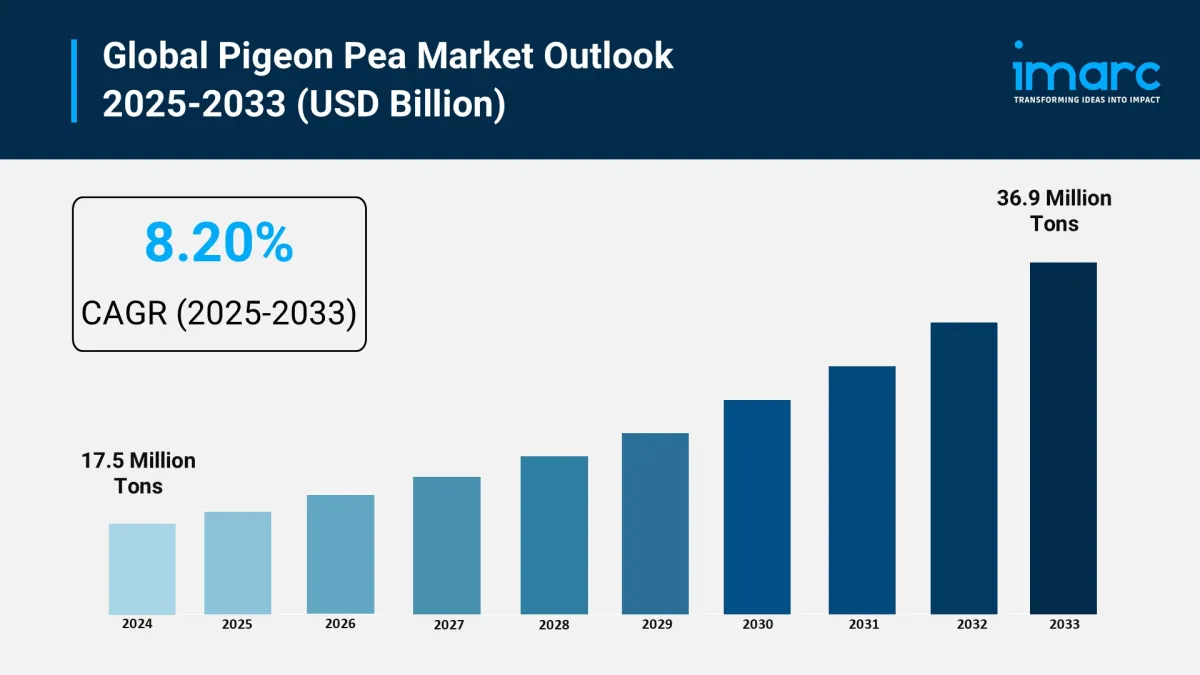
Global Pigeon Pea Market Report 2025: Size Projected 36.9 Million Tons, CAGR Of 8.20% By 2033.
(MENAFN- IMARC Group)
Global Pigeon Pea Market Overview:
The global pigeon pea market reached a value of USD 1,237.3 Million in 2024 and is projected to attain USD 3,183.7 Million by 2033 , expanding at a CAGR of 12.54% during 2025–2033 . Growth is driven by rising consumer demand for plant-based proteins, expanding applications in food and beverages, and the increasing focus on sustainable agriculture. With their rich nutritional profile, pigeon peas are gaining popularity in both traditional diets and modern health-conscious lifestyles, making them a key contributor to global food security and sustainable farming practices.
Request Free Sample Report: https://www.imarcgroup.com/pea-protein-market/requestsample
Key Stats
-
Market Value (2024): USD 1,237.3 Million
Projected Value (2033): USD 3,183.7 Million
CAGR (2025–2033): 12.54%
Leading Application Segment (2025): Meat substitutes and dietary supplements are anticipated to hold strong shares due to growing demand for high-protein, plant-based products.
Key Regions: Asia Pacific (largest), Africa and Latin America (fastest-growing), North America and Europe (high adoption of plant-based diets).
Major Companies: Axiom Foods, Roquette Frères S.A., Nutri-Pea Limited, Cosucra-Groupe Warcoing, The Scoular Company, and others.
Growth Drivers
Several factors are fueling the global pigeon pea market:
-
Shift Toward Plant-Based Nutrition: Rising consumer awareness of health benefits and sustainability is driving demand for protein-rich legumes such as pigeon peas.
Food Security & Sustainability: Pigeon peas' drought resistance, nitrogen-fixing ability, and role in crop rotation support climate-resilient agriculture.
Government Support: Initiatives across Asia and Africa are promoting pigeon pea cultivation to improve self-sufficiency and reduce reliance on cereals.
Expanding Applications: Use in ready-to-eat meals, flour, protein isolates, and functional food products is widening market opportunities.
Global Trade: Growing exports, particularly to India, Africa, and Latin America, are strengthening the crop's position in international markets.
Contact Out Analysts for Brochure Requests, Customization, and Inquiries Before Purchase: https://www.imarcgroup.com/request?type=report&id=662&flag=C
AI and Technology Impact
While pigeon pea production is largely traditional, modern agritech solutions are beginning to transform the value chain. AI-driven precision farming tools and remote sensing technologies help farmers monitor soil quality, predict crop yields, and optimize irrigation. Additionally, digital platforms are streamlining global trade and supply chains, reducing inefficiencies and price volatility. Innovations in processing technology are also enabling the production of pigeon pea isolates and protein concentrates, improving productivity and enhancing value-added product availability.
Segmental Analysis
By Application:
-
Dietary Supplements: Growing use of pigeon pea protein in powders and capsules for fitness and wellness markets.
Bakery Products: Added as flour or protein enhancers in bread, biscuits, and snacks.
Meat Substitutes: Rising adoption in plant-based meat alternatives due to texture and protein content.
Beverages: Used in protein shakes, health drinks, and fortified beverages.
Others: Traditional cuisines, soups, and stews across Asia and Africa.
By End User:
-
Retail: High demand from household consumption and packaged products.
Institutional: Usage in restaurants, food service, and nutrition programs, particularly in developing economies.
Regional Insights
-
Asia Pacific: The largest market, led by India, which is both a major producer and consumer. High population growth and plant-based diet preferences fuel demand.
Africa: A rapidly expanding market, with pigeon peas being a vital crop for food security and climate-resilient farming.
Latin America: Strong growth in Brazil and Mexico due to rising plant-based food adoption and agricultural expansion.
North America: Increasing consumer interest in plant proteins and sustainable food choices drives steady demand.
Europe: Rising vegan and vegetarian population supports use in meat substitutes and health foods.
Middle East & Africa: Investments in food security initiatives and agricultural sustainability boost the market.
Market Dynamics
Drivers:
-
Growing demand for plant-based diets.
Government support for sustainable crops.
Expanding international trade.
Restraints:
-
Price volatility due to weather dependency.
Limited awareness in developed regions compared to soy and pea protein.
Key Trends:
-
Value-added pigeon pea products like flour, isolates, and fortified foods.
Climate-smart agriculture practices.
Increased role in global protein blends and functional foods.
Leading Companies
Key players in the global pigeon pea and pea protein market include:
Axiom Foods, Inc. – Specializes in plant-based protein ingredients for dietary supplements. Roquette Frères S.A. – Leading producer of pea protein for food and nutrition markets. Cosucra-Groupe Warcoing – Focuses on natural plant-based food solutions. Nutri-Pea Limited – Offers sustainable pea protein concentrates. The Scoular Company – Provides agricultural solutions with strong focus on pulses. Shandong Jianyuan Foods Co. Ltd. – Chinese supplier of protein-rich food ingredients. Sotexpro SA – Specializes in textured vegetable proteins. Naturz Organics – Global supplier of organic pulses and protein ingredients. Fenchem – Focuses on natural nutrition ingredients including plant proteins. Glanbia Plc – Active in sports nutrition and functional food solutions.Recent Developments
-
2024: Roquette expanded its pea protein production facility to meet rising global demand for plant-based foods.
2024: Axiom Foods introduced new organic pigeon pea protein isolates for functional beverages.
2023: The Scoular Company launched new partnerships to strengthen pulse trade networks in Asia.
2023: Nutri-Pea Limited invested in advanced processing technologies for high-purity protein concentrates.
2023: African agricultural cooperatives, supported by international NGOs, scaled pigeon pea cultivation in drought-prone regions.
2023: Glanbia introduced pigeon pea-based protein formulations in its sports nutrition segment.

Legal Disclaimer:
MENAFN provides the
information “as is” without warranty of any kind. We do not accept
any responsibility or liability for the accuracy, content, images,
videos, licenses, completeness, legality, or reliability of the information
contained in this article. If you have any complaints or copyright
issues related to this article, kindly contact the provider above.
Most popular stories
Market Research

More Story








Comments
No comment