







403
Sorry!!
Error! We're sorry, but the page you were looking for doesn't exist.
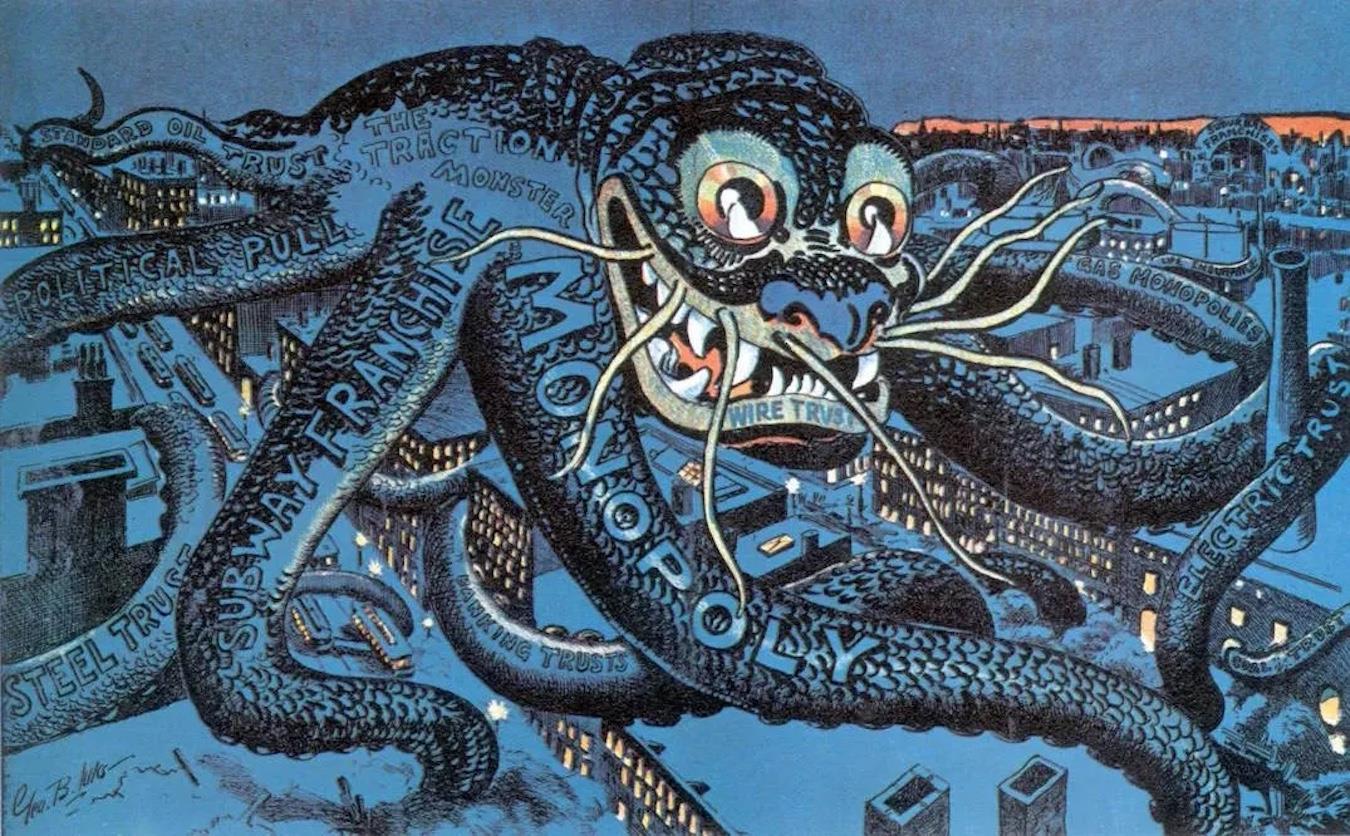
How I Learned To Stop Worrying And Love American Monopolies
(MENAFN- Asia Times)
For many years, I was a big proponent of the idea that increased market power was harming the US economy in various ways. In the 2010s, in the economics world, circumstantial evidence began to pile up, implicating increased industrial concentration as the culprit behind a variety of recent negative trends.
Here's what I wrote in 2017, after reading a bunch of that evidence:
Some of this is micro evidence, demonstrating some of the pieces of the causal chain that some economists think leads from lax antitrust to bad economic outcomes. The Azar et al. (2017) paper shows that labor market concentration hurts wages. The Blonigen and Pierce (2016) paper shows that mergers raise prices.
The rest is macro evidence and macro theory. Economists see some trend in the economy - a lower labor share of national income, or decreased business investment, or fewer new companies being formed - and they think about whether something like monopoly power could explain those trends.
Just because a single story can explain the trends, of course, doesn't mean it does. Ultimately, you need a whole lot of micro evidence - not just a few papers - to prove each link in the chain of causality from weak antitrust enforcement to higher prices, lower output, lower wages, and so on.
But in this case, the market power explanation was very tantalizing, because it had the power to explain so many of 21st-century America's dysfunctions at the same time.
This is why at Bloomberg, I wrote consistently in support of the idea that market power was making the American economy both less efficient and more unequal, and that stronger antitrust enforcement was a good solution to try. (However, I did note that antitrust wasn't guaranteed to be a remedy, and that Big Tech companies were a bad target for antitrust enforcement.)
When Biden was elected, I was optimistic. His appointment of people like Lina Khan showed that antitrust was finally being taken seriously in Democratic Party circles. Finally, it seemed, the growing clamor of economists was going to result in some real efforts at reform.
In that post, I revisited some of the important recent papers about market power, and I also noted that prominent economists were increasingly putting their reputations on the line by writing popular books advancing the thesis that market power was hurting our economy:
I concluded that the Biden administration's shift toward antitrust was a healthy example of ideas making their way from academic economics to the halls of power:
I wasn't always happy with the Biden administration's antitrust actions - the government lost most of its cases against Big Tech, and the vendetta against Meta seemed misplaced.
But overall, a lot of action seemed to be happening in the prosaic, boring sectors of the economy where market power has probably been eroding the foundations of capitalism for years.
In meat processing (multiple times ), in publishing, in insurance brokering, in pharma, in medical care provision, and so on, Biden's Federal Trade Commission (FTC) and Department of Justice (DOJ) notched up real wins - not enough to reverse the US economy's trend toward greater concentration, but possibly enough to create a“chilling effect” that would restrain the trend toward megacorporations-in-everything.
And yet over the last couple of years, I've had increasingly serious doubts about the antimonopoly movement. I'm still concerned about corporate power itself - in fact, in many ways, I'm more concerned than I was a decade ago, because of the advent of AI and the unprecedented corruption of the Trump administration.
But I'm increasingly unenthusiastic about the ability of the antimonopoly movement, as it currently exists in the Democratic Party, to make useful headway in curbing or balancing corporate power. Antimonopoly is simply too important to leave to the antimonopolists.
Antimonopoly should be a tool, not an obsessionSpeaking about Milton Friedman, Robert Solow once quipped:“Everything reminds Milton of the money supply. Well, everything reminds me of sex, but I keep it out of the paper.” I am starting to feel that way about the antimonopoly folks.
Jonathan Chait has a long and very damning article about the antimonopoly movement, focusing on its crusading founder, the former journalist Barry C. Lynn.
Until I read Chait's article, I had never even heard of Lynn; this demonstrates that I'm very much out of the loop when it comes to D.C. policymaking and thought leadership, but it also shows how Lynn has escaped scrutiny compared to more popular figures like Lina Khan, Elizabeth Warren, and Matt Stoller.
In any case, from Chait's description of Lynn, he is not the type of person whose movement I would want to follow. First of all, he seems monomaniacally obsessed with monopoly power:
This monomania is obviously just silly. A lot of these links are just incredibly tenuous, requiring heroic leaps of assumptions about society, politics, culture, and economics. If you want to say that corporate concentration is responsible for racism, for example, you have to believe that:
-
racism has risen recently (highly doubtful )
the rise in racism, if it exists, is caused by economic factors (doubtful)
those economic factors are primarily - not just slightly - due to corporate concentration (highly doubtful)
Even the economics papers that find measurable effects of corporate concentration on low wages, for example, find that the effect differs enormously by geographic location.
If monopsony power is responsible for low wages, then minimum wages should increase employment rather than decreasing it; in some areas, this does seem to happen, while in other areas minimum wages decrease employment, consistent with a greater amount of competition in the latter areas.
Furthermore, several credible research teams - Rossi-Hansberg et al. (2021), Rinz (2022), Autor et al. (2023) and others - have found that employer concentration has actually decreased in local markets in recent decades. This means that not just racism, but any social ill that Barry C. Lynn and his followers want to ascribe to labor monopsony, should have decreased over that period.
Another example is inflation. Antimonopoly crusaders like Elizabeth Warren were quick to blame corporate greed for inflation in 2021-22. There was extremely little data to back this up. Here's what I wrote at the time:
These are just two examples of the shaky chain of reasoning and evidence that backs up expansive claims like Lynn's. There are many more, if you want to go looking for them. More sober antitrust types absolutely know that monopoly power is not a Grand Theory of Everything Bad in America. From Chait's article:
This is good. But this reasonable, moderate perspective doesn't seem to be what's animating the modern antimonopoly movement. Chait details a telling exchange between Ezra Klein and Zephyr Teachout:
Admittedly, these are words, and not actions. Chait may have also cherry-picked them from among antimonopoly movement leaders' more reasonable statements, in order to make his point.
But when you look at the movement's actual actions, you can clearly see the obsessive, all-encompassing nature of the belief system. For example, consider the movement's choice of targets. These include some industries with high profit margins, but also some with very low margins.
These include grocery stores, airlines and health insurers. Grocery stores and health insurers both consistently have much lower profit margins than American corporations in general, often hovering near the zero mark. Airlines are a cyclical industry that sometimes sees some very profitable years, but generally hovers below the average:
The causal chain that runs from weak antitrust to all sorts of social harms necessarily runs through profits. If companies aren't making profit, they aren't controlling the market.
Latest stories South Korean Starbucks probe: arbitrary power in justice's name War heats up as Russia, Ukraine trade drone and missile attacks Beijing vows to retaliate as EU warns of China Shock 2.0Yet Elizabeth Warren blamed high food prices on grocery stores' market power during the post-pandemic inflation, despite the fact that these stores make very little profit, and their margins actually declined as inflation accelerated. You could see that exact same misplaced focus in Lina Khan's blockage of the Kroger/Albertsons merger.
As for airlines, the Biden administration's blockage of the Spirit/JetBlue merger resulted in Spirit Airlines simply going out of business entirely. Corporate concentration was achieved after all - but it was achieved with disorder, corporate failure, and 17,000 unemployed workers rather than with an orderly merger that would have preserved some of Spirit's routes and workers.
Not exactly a resounding success for the antimonopoly movement - but that's what happens when you try to use antitrust tools against companies in low-margin industries.
Then there's the case of housing. The antimonopoly people have eagerly embraced the idea that corporate landlords buying up rental properties and jacking up the price is a major cause of high rent.
Democrats and Republicans have both embraced this piece of“slopulism”, despite the fact that the percent of homes owned by corporate landlords is tiny and there's some evidence showing that corporate landlords tend to charge lower rents. Supply constraints - failure to build more housing - is actually the reason for high rents, so the antimonopoly movement is distracting us from solving the real problem.
The movement's obsessive monomania - its conviction that corporate concentration is the root of all of America's problems - is causing it to pick the wrong targets and hurt workers. That doesn't mean bigger corporations are better, or that there aren't industries where we need stronger antitrust.
But the antimonopolists' totalizing obsession causes them to ignore the evidence of where and when their ideas are needed, because they assume that their ideas are always the top priority in every situation and should be applied in a blanket way to any target they choose.
The science on monopoly power isn't settledRichard Feynman once said of science that“Of all its many values, the greatest must be the freedom to doubt.” Now you can respond that economics and politics aren't“science”, but that makes the freedom to doubt even more important; the less conclusively that any one data set can answer your questions, the more important it is to look at a wide variety of data sets and consider a variety of explanations and theories.
From Jonathan Chait's description of Barry C. Lynn, he doesn't seem like the kind of guy who's inclined to look at evidence that goes against his ideas:
Lina Khan has also written that“There are no such things as market 'forces'.” Statements like this certainly don't do much to refute Chait's allegation that the antimonopoly belief system“is more like a religion than an economic theory.”
First of all, as an aside, we should consider what it would mean for market forces not to exist and prices to be determined by politics. It would mean that grocery stores carefully calculate exactly how much they can charge for a cucumber or a package of napkins without Senators giving them an angry call or the working class rioting, or something like that.
That's kind of preposterous. It would also mean that small businesses would charge lower prices, because they're less politically powerful than big businesses. But in fact, it's big businesses that charge lower prices for the same goods. So the“prices are determined by politics” idea is just abjectly ridiculous, except maybe in a few special cases or where explicit regulation is involved.
But more to the point: Market forces obviously do exist. When you include sales taxes on price tags - reminding people that prices are higher than they had thought - they buy less, proving that demand curves exist and slope downward. When there is bad weather at sea, the price of fish goes up. When you charge electricity customers more, they use less electricity.
And so on. Market forces are not easy to observe in all cases, and they're not always the most important determinant of prices. But their existence has been proven so thoroughly, by so much careful empirical observation, that to deny their existence requires a deep level of mysticism and blind faith.
If you're not the kind of person to believe in empirical economics, then of course you're not going to care if economists find evidence against your worldview. But once we move out of the realm of willful faith-based belief and into the real world of evidence and observation, we find that the science on monopoly power is far from settled.
First of all, there is the evidence I cited before about decreasing concentration in local labor markets (even as concentration increases nationwide). The monopsony wage penalty might be very high, but it was probably even higher in the past; this leaves room for antitrust action to help workers, but it should make us question whether monopoly power is at the root of slow wage growth.
But more fundamentally, the entire story about creeping market power being responsible for a bunch of different ills in the modern American economy is under serious dispute.
For example, the whole story about monopoly power increasing in recent decades relies on the idea that price markups have increased - if companies can't charge higher prices relative to their costs, they must not be very powerful.
Economists like De Loecker and Eeckhout find that markups have increased a lot, but there are plenty of economists who disagree with that finding! There are tons of measurement issues involved in trying to estimate markups across the whole economy. Some economists claim that essentially the entire increase in markups is due to the finance sector.
There are plenty of other pieces of the monopoly power story that are also disputed. Shapiro and Yurukoglu (2024) summarize a bunch of these. It's hard to define what each“market” is over time, because the boundaries of the categories are arbitrary, and the nature of products themselves keeps changing.
It's hard to choose the region over which local concentration should be measured (when is one store in the same“market” as another?). Companies' costs are hard to measure for many reasons - for example, companies sell lots of different things, and researchers don't necessarily have the data to determine which costs are for which products.
Profits are hard to measure because the cost of risk is hard to assess. And so on. In general, choosing a different set of assumptions can get you wildly different results regarding how much monopoly power has actually risen in America.
The point here is not that De Loecker and Eeckhout, or the other economists who concluded in the 2010s that monopoly power is a big deal, were wrong. Maybe they were, maybe they weren't. Nor should you conclude that economics is just a game of“he said, she said” where everyone contradicts each other and nobody really knows anything.
The correct takeaway here is that these questions are very subtle and difficult, and the most careful, serious researchers will take a long time to hash out the correct answer. In the meantime, we must live with uncertainty.
A big problem with the antimonopoly crusaders is that they don't just refuse to live with uncertainty - they insist that you don't live with uncertainty either. If you say,“Hey dudes, maybe corporate landlords actually lower rents”, they won't debate the finer points of causal estimation with you - they'll simply label you as a corporate shill and dismiss you.
Don't let the factionalists winIt's this last bit - the anathematization of anyone who disagrees with them - that really warns me away from the antimonopoly movement. Chait describes in his article how anyone who tries to buck the antimonopoly people gets accused of being a paid corporate hack:
This tactic was clearly on display when the antimonopoly people leapt to savage Ezra Klein and Derek Thompson's book“Abundance.” Matt Stoller wrote a post entitled“An Abundance of Sleaze: How a Beltway Brain Trust Sells Oligarchy to Liberals.” Dylan Gyauch-Lewis[1] called the Abundance movement
“The new centrist push to regain control of the Democratic Party, with corporate money.” Barry C. Lynn said that Abundance wants“to cozy up to good oligarchs, so they can shelter us until the MAGA storm blows over.”
First of all, claiming that anyone who disagrees with your ideas must be on the payroll of nefarious forces is blatant intellectual dishonesty. It also signals how weak your argument is if you have to accuse every critic of being a bad actor.
But beyond that, the antimonopoly crusaders' reaction to“Abundance” shows how utterly factionalist they are. They could have simply said,“Yes, we want abundance too. Guess how you get abundance? By breaking up monopolies!”
Or something like that. They could have easily tried to co-opt the energy behind“Abundance” and treated Ezra Klein and Derek Thompson as potential allies. Instead, they leapt instantly to the attack with maximum savagery.
This is the behavior of factionalists, for whom ideas and policy are less important than building power for a clique of favored allies and fellow-travelers within the Democratic Party.
Klein and Thompson were a threat not because their ideas contradicted those of the antimonopoly clique, but simply because they were not beholden to the patronage or the intellectual legacy of that clique. They were not on the team, so they were the enemy.
In my view, it is very dangerous for any political party to allow itself to be entered and captured by a clique or faction like this. I've spent a long time being very favorable to the ideas being put forward by the antimonopoly people, but their behavior with regards to the Abundance liberals - and the shoddy reasoning, baseless accusations, and backroom arm-twisting that they employ in these debates - has given me what the Zoomers call“the ick.”
A problem with economic policy is that it is very vulnerable to intellectual pseudo-cults. Economics research is very hard to understand, isn't always useful, and rarely offers clear-cut answers.
So policymakers and writers seeking certainty and a reason for decisiveness often fall victim to charismatic gangs of intellectuals who claim that economics is solved and that they have it all figured out. On the GOP side, these include the“supply-siders” in the 1980s and the“national conservatives” today. On the Democratic side, it includes the Modern Monetary Theory (MMT) people.
But MMT failed - essentially no one listens to people who say infinite deficits are good. The antimonopoly faction, on the other hand, appears to have succeeded in winning enormous power and prestige within an increasingly epistemically closed progressive movement.
Elizabeth Warren was basically a one-woman Organization Department[2] for the Biden administration, popular Democrats like AOC are going around claiming that“market power” is what produces billionaires, and every major progressive publication now platforms the antimonopoly people's intellectual output.
Given my writings about the problems of corporate power in the past - and my fear of the overwhelming power that AI companies might achieve - it would be relatively easy for me to join this movement. But I can't, because monomaniacal obsession, epistemic closure, anti-empiricism, and intense factionalism are the kinds of things I just can't sign on to.
Corporate power is a real problem in our society. But we need more reasonable programs and more reasonable people to fight it effectively. Banning corporate landlords, calling for price controls, attacking the grocery store industry, forcing airlines out of business and making accusations against anyone who calls for deregulation of housing supply are just signs of an approach that's going to lead nowhere good.
Notes1 When I had GPT proofread this post before publication, it flagged the name“Dylan Gyauch-Lewis”, but its only comment was:“This unusual spelling appears to be correct.”
2 This is quite a compliment!
This article was first published on Noah Smith's Noahpinion Substack and is republished with kind permission. Become a Noahopinion subscriber here.
Thank you for registering!
Sign up for one of our free newsletters-
The Daily Report
Start your day right with Asia Times' top stories
AT Weekly Report
A weekly roundup of Asia Times' most-read stories
-
Share on X (Opens in new window)
Share on LinkedIn (Opens in new window)
LinkedI
Share on Facebook (Opens in new window)
Faceboo
Share on WhatsApp (Opens in new window)
WhatsAp
Share on Reddit (Opens in new window)
Reddi
Email a link to a friend (Opens in new window)
Emai
Print (Opens in new window)
Prin

Legal Disclaimer:
MENAFN provides the
information “as is” without warranty of any kind. We do not accept
any responsibility or liability for the accuracy, content, images,
videos, licenses, completeness, legality, or reliability of the information
contained in this article. If you have any complaints or copyright
issues related to this article, kindly contact the provider above.
Most popular stories
Market Research

More Story








Comments
No comment