




403
Sorry!!
Error! We're sorry, but the page you were looking for doesn't exist.
Amla Extract Market Size, Share, Growth, Analysis, Report, 2034
| Market Metric | Details & Data (2025-2034) |
|---|---|
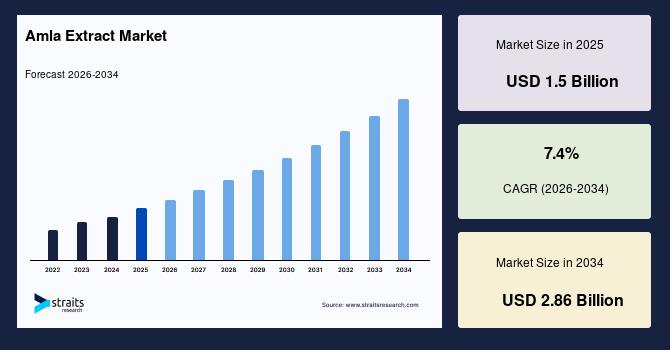
| 2025 Market Valuation | USD 1.5 Billion |
| Estimated 2026 Value | USD 1.61 Billion |
| Projected 2034 Value | USD 2.86 Billion |
| CAGR (2026-2034) | 7.4% |
| Study Period | 2022-2034 |
| Dominant Region | North America |
| Fastest Growing Region | Asia Pacific |
| Key Market Players | Biomax Life Sciences Limited, Taiyo International, Arjuna Natural, Patanjali Ayurveda Limited, Dabur |
Download Free Sample Report to Get Detailed Insights.
Amla Extract Market Dynamics Market DriversRising Health Consciousness and Preventive Healthcare Trends
Consumers are shifting toward preventive healthcare to enhance immunity, digestion, and overall wellness, which is driving demand for Amla Extract in dietary supplements and functional foods. With increasing incidences of lifestyle-related illnesses, consumers are adopting health-enhancing superfoods that support long-term well-being.
-
For instance, according to the 2024 report of the Nutrition Business Journal, global health-conscious consumers increased their spending on natural supplements by 15%. This shift has been reflected in the growing popularity of Amla-based immunity shots, superfood blends, and collagen-enhancing powders infused with Amla.
Companies like Arjuna Natural and Ambe PhytoExtracts Pvt. Ltd. have been actively developing Amla-based anti-inflammatory extracts that may be used to treat conditions such as arthritis and joint pain, further expanding Amla's functional applications. Amla's adaptogenic and detoxifying properties also draw the attention of athletes and wellness influencers, broaden its audience base, and reinforce its role in modern nutritional strategies.
Government Initiatives Promoting Herbal and Ayurvedic Medicine
Various governments promote traditional medicine and herbal healthcare through funding, policy support, and dedicated research initiatives, particularly in India and China. These programs aim to enhance the global recognition of indigenous healing systems and ensure quality standards in herbal formulations.
-
For example, the Indian government's Ministry of AYUSH has taken multiple initiatives toward integrating AYUSH systems of medicine, including Ayurveda, with Allopathic medicine. In 2024, the ministry allocated $500 million to Ayurveda-based startups and herbal medicine R&D projects, significantly boosting the commercialization of Amla extracts.
Similarly, China's National Administration of Traditional Chinese Medicine has included Amla in new herbal formulations for lung health and metabolic support, fostering collaborations between TCM practitioners and pharmaceutical companies like Tong Ren Tang and Yunnan Baiyao.
Furthermore, ASEAN countries are establishing regulatory frameworks to ease import/export processes for Ayurvedic and herbal products, paving the way for a more interconnected global herbal supplement trade.
Market RestraintsHigh Production Costs for Organic Amla Extract
Organic Amla farming requires stringent quality control, pesticide-free cultivation, and third-party certification, resulting in higher production costs. The need for skilled labor, careful post-harvest handling, and eco-friendly processing methods further adds to the expense. These factors make organic Amla Extract significantly more expensive, limiting its accessibility among price-sensitive consumer segments in emerging markets. In 2024, India's Organic Products Exporters Association highlighted a 20% increase in organic Amla farming costs due to stricter pesticide regulations and higher labor expenses.
Despite this, premium organic brands like Organic India and Gaia Herbs have expanded their offerings, banking on the growing willingness of consumers to pay extra for certified organic products. Additionally, supply chain inefficiencies, limited mechanization, and seasonality of Amla cultivation contribute to inconsistencies in supply and pricing, posing challenges for large-scale manufacturers aiming for steady output and cost control.
Market OpportunitiesProduct Innovation and New Formulations
Introducing new product formats such as Amla-infused protein powders, effervescent tablets, and probiotic blends can attract diverse consumer segments, including athletes, vegans, and aging populations. Companies can invest in research and development (R&D) to enhance bioavailability and combine Amla with complementary ingredients to create multifunctional products targeting immunity, skin health, metabolism, and mental clarity.
-
For instance, in February 2025, Nestlé Health Science and PepsiCo's Tropicana launched fortified Amla-based functional beverages designed to boost immunity and skin health, capitalizing on the growing consumer demand for functional and nutritious drinks. These beverages include added collagen peptides, biotin, and electrolytes, offering a convenient wellness solution.
Additionally, startups in the wellness and food tech space are exploring applications of Amla in plant-based desserts, chewables, and even adaptogenic coffees. This innovation-driven market landscape presents vast opportunities for differentiation and premiumization in the global Amla Extract industry.
Regional Insights North America: Dominant Region with 24.6% Market ShareNorth America's amla extract market is expanding due to growing consumer awareness regarding natural and nutrient-rich ingredients. The rising preference for preventive healthcare and functional supplements has increased the demand for Amla Extract in nutritional supplements, immunity boosters, and cardiovascular wellness products. Consumers in the U.S. and Canada increasingly incorporate Amla-based products into their diets, particularly in immune support blends, herbal supplements, and functional beverages. The expanding organic and clean-label movement further reinforces market growth as brands emphasize transparency in sourcing and production methods. Furthermore, partnerships between health and wellness brands and Ayurveda-based manufacturers fuel the region's market growth.
The U.S. market has grown substantially due to rising consumer preference for natural and herbal remedies. Increased interest in Ayurveda and holistic health has fueled demand for Amla-based dietary supplements and herbal medicines. The trend of plant-based wellness and botanical skincare in the U.S. has further supported Amla Extract's inclusion in beauty, wellness, and pharmaceutical products. As a result, major nutraceutical brands are launching innovative formulations, such as chewable tablets, effervescent powders, and functional beverages, catering to diverse consumer preferences.
Asia-Pacific: Fastest-Growing RegionAsia-Pacific holds the largest share of the Amla Extract market, driven by the long-standing use of Amla in traditional medicine, particularly Ayurveda. The region's strong demand is further supported by increasing awareness of Amla's benefits, including improved immunity, digestive health, and skin and hair nourishment. Countries like India and China lead in Amla cultivation and processing, with many startups and established players innovating new product formats. Additionally, the surge in e-commerce and digital health trends in markets like Japan, South Korea, and Southeast Asia has contributed to Amla Extract's accessibility and popularity among urban consumers. The rising disposable income of consumers in emerging economies has also increased spending on herbal and plant-based dietary supplements.
Powdered Amla Extract is highly sought after in Japan due to its ease of use and long shelf life. The preference for organic and chemical-free products aligns with Japan's culture of health and eco-consciousness. With the rising demand for anti-aging and collagen-boosting skincare, Amla Extract is now featured in several high-end beauty formulations, including serums and facial masks.
The Indian market is driven by the increasing consumption of dietary supplements and natural beauty products. Companies like Dabur and Patanjali leverage this trend by expanding their Amla-based product portfolios, including juices, tablets, oils, and skincare formulations. The increasing focus on Ayurvedic healthcare and government initiatives promoting traditional medicine practices have further contributed to the robust growth of Amla Extract demand in the country.
Europe Amla Extract Market TrendsEurope accounts for 21.3% of the global market share, with strong demand for natural, organic, and plant-based products in food, beverages, cosmetics, and supplements. Amla Extract aligns well with the region's preference for sustainable and clean-label products. Increasing awareness about Ayurveda and traditional herbal medicine in European countries has propelled market expansion. Additionally, regulatory support for botanical-based supplements has encouraged wider adoption across multiple industries, including food, pharma, and beauty.
The German market is seeing increasing demand for Ayurvedic and traditional medicines, supporting the growth of Amla Extract-based products. Consumers seeking holistic wellness solutions are driving its adoption in supplements and functional foods. German manufacturers are incorporating Amla into innovative formulations, including probiotic drinks, organic energy bars, and herbal teas.
Interest in natural and Ayurvedic medicine is fueling Amla Extract's growth in Brazil. It is widely used in beauty and skincare formulations due to its anti-aging and hair-nourishing properties. Its detoxifying and digestive benefits are also gaining popularity among health-conscious Brazilian consumers. The surge in demand for superfoods and botanical ingredients has led to a growing number of Amla-based dietary supplements entering the market.
Amla Extract Market Segmentation Analysis By Product TypeCapsules and tablets, mainly standardized extract and herbal blend capsules, dominate the market due to their convenience, standardized dosage, and ease of consumption. They appeal to health-conscious consumers seeking an effortless way to incorporate Amla Extract into their daily routine. Finally, oil-based Amla Extract products, including cold-pressed and refined oils, are widely used for hair and skin nourishment in the beauty and wellness industry.
By ApplicationDietary supplements lead the market due to rising consumer awareness regarding immunity, digestion, and overall well-being. Amla-based supplements are extensively used for weight management, skin health, and anti-aging benefits. With the increased focus on preventive healthcare and natural nutrition, Amla Extract has gained prominence in formulations targeting cardiovascular support, detoxification, and stress management. Amla Extract is widely incorporated into juices, herbal teas, energy bars, and fortified snacks in the food and beverage sector, enhancing their functional benefits.
By SourceOrganic Amla Extracts are certified organic and produced without artificial chemicals, pesticides, or genetically modified organisms (GMOs). The increasing demand for clean-label, sustainable, and eco-friendly products has driven the preference for organic extracts, particularly in high-end cosmetics, nutraceuticals, and functional foods. Consumers seeking natural and non-toxic skincare and dietary supplements prefer organic Amla due to its purity and ethical sourcing.
List of Key and Emerging Players in Amla Extract Market-
Biomax Life Sciences Limited
Taiyo International
Arjuna Natural
Patanjali Ayurveda Limited
Dabur
Archerchem
SYDLER
RiSun Bio-Tech Inc
Ambe PhytoExtracts Pvt. Ltd.
Herbeno Herbals
Bhumi Amla
-
July 2024- Dabur expects a consumption uptick in FY25, with power brands to drive growth. Dabur's 75 percent business comes from domestic businesses like Dabur Amla.
In 2024- Bhumi Amla has upped the production level of organic Amla Extracts in 2024. In addition, the company has employed more environment-friendly and geographical expansion processes to cater to the increasing demand from other parts of the world.
As per our analyst, the global amla extract market is poised for significant growth, driven by rising health consciousness, increasing demand for natural supplements, and expanding applications across various industries. While challenges such as production costs, regulatory hurdles, and supply chain fluctuations persist, opportunities in emerging markets, product innovation, and technological advancements present promising avenues for expansion. Companies focusing on quality, sustainability, and consumer education will be well-positioned to capitalize on the growing demand for Amla Extract worldwide.
Report Scope| Report Metric | Details |
|---|---|
| Market Size in 2025 | USD 1.5 Billion |
| Market Size in 2026 | USD 1.61 Billion |
| Market Size in 2034 | USD 2.86 Billion |
| CAGR | 7.4% (2026-2034) |
| Base Year for Estimation | 2025 |
| Historical Data | 2022-2024 |
| Forecast Period | 2026-2034 |
| Report Coverage | Revenue Forecast, Competitive Landscape, Growth Factors, Environment & Regulatory Landscape and Trends |
| Segments Covered | By Product Type, By Application, By Source, By Distribution Channel |
| Geographies Covered | North America, Europe, APAC, Middle East and Africa, LATAM |
| Countries Covered | US, Canada, UK, Germany, France, Spain, Italy, Russia, Nordic, Benelux, China, Korea, Japan, India, Australia, Taiwan, South East Asia, UAE, Turkey, Saudi Arabia, South Africa, Egypt, Nigeria, Brazil, Mexico, Argentina, Chile, Colombia |
Download Free Sample Report to Get Detailed Insights.
Amla Extract Market Segments By Product Type-
Powder
-
Fine powder
Coarse powder
-
Concentrated liquid
Ready-to-use liquid
-
Standardized Extract capsules
Herbal blend capsules
-
Cold-pressed oil
Refined oil
-
Food and Beverages
-
Juices and Beverages
Functional foods (e.g., energy bars, fortified snacks)
Sauces, Dressings, and Seasonings
-
Skin care products (creams, lotions, serums)
Hair care products (shampoos, conditioners, oils)
Anti-aging and anti-wrinkle products
-
Herbal medicines
Traditional medicine formulations
Prescription-based remedies (Vitamin C supplements)
-
Immunity-boosting supplements
Weight management supplements
Anti-aging supplements
-
Organic
-
Certified organic amla Extracts
Non-GMO and pesticide-free Extracts
-
Non-organic but sustainably sourced amla
Traditional farming methods
-
Online Retail
-
E-commerce platforms (Amazon, eBay, etc.)
Specialized herbal product websites
Direct-to-consumer brands (via brand websites)
-
Supermarkets and Hypermarkets
Specialty stores (health stores, organic food stores)
Pharmacies and drug stores
-
Direct sales to manufacturers (B2B sales)
Herbal and wellness product distributors
-
North America
Europe
APAC
Middle East and Africa
LATAM

Legal Disclaimer:
MENAFN provides the
information “as is” without warranty of any kind. We do not accept
any responsibility or liability for the accuracy, content, images,
videos, licenses, completeness, legality, or reliability of the information
contained in this article. If you have any complaints or copyright
issues related to this article, kindly contact the provider above.
Most popular stories
Market Research

More Story








Comments
No comment