




403
Sorry!!
Error! We're sorry, but the page you were looking for doesn't exist.
Blood Grouping Reagents Market Size, Share, Growth, Analysis, 2034
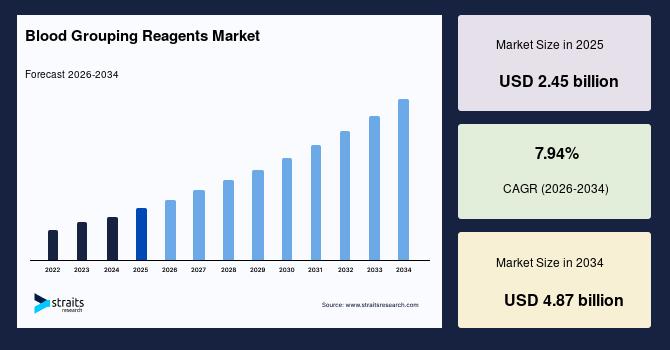
| Market Metric | Details & Data (2025-2034) |
|---|---|
| 2025 Market Valuation | USD 2.45 billion |
| Estimated 2026 Value | USD 2.64 billion |
| Projected 2034 Value | USD 4.87 billion |
| CAGR (2026-2034) | 7.94% |
| Study Period | 2022-2034 |
| Dominant Region | North America |
| Fastest Growing Region | Asia Pacific |
| Key Market Players | Merck KGaA, Bio-Rad Laboratories, Inc, Novacyt Group, Beckman Coulter, Inc, Haemokinesis Pty Ltd |
Download Free Sample Report to Get Detailed Insights.
Blood Grouping Reagents Market Growth Factors Growing Prevalence of Chronic DisordersThe rising incidence of chronic disorders drives the need for effective treatments. In conjunction with the COVID-19 pandemic, chronic illnesses such as anemia, hemophilia, lymphoma, diabetes, and leukemia impose significant societal and healthcare costs. As per the Centers for Disease Control and Prevention, six out of ten adults suffer from chronic disease, while four out of ten suffer from more than two chronic diseases in 2019. The data demonstrate the escalating disease burden and their effective management.
Furthermore, the WHO reports that anemia affects more than 1.62 billion people worldwide, or approximately 24.8% of the global population. Anemia is also prevalent among women of reproductive age due to iron deficiency. Anemia is prevalent among women aged 15 to 49. According to the WHO, 29.9% of women aged 15 to 49 had anemia in 2019. Additionally, 39.8% of children aged 6 to 59 months suffered from anemia in 2019. Thus, the surging prevalence of chronic illnesses, specifically those associated with blood, is expected to boost market growth over the forecast period.
Increase in Blood DonationThere has been an increase in the global blood donation rate due to increased public awareness of the significance of blood donation. Patients requiring blood transfusions for treatment, such as those with severe anemia, liver and kidney disease leading to anemia, and Hemophilia, are associated with increased donation rates. There is an increasing global recognition of the possible advantages associated with blood donation.
Donating blood is also known to improve donors' mental and physical health by reducing tension, enhancing emotional well-being, and reducing the risk of heart disease and heart attack while replenishing blood cells. Due to these factors, more people donate blood at hospitals, clinics, and blood banks to help save the lives of those requiring transfusions. As a result, the demand for blood component products, including reagents, is increasing among end-users such as hospitals, clinics, and blood banks.
Market Restraining Factors Concerns regarding the Effectiveness and Precision of Test KitsThe demand for blood grouping reagent test kits increased during the COVID-19 epidemic. The rising demand for blood typing kits, RT-PCR test kits, and serology test kits drives up the sales of market participants. However, numerous complaints were lodged during the pandemic about the inaccuracy of the rapid test kits' test results. Urgent demand for test devices on a large scale could have compromised the product's quality. The government authority also mandated serological testing in the identified regions with highly exposed populations to coronavirus. Such factors restrict market growth.
Market Opportunity Advent of Automated Blood Grouping DevicesPopulation growth and an increase in the number of blood grouping diagnostics have created a demand for automated blood grouping devices. The automated systems can conduct many tests with a single input, improving efficiency and productivity within the specified time frame. These devices are programmed to conduct high precision and consistency tests while preventing sample contamination.
In addition, market participants offer fully automated blood typing devices with remote access capabilities for improved monitoring and result validation. This equipment has features such as tube size and diameter recognition, an integrated quality control program, random sample placement, real-time reagent and sample status information, and high-definition color results. Such benefits provided by automated blood grouping devices are expected to provide market growth opportunities.
Regional Insights North America: Dominant Region with A Significant Market ShareNorth America is the most significant global blood grouping reagents market shareholder and is expected to expand substantially over the forecast period. Numerous factors have contributed to the increasing prevalence of blood grouping reagents in North America. The market for blood grouping reagents in North America is anticipated to expand in the coming years because of the prevalence of chronic diseases, an aging population, and the number of surgical procedures. This necessitates using blood grouping reagents for accurate blood grouping and cross-matching. In addition, the rising need for blood transfusions across the region can be linked to the rising demand for blood grouping reagents. For instance, according to givingblood, 4.5 million Americans will require blood transfusions annually by 2023. In the United States and Canada, 43,000 pints of donated blood are utilized daily.
Furthermore, North America is renowned for its advanced healthcare systems and technological advancements. Automated blood typing systems and point-of-care diagnostic devices, which require compatible blood grouping reagents, have been adopted in the region. These advancements enhance efficiency, accuracy, and patient outcomes. Collaborations and partnerships between blood banks, healthcare providers, and manufacturers of blood classification reagents have also emerged in North America. These collaborations seek to improve the research, development, and adoption of advanced blood grouping reagents, accelerating market expansion. For instance, Bio-Rad Laboratories announced a partnership with Seegene in 2021 to manufacture and market molecular diagnostic instruments for infectious diseases.
Asia-Pacific: Fastest Growing RegionThe Asia-Pacific market is anticipated to experience a significant growth pace due to the rise in the prevalence and incidence of chronic disorders in Asian nations. Asia-Pacific is predicted to have the quickest expansion rate for the blood grouping reagents market. The expansion of this market is being driven by rising public awareness of blood donation, government efforts, and rising demand for blood banking services. The tenth largest cause of death worldwide is car accidents.
Additionally, the rising number of traumatic injuries from accidents and other trauma in the area is one of the major reasons influencing the market's expansion. India had one of the highest rates of road accidents in the world in 2019, with around 500,000 incidents, resulting in 150,000 fatalities and 300,000 permanent disabilities. According to figures from the transport ministry, there were 467,044 registered road accidents in India in 2018, up 0.5% from 464,910 in 2017. Similarly, the National Bureau of Statistics of China reported 63,194 fatal road accidents in 2018. The need for blood grouping reagents in the region is expected to rise due to the high number of traffic accidents that result in severe injuries.
Segmentation Analysis By ProductThe global market is segmented into consumables, instruments, software & services.
Consumables, including reagents and test kits, dominate the blood grouping reagents market due to their essential role in blood grouping tests. These consumables are critical for determining an individual's blood type and compatibility for transfusions and transplants. Manufacturers like Bio-Rad Laboratories, Inc., Grifols, and Immucor, Inc., are key players in providing consumables for blood grouping tests. For example, Bio-Rad Laboratories offers a wide range of blood typing reagents and kits, including its IH-Combi Plex range, known for its reliability and accuracy. The dominance of consumables is supported by the consistent demand for these products in healthcare settings worldwide.
By TechniqueThe global market is segmented into PCR-based and microarray techniques, assay-based techniques, massively parallel sequencing techniques, serology, and other techniques.
PCR-based and microarray techniques are dominant in the blood grouping reagents market due to their high sensitivity and specificity in detecting blood group antigens and antibodies. These techniques allow for the rapid and accurate typing of blood samples, making them invaluable in blood transfusion services and transplantation. Manufacturers like Grifols, Bio-Rad Laboratories, and Ortho Clinical Diagnostics offer PCR-based and microarray techniques for blood grouping. For instance, Ortho Clinical Diagnostics' ORTHO BioVue System is known for its high-throughput capabilities and accuracy in blood typing. The dominance of PCR-based and microarray techniques is supported by their widespread adoption in clinical laboratories and blood banks worldwide.
By Test TypeThe global market is segmented into blood group and phenotype, antibody screening, cross-matching tests, antibody identification, Coombs tests, and antigen typing.
Antibody screening is a dominant test type in the blood grouping reagents market, as it plays a crucial role in detecting unexpected antibodies that can cause adverse reactions during blood transfusions. Manufacturers like Immucor, Inc., Bio-Rad Laboratories, and Quotient Limited offer a range of reagents and kits for antibody screening tests. For example, Immucor's Capture-R Ready-Screen Kit is widely used for its efficiency in detecting unexpected antibodies. The dominance of antibody screening is supported by its importance in ensuring safe and compatible blood transfusions, making it a standard practice in blood banks and clinical laboratories worldwide.
By End UserThe global market is segmented into hospitals and blood banks, clinical laboratories, and academic and research institutes.
Hospitals are the dominant end-users of blood grouping reagents due to the high volume of blood grouping tests performed in hospital settings, particularly for patients requiring transfusions and surgeries. The Centers for Disease Control and Prevention (CDC) report highlights that the hospitals perform a significant number of blood transfusions annually, showcasing the importance of blood grouping tests in these settings. Manufacturers often tailor their products to meet the specific needs of hospitals, offering reliable and efficient reagents and instruments.
-
For instance, Grifols provides hospitals with its Erytra and DG Gel systems, known for their accuracy and ease of use in blood typing. The dominance of hospitals as end-users is supported by their role as major healthcare providers and the central hub for blood transfusion services.
-
Merck KGaA
Bio-Rad Laboratories, Inc
Novacyt Group
Beckman Coulter, Inc
Haemokinesis Pty Ltd
Rapid Labs Ltd
Cardinal Health
Thermo Fisher Scientific Inc.
Diagast
Atlas Medical
Alba Bioscience Limited
PerkinElmer
Lorne Laboratories Limited
BAG Diagnostics
Biorex Diagnostic
-
July 2023- Quanterix Corporation, a business fueling scientific discovery and breakthrough diagnostics through ultrasensitive biomarker detection, announced the launch of LucentAD, a test designed to aid in evaluating patients exhibiting cognitive symptoms consistent with the early stages of Alzheimer's disease (AD).
August 2023- C2N Diagnostics introduced a new blood test called PrecivityAD2 for clinical use. The new blood test can diagnose Alzheimer's disease (AD) and other causes of cognitive decline in patients with Alzheimer's disease (AD) symptoms.
| Report Metric | Details |
|---|---|
| Market Size in 2025 | USD 2.45 billion |
| Market Size in 2026 | USD 2.64 billion |
| Market Size in 2034 | USD 4.87 billion |
| CAGR | 7.94% (2026-2034) |
| Base Year for Estimation | 2025 |
| Historical Data | 2022-2024 |
| Forecast Period | 2026-2034 |
| Report Coverage | Revenue Forecast, Competitive Landscape, Growth Factors, Environment & Regulatory Landscape and Trends |
| Segments Covered | By Product, By Technique, By Test Type, By End-User |
| Geographies Covered | North America, Europe, APAC, Middle East and Africa, LATAM |
| Countries Covered | US, Canada, UK, Germany, France, Spain, Italy, Russia, Nordic, Benelux, China, Korea, Japan, India, Australia, Singapore, Taiwan, South East Asia, UAE, Turkey, Saudi Arabia, South Africa, Egypt, Nigeria, Brazil, Mexico, Argentina, Chile, Colombia |
Download Free Sample Report to Get Detailed Insights.
Blood Grouping Reagents Market Segments By Product-
Consumables
Instruments
Service And Software
-
PCR-based and Microarray Technique
Assay-Based Techniques
Massively Parallel Sequencing Techniques
Serology
Other Techniques
-
Blood Group and Phenotype
Antibody Screening
Cross-matching Tests
Antibody Identification
Coombs Tests
Antigen Typing
-
Hospitals and Blood Banks
Clinical Laboratories
Academic and Research Institutes
-
North America
Europe
APAC
Middle East and Africa
LATAM

Legal Disclaimer:
MENAFN provides the
information “as is” without warranty of any kind. We do not accept
any responsibility or liability for the accuracy, content, images,
videos, licenses, completeness, legality, or reliability of the information
contained in this article. If you have any complaints or copyright
issues related to this article, kindly contact the provider above.
Most popular stories
Market Research

More Story








Comments
No comment