




403
Sorry!!
Error! We're sorry, but the page you were looking for doesn't exist.
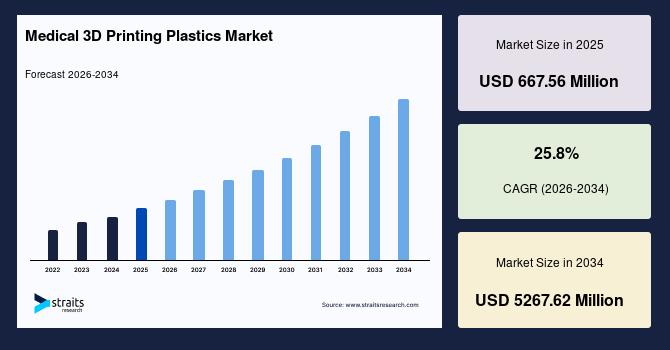
Medical 3D Printing Plastics Market Size, Share, Growth, 2034
| Market Metric | Details & Data (2025-2034) |
|---|---|
| 2025 Market Valuation | USD 667.56 Million |
| Estimated 2026 Value | USD 839.79 Million |
| Projected 2034 Value | USD 5267.62 Million |
| CAGR (2026-2034) | 25.8% |
| Study Period | 2022-2034 |
| Dominant Region | North America |
| Fastest Growing Region | Europe |
| Key Market Players | 3D Systems Inc., DSM, Arkema, Evonik Industries AG, SABIC |
Download Free Sample Report to Get Detailed Insights.
Medical 3D Printing Plastics Market Dynamics Market DriversGrowing Medical Devices Industry
The medical devices industry continues to leverage technology development in medical plastics at a rapidly growing rate. It has recognized the added value of 3D printing or additive manufacturing for various medical applications. Additive manufacturing is used to develop new orthopedic implants, surgical cutting and drill guides, and prosthetics, and to design replicas of bones, organs, and blood vessels. Factors such as increasing healthcare expenditure, expanding home healthcare sector, growing geriatric population (especially in North America and Europe), and rising incidences of cardiovascular diseases are propelling the demand for medical devices. Moreover, the medical devices market is anticipated to be driven by several government initiatives that support early diagnosis of diseases, such as the United Nations Task Force's programs for the prevention and control of cervical cancer, the construction of long-term care facilities, and advantageous policies like reimbursement coverage.
Furthermore, favorable regulations and local incentives, especially in nations like India and China, will drive the demand for medical devices in the coming years. For instance, the government of China has laid out multiple initiatives such as the 13th Five Year Plan, Healthy China 2030, and Made in China 2025 to support long-term growth and innovation in healthcare delivery, which is expected to fuel the demand for medical devices, in turn, propelling the growth of the medical 3D printing plastics market over the forecast period. Moreover, the outbreak of the COVID-19 pandemic played a huge role in boosting the demand for medical devices worldwide. Countries such as the U.S., China, Brazil, India, Russia, and Spain are investing heavily in manufacturing medical devices such as invasive and non-invasive ventilators, filters for ventilators, oropharyngeal airway devices, catheters, cannulae, and others, thereby creating lucrative growth opportunities for the medical 3D printing plastics market.
Rising Demand for Prosthetics Application
3D printing technology is becoming revolutionary in prosthetic manufacturing as it is low-time-consuming, easy to customize, and labor-intensive. The technology is widely used in manufacturing prosthetics for people with limb amputations. Improving patient knowledge about replacement surgeries, coupled with the rising geriatric population, especially in countries such as Germany, the U.S., Japan, Canada, and others, is expected to fuel the demand for limb amputations in the coming years. In recent years, more people are engaging in physical activities and choosing sports as a career, which is expected to increase sports injuries. As per the National Safety Council, in 2019, the U.S. accounted for about 468,000 injuries in the sports and recreation category.
Moreover, there has been an alarming increase in frequent road accidents, thus driving the demand for limb amputation procedures globally. As per the National Safety Council, in 2019, the U.S. accounted for about 4.4 million road injuries, significantly contributing to the demand for prosthetics. The rising number of amputations due to osteosarcoma and joint cancer, predominantly in the adolescent age group, is another factor fueling the prosthetics industry, propelling the demand for medical 3D printing plastics.
Furthermore, the increasing rate of limb amputation has propelled the demand for artificial limbs or prosthetics, leading to the development of 3D-printed prosthetics with polypropylene, which is quick to manufacture and can be easily customized according to the patient's requirement, thus reducing the cost of the final product. According to the American Orthotics and Prosthetics Association, average prosthetic costs are between USD 1,500 and USD 8,000, which can be reduced to USD 50 with 3D printing. Therefore, increasing demand for polypropylene-based 3D-printed prosthetics is augmenting the medical 3D printing plastics market growth.
Market RestraintsHigh Costs Associated with 3D Printing
3D printing or additive manufacturing is witnessing a surge in demand in the global market as it is highly efficient compared to traditional manufacturing methods such as blow molding, injection molding, extrusion, etc. Additive manufacturing avoids tooling-related constraints on geometries, which can be achieved through traditional production. It also aids efficiently in manufacturing products at a low production rate, thereby allowing manufacturers to produce a single unit customized per buyer's need, along with high differentiation. However, due to high production costs, 3D printing is mainly restricted to creating prototypes of product models. Thus, the high cost of production for 3D-printed plastic parts is a barrier to market growth.
Additionally, the initial cost of procurement of 3D printing equipment is high. Commercial-grade equipment is capital-intensive. Moreover, the cost of materials and medical plastics for 3D printing is high as they are premium grade, particularly designed for 3D printing applications in the medical industry. However, to cope with huge production costs, manufacturers of 3D printers are engaged in extensive research and development activities to develop a low-cost powder-based 3D printer that utilizes inkjet printing technology. The printer uses readily available off-the-shelf parts available in the market to further reduce costs.
Market OpportunitiesIncreasing Complexity Concerning Product Design and Engineering
Medical device manufacturers' manufacturing of high-quality and safe devices for patient care is a significant concern. The regulations related to medical devices are vast, rapidly growing, and complicated by legal technicalities. Medical devices that are functional and effective result from well-managed production processes. Medical devices, biological products, and pharmaceuticals are subject to stringent regulations and standards addressed by Good Manufacturing Practice (GMP), sometimes called "quality systems in manufacturing."
Many medical device companies have outsourced R&D to minimize business risks, hasten product market entry, and reduce costs. These lead to a significant rise in expenditure levels; therefore, medical device original equipment manufacturers rapidly adhere to outsourcing as one of the effective cost-curbing tools. Moreover, implantable medical devices (IMDs) are being used increasingly to improve patients' medical outcomes. The implantable medical device design must balance complexity, reliability, power consumption, and costs. Businesses focus more on innovation and less on non-core activities to launch successful products. These factors are anticipated to boost the medical device outsourcing market.
Regional Analysis North America Dominates the Global MarketNorth America is the most significant global medical 3D printing plastics market shareholder and is estimated to exhibit a CAGR of 25.6% during the forecast period. A large portion of the demand for medical 3D printing plastics comes from the increasing use of 3D printing technology in the medical field, particularly in the production of implants, prostheses, and surgical tools. The advantages of PLA filament include its ease of use, the superior quality of the printed object, and its widespread application across many sectors, including healthcare. One major factor driving the market growth in North America has been the rising per capita healthcare spending in the U.S. in the form of health insurance.
Furthermore, the demand for prostheses, braces, surgical planners, prototypes, and dental equipment is expected to augment in the coming years, thereby driving the North American medical 3D printing plastics market over the forecast period. A high adoption rate of 3D plastic printing across the medical industry will likely boost market growth. Moreover, the presence of key manufacturers is anticipated to fuel the demand for medical 3D printing plastics in the region. An increase in mergers and acquisitions, higher R&D investments, operational integration, and site relocations primarily drive the demand for medical 3D plastics printing in North America.
Europe Medical 3D Printing Plastics Market TrendsEurope is expected to grow at a CAGR of 26.1% during the forecast period. The European medical 3D printing plastics market is consistently engaged in extensive research and development activities to expand its manufacturing base. Medical device manufacturers are increasingly utilizing 3D printing technology as it allows them to lower manufacturing and inventory costs, thereby assisting in achieving economies of scale. Moreover, major market players and numerous European production units will likely drive market growth over the forecast period. Mass customization, newer capabilities, shorter lead times, and high speed are expected to propel the growth of the medical 3D printing plastics market in Europe. Europe was the second-largest regional market in terms of volume and revenue in 2020 and is expected to retain its place over the forecast period.
Furthermore, the increasing geriatric population and growing prevalence of chronic illnesses in the region are boosting the demand for medical devices, fueling the growth of the market. The high rate of adoption of 3D printing plastics across the medical industry, coupled with increasing government investment in the healthcare sector, is expected to positively influence the European medical 3D printing plastics market over the forecast period.
Asia-Pacific is expected to expand substantially over the forecast period. Regarding volume and revenue, Japan dominated the Asia-Pacific medical 3D printing plastics market in 2022. The region is driven by the ascending product demand in various applications, including orthopedic implants and fracture fixation. Rising cases of osteoporosis and osteoarthritis in countries such as Japan and China, owing to the higher elderly population ratio, are expected to drive market growth in the region in the coming years.
According to Japan's Statistics Bureau, the Ministry of Internal Affairs and Communications, in 2019, the elderly population (above 65 years) in the country grew by 1% from the previous year to reach 35.89 million, accounting for 28% of its population. This trend, coupled with low bone density conditions, rising adoption of orthopedic implants in middle-aged patients, and the introduction of biodegradable implants and internal fixation devices, is anticipated to fuel the need for medical 3D printing plastics over the projected period.
Medical 3D Printing Plastics Market Segmentation Analysis By TypeThe global market is categorized into photopolymer, PEEK, polylactic acid, ABS, polyamide, and PETG. The photopolymer segment dominates the global market and is estimated to exhibit a CAGR of 25.6% during the forecast period. Photopolymers are soluble liquid mixtures of monomers, polymer bases, and oligomers, along with a photoinitiator. They are light-sensitive polymeric materials whose physical and chemical characteristics are altered by light. Ultraviolet light initiates the reaction and modifies the properties of photopolymers. They play a significant role in several printing processes, such as 3D printing, poly-jet, and inkjet printing.
Moreover, Photopolymers are used extensively across several application industries as they act as binders, additives, colorants, plasticizers, and chemical agents in 3D printed products. They also offer several advantages, such as clarity in the image, better ink deposition, and high durability. Tooth dentures are a common medical application for photopolymers manufactured through 3D printing. For instance, Graphy, Inc., a South Korea-based 3D printable photopolymer resin manufacturer, provides Tera Harz, a 3D printing material for dental applications.
Polyether ether ketone (PEEK), a semi-crystalline polyaromatic thermoplastic polymer, has many favorable mechanical properties that enable its use in surgical applications. PEEK-LTI, PEEK-LT2, and PEEK-LT3 are the forms of PEEK used in orthopedic, spine, and maxillofacial surgeries. The combined use of PEEK composites enhances antimicrobial and osteoinductive capabilities. The composites made from PEEK are becoming an increasingly influential group of biomaterials for extensive application in the medical field.
In dentistry, PEEK implants exhibit low-stress shielding compared to titanium implants owing to the proximity of PEEK to the human bones in terms of mechanical properties. PEEK is also a formidable material for fixed prostheses. Pedicle-based rod systems are constructed using polyetheretherketone (PEEK) material, primarily for non-fusion. However, they can also serve as an attachment for fusion procedures in certain instances.
By FormThe global market has been further segmented into filament, powder, and ink. The filament segment owns the highest medical 3D printing plastics market share and is estimated to grow at a CAGR of 26.2% during the forecast period. The 3D plastic filaments are thermoplastics and are widely used across the global 3D printing market as they attain flexibility on heating. Polylactic acid and ABS filaments are commonly utilized in the printing industry globally. They are used as thermoplastic feedstock, which is used for fused deposition modeling in 3D printers. Customers are increasingly adopting plastic filaments made from recycled plastics due to rising environmental consciousness. Reflow is one of the companies that produces and sells plastic filaments for 3D printing made from recycled plastic.
The powder segment is the second largest. A few properties of 3D printing plastics include flexibility, high rigidity, and temperature resistance. The powder is also available in vibrant color options. However, due to their high porosity, their demand will likely be restrained in the global 3D printing plastics market. Moreover, high-end 3D printers use powder-based plastics. Polyamide/nylon and aluminide are commonly used to construct 3D models in powdered form. Selective laser sintering is among the most preferred technologies for 3D printed parts from polyamide powder.
List of Key and Emerging Players in Medical 3D Printing Plastics Market-
3D Systems Inc.
DSM
Arkema
Evonik Industries AG
SABIC
Stratasys Ltd
EnvisionTEC Inc
Solvay
Apium Additive Technologies GmbH
-
October 2023 - Formlabs announced the addition of three 3D printing materials with a healthcare theme to its library. The company's inventory includes BioMed Elastic 50A Resin, BioMed Flex 80A Resin, and IBT Flex Resin.
| Report Metric | Details |
|---|---|
| Market Size in 2025 | USD 667.56 Million |
| Market Size in 2026 | USD 839.79 Million |
| Market Size in 2034 | USD 5267.62 Million |
| CAGR | 25.8% (2026-2034) |
| Base Year for Estimation | 2025 |
| Historical Data | 2022-2024 |
| Forecast Period | 2026-2034 |
| Report Coverage | Revenue Forecast, Competitive Landscape, Growth Factors, Environment & Regulatory Landscape and Trends |
| Segments Covered | By Type, By Form |
| Geographies Covered | North America, Europe, APAC, Middle East and Africa, LATAM |
| Countries Covered | US, Canada, UK, Germany, France, Spain, Italy, Russia, Nordic, Benelux, China, Korea, Japan, India, Australia, Taiwan, South East Asia, UAE, Turkey, Saudi Arabia, South Africa, Egypt, Nigeria, Brazil, Mexico, Argentina, Chile, Colombia |
Download Free Sample Report to Get Detailed Insights.
Medical 3D Printing Plastics Market Segments By Type-
ABS
PEEK
PETG
Photopolymer
Polyamide
Polylactic Acid
-
Filament
Powder
Ink
-
North America
Europe
APAC
Middle East and Africa
LATAM

Legal Disclaimer:
MENAFN provides the
information “as is” without warranty of any kind. We do not accept
any responsibility or liability for the accuracy, content, images,
videos, licenses, completeness, legality, or reliability of the information
contained in this article. If you have any complaints or copyright
issues related to this article, kindly contact the provider above.
Most popular stories
Market Research

More Story







Comments
No comment