




403
Sorry!!
Error! We're sorry, but the page you were looking for doesn't exist.
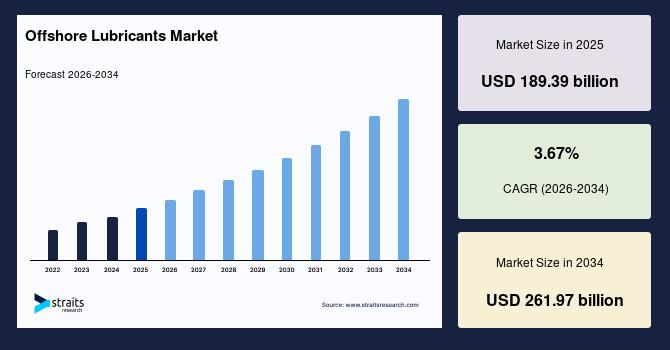
Offshore Lubricants Market Size, Share, Growth, Analysis, 2034
| Market Metric | Details & Data (2025-2034) |
|---|---|
| 2025 Market Valuation | USD 189.39 billion |
| Estimated 2026 Value | USD 196.35 billion |
| Projected 2034 Value | USD 261.97 billion |
| CAGR (2026-2034) | 3.67% |
| Study Period | 2022-2034 |
| Dominant Region | Asia Pacific |
| Fastest Growing Region | North America |
| Key Market Players | BP plc (U.K.), Chevron Corporation (U.S.), Exxon Mobil Corporation (U.S.), Royal Dutch Shell plc (Netherlands), Total S.A. (France) |
Download Free Sample Report to Get Detailed Insights.
Offshore Lubricants Market Drivers Lubricants Are Utilized in A Variety of Offshore ApplicationsLubricants find employment in various applications offshore, including turbines, vessel engines, hydraulic equipment, gearboxes, and machinery. They reduce the amount of wear and tear that the machinery experiences and increase the overall efficiency of the operation. It is anticipated that expanding offshore oil and gas exploration and production activities, particularly those in the Gulf of Mexico, the Caspian Sea, the Arabian Sea, and the Red Sea, would fuel worldwide industry growth over the projected period. The development of the industry is significantly influenced by the regulatory regulations that are in place. The environmental policies linked with their use are continually being developed, formulated, and established by regulatory authorities such as the United States Environmental Protection Agency (EPA), REACH, and ECHA.
Demand for Global EnergyAn increase in offshore exploration operations, the expansion of subsea systems, and the demand for global energy, oil, and gas are the primary growth drivers for the offshore lubricants market. Regulatory rules, such as those of the U.S. Environmental Protection Agency, the European Union's REACH, and the European Chemicals Agency (ECHA), significantly influence the industry's development. According to the International Energy Agency (IEA), the worldwide demand for oil in 2019 is 6.9 mb/d and is projected to reach 104.7 mb/d by 2023. It is anticipated that demand will increase at an average yearly rate of 1.2 mb/d. In addition, other organizations, such as Beaches Environmental Assessment and Coastal Health (BEACH), have revised laws, such as the Clean Water Act, to regulate and limit petrochemical pollution in oceans and seas.
Market Restraint Stringent RegulationsThe inappropriate disposal of marine lubricants, which endangers aquatic life (such as flora and wildlife), has generated widespread concerns surrounding offshore lubricants. This has led to very stringent guidelines and regulations concerning offshore lubricants. These regulations offer a significant obstacle to the growth pace of the offshore lubricants business. This offshore lubricants market report provides details of recent market developments, trade regulations, import-export analysis, production analysis, value chain optimization, market share, the impact of domestic and localized market players, analyses opportunities in terms of emerging revenue pockets, changes in market regulations, strategic market growth analysis, market size, category market growths, application niches and dominance, product approvals, product launches, geographies covered, and competitive landscape. For more information on the offshore lubricants market, contact Straits Research for an Analyst Brief; our staff will assist you in making a well-informed decision for market expansion.
Market Opportunity Utilization of Bio-LubricantsIn addition, according to the estimate, the increased utilization of bio-based raw materials to satisfy the growing demand for environmentally friendly products would further present profitable opportunities to market participants between 2022 and 2029. The use of environmentally friendly lubricants, such as bio-based lubricants, which minimize the amount of volatile organic compounds (VOCs) and gas toxicity, is strongly encouraged by several projects focused on promoting sustainability. Using energy-saving resin systems, bio-based offshore lubricants, green and sustainable offshore lubricants, and other energy-saving offshore lubricants are often favoured in underdeveloped countries and more developed nations.
Regional AnalysisIn 2021, Asia Pacific was the most critical consumer region, accounting for more than 27% of the market's total volume. For the projected period, it is anticipated that the expansion of the area will be driven by an increase in the number of offshore projects in India, Indonesia, Malaysia, and China. On the other side, increased economic growth in the region has made it possible for there to be more maritime trade. Because of this, there has been a considerable rise in maritime travel in recent years. This factor is anticipated to increase the need for offshore lubricants in the Asia Pacific region.
North America came in second place, accounting for 18.2 % of the global market share in 2014. The Asia Pacific was the market's dominant region in 2014. Marine lubricants are subject to strict rules imposed by North America's the United States Environmental Protection Agency (EPA). It is anticipated that the growing number of offshore activities in the Gulf of Mexico will be a primary driver driving the expansion of this region. By the end of the forecast period in 2022, it is anticipated that North America will account for 17.2 % of the total market volume.
Application InsightsThe worldwide engine oil market has been categorised into engine oil, hydraulic oil, gear oil, grease, cylinder oil, turbine oil, and compressor oil. In 2021, the engine oil application sector accounted for more than 74 % of the total market volume. Increasing maritime traffic due to expanding international trade is the primary driver. However, engine oil is anticipated to lose market share and account for only 73.1% of the total market volume by 2022, primarily due to the growing demand for grease and gear oil. The majority of marine engines, boat engines, and container engines utilise engine oils. Engine oil serves a critical role in helping engines achieve maximum output efficiency. These oils are specially prepared for the speed and stroke of engines. They prevent engine corrosion and wear and tear. Increasing maritime traffic is anticipated to drive demand for engine oils over the projected period. Due to its rising usage in offshore machinery, vessels, and other oil & gas equipment, grease is anticipated to have the highest volume growth during the projection period. Maintaining the efficiency of their equipment is preferred by manufacturers to prevent downtime and, consequently, operational expenses. This factor is anticipated to impact demand over the projected period significantly.
End-Use InsightsThe offshore lubricants market has been categorised into offshore rigs, FPSOs (floating, production, storage, and offloading vessels), and OSVs (offshore supply vessels) (offshore support vessels). In 2021, OSVs represented the largest end-use market and 57.0% of the offshore lubricants market volume worldwide. The offshore drilling and production sectors rely heavily on OSVs as support systems. Principal offshore supply vessels are AHTS (Anchor Handling Tug Supply Vessel) and PSV (Production Supply Vessel) (Platform Supply Vessel). AHTS provides semi-submersible rigs and lodging barges with an anchor. AHTS anchors semi-submersible rigs, FPSOs, accommodation barges, and other vessels. Increasing utilisation rates of OSVs are directly inferred by their increasing maintenance, which is anticipated to stimulate demand for offshore lubricants. Increasing OSV utilisation due to rising exploration and production of deepwater reserves would necessitate more maintenance, leading to an increase in demand for lubricants such as engine oils, gear oils, compressor oils, hydraulic fluids, and transmission fluids.
List of Key and Emerging Players in Offshore Lubricants Market-
BP plc (U.K.)
Chevron Corporation (U.S.)
Exxon Mobil Corporation (U.S.)
Royal Dutch Shell plc (Netherlands)
Total S.A. (France)
Aegean Marine Petroleum (Greece)
Fuchs Petrolub SE (Germany)
Gulf Oil Corporation (U.S.)
Idemitsu Kosan Co.,Ltd. (Japan)
JXTG Nippon Oil & Energy Corporation (Japan)
-
In June 2022, bp to lead and operate one of the world's largest renewables and green hydrogen energy hubs based in western Australia.
In May 2022, bp and Clean Planet Energy reach agreement to help advance the circular plastics economy.
In June 2022, Chevron, Cummins Team on Renewable Natural Gas Engine Demonstration with Walmart.
In June 2022, ExxonMobil announces sale of interests in Montney and Duvernay Canadian assets.
| Report Metric | Details |
|---|---|
| Market Size in 2025 | USD 189.39 billion |
| Market Size in 2026 | USD 196.35 billion |
| Market Size in 2034 | USD 261.97 billion |
| CAGR | 3.67% (2026-2034) |
| Base Year for Estimation | 2025 |
| Historical Data | 2022-2024 |
| Forecast Period | 2026-2034 |
| Report Coverage | Revenue Forecast, Competitive Landscape, Growth Factors, Environment & Regulatory Landscape and Trends |
| Segments Covered | By Application, By End-Use |
| Geographies Covered | North America, Europe, APAC, Middle East and Africa, LATAM |
| Countries Covered | US, Canada, UK, Germany, France, Spain, Italy, Russia, Nordic, Benelux, China, Korea, Japan, India, Australia, Taiwan, South East Asia, UAE, Turkey, Saudi Arabia, South Africa, Egypt, Nigeria, Brazil, Mexico, Argentina, Chile, Colombia |
Download Free Sample Report to Get Detailed Insights.
Offshore Lubricants Market Segments By Application-
Engine Oil
Hydraulic Oil
Gear Oil
Grease
Others
-
Offshore Rigs
FPSOs (Floating, Production, Storage & Offloading Vessels)
OSVs (Offshore Support Vessels)
-
North America
Europe
APAC
Middle East and Africa
LATAM

Legal Disclaimer:
MENAFN provides the
information “as is” without warranty of any kind. We do not accept
any responsibility or liability for the accuracy, content, images,
videos, licenses, completeness, legality, or reliability of the information
contained in this article. If you have any complaints or copyright
issues related to this article, kindly contact the provider above.
Most popular stories
Market Research

More Story








Comments
No comment