




403
Sorry!!
Error! We're sorry, but the page you were looking for doesn't exist.
Surgical Tourniquets Market Size, Share, Growth, Analysis, 2034
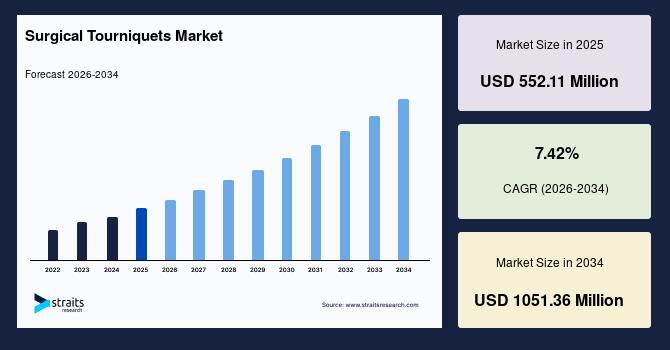
| Market Metric | Details & Data (2025-2034) |
|---|---|
| 2025 Market Valuation | USD 552.11 Million |
| Estimated 2026 Value | USD 593.07 Million |
| Projected 2034 Value | USD 1051.36 Million |
| CAGR (2026-2034) | 7.42% |
| Study Period | 2022-2034 |
| Dominant Region | North America |
| Fastest Growing Region | Asia Pacific |
| Key Market Players | Zimmer Biomet, Stryker, Delfi Medical Innovations, Hammarplast Medical, VBM Medizintechnik |
Download Free Sample Report to Get Detailed Insights.
Market Drivers Increasing Incidence of Traumatic InjuriesThe use of surgical tourniquets in emergency and surgery situations is necessary due to a growing number of accidents, falls and sports injuries around the world. Traumatic injuries often require immediate medical attention to control bleeding and stabilize the patient, making tourniquets a critical tool in these scenarios.
For instance,
-
According to the World Health Organization (WHO), road traffic accidents cause approximately 1.3 million deaths annually, and between 20 to 50 million people suffer non-fatal injuries. The demand for surgical tourniquets in the field of emergency medicine is strongly driven by road accidents.
The National Safety Council reported that 3.6 million people with injuries from sports and recreational equipment were seen at emergency departments in 2022. These injuries often require immediate intervention, including the use of tourniquets to manage severe bleeding and stabilize fractures.
The market for tourniquets is constantly being innovated by different manufacturers. For example, Sam Medical has launched a SAM XT Extremity Tourniquet that is designed to be quickly deployed in the case of trauma. The innovative design of the tourniquet allows for precise pressure control and ease of use, which makes it ideal for emergency responders as well as military applications.
As a result, the market for surgical tourniquets is booming at a rapid pace, with all the above-mentioned increases in injuries and product launches.
Growing Military ExpendituresThe demand for improved tourniquet systems is driven by an increase in military expenditure and the focus on improving emergency medical responses in combat areas. The introduction of Smart Tactical Application Tourniquet (S.T.A.T.), designed specifically for military use provides rapid application and is effective in controlling severe hemorrhage, making it an essential tool for combat medics.
In addition, in order to improve the survival and treatment of soldiers on the ground, armies all over the world are investing heavily in health technologies. In fact, in 2021, global spending on armed forces was USD 2.1 trillion, according to the Stockholm International Peace Research Institute. In order to ensure the efficient treatment of casualties in combat, significant budgetary allocations are made for modern medical equipment such as tourniquets.
-
The United States Department of Defense is investing in advanced healthcare technology for its personnel. For instance, the Tactical Combat Casualty Care (TCCC) guidelines emphasize the use of tourniquets as a critical component of life-saving measures on the battlefield.
These statistics show the critical role played by surgical tourniquets in dealing with traumatic injuries and their impact on military investment for technological progress.
Market Restraints High Cost of Advanced Tourniquet SystemsThe cost of advanced tourniquet systems is very high. The high cost associated with advanced tourniquet systems can limit their adoption, particularly in low- and middle-income countries. Advanced tourniquet systems, which often feature automated pressure control, safety alarms, and other high-tech functionalities, are expensive to produce and purchase. This financial barrier is making it difficult to acquire and use these devices for healthcare professionals in resource-limited settings. The basic mechanical tourniquets can cost between USD 20 and USD 50, while advanced electronic tourniquet systems with features such as automatic pressure regulation or integrated alarms may be priced in the range of several thousand dollars. Depending on the configuration and additional accessories, the automatic tourniquet system is priced from 1500 to 5000 USD.
-
According to the World Bank, many low- and middle-income countries (LMICs) have limited healthcare budgets. For instance, in Sub-Saharan Africa, the average health expenditure per capita is approximately USD 83, compared to over USD 4,000 in high-income countries. This disparity makes it difficult for hospitals in LMICs to afford high-cost medical devices, including advanced tourniquet systems.
Thus, the high cost of advanced tourniquet systems poses a significant challenge to their widespread adoption, particularly in regions with constrained healthcare budgets. This financial barrier highlights the need for cost-effective solutions and potential funding support to enhance the availability of these life-saving devices in low- and middle-income countries.
Market Opportunity Advancements in Tourniquet TechnologyThe effectiveness and use of surgical tourniquets have been significantly improved by technological advances such as automatic tourniquet systems with safety features and accurate pressure controls. These innovations represent substantial growth opportunities for the market as they improve patient outcomes, enhance safety, and increase efficiency in surgical or emergency settings.
For instance,
-
Modern tourniquet systems, such as the Zimmer ATS 4000 Automatic Tourniquet System feature automated pressure regulation, which ensures that the pressure applied is consistent and within safe limits. This reduces the risk of complications such as nerve damage and tissue injury, improving patient safety and outcomes. Moreover, integrated safety features such as alarms and alerts are now part of the more sophisticated tourniquet systems. In the case of Delfi Medical Innovations' EasiFit Cuff, sensors have been developed to warn clinicians if cuffs are being used incorrectly or lost pressure is lost in a surgical procedure. This will improve the reliability and security of procedures.
Systems like the Stryker SmartPump Tourniquet System offer wireless connectivity and integration with hospital data systems. This allows for real-time monitoring and recording of tourniquet use, which can be critical for post-operative analysis and improving surgical protocols.
These technological advancements, with enhanced features such as automated pressure control, integrated safety systems, and wireless connectivity, are expected to improve patient outcomes and drive the adoption of advanced tourniquet systems in both surgical and emergency settings.
Regional InsightsNorth America is the most significant global surgical tourniquets market shareholder and is expected to expand substantially during the forecast period. This region has a well-established healthcare infrastructure, high adoption rates of advanced medical technologies, and a large number of surgical procedures performed annually.
-
The United States surgical tourniquets market is leading in terms of market share. The National Library of Medicine reports that globally, more than 310 million surgical procedures are performed annually and approximately 40 to 50 million belong to the United States, thereby driving the surgical tourniquets market growth.
The Canadian surgical tourniquets industry is expected to see significant growth due to factors such as an aging population, increasing chronic diseases like osteoarthritis, and advancements in surgical techniques. The Arthritis Facts and Figures, published by the Arthritis Society, reported that over 4 million Canadians are affected by osteoarthritis, resulting in a growing need for orthopedic surgeries using pneumatic tourniquets. Hence, the anticipated rise in orthopedic surgeries is likely to drive the growth of the market in Canada.
Asia Pacific region is expected to emerge in the market. The market's major impact drivers are the growing preference for trials by global players due to low-cost structures and higher investment in research and development. Improved reimbursement policies for surgical procedures in some Asia Pacific countries are also expected to drive market growth.
-
The Indian surgical tourniquets market is pivotal in shaping the Asia Pacific market. The allocation for the Pradhan Mantri Ayushman Bharat Health Infrastructure Mission has increased significantly from USD 251.65 million (?2,100 crore) in 2023-24 to USD 492.17 million (?4,108 crore) in 2024-25. This boost in funding is expected to enhance healthcare infrastructure, including hospitals and surgical facilities, driving the adoption of advanced medical technologies like surgical tourniquets in India.
China is expected to see significant growth as the country has a large and rapidly growing healthcare market, driven by its massive population and increasing healthcare spending. The country's healthcare infrastructure is rapidly expanding, leading to a higher demand for medical devices, including surgical tourniquets. Additionally, China also has a strong manufacturing base, which allows for the production of tourniquets at a lower cost, making them more affordable and accessible.
The market is divided into tourniquet systems, tourniquet cuffs, and others. The tourniquet cuffs segment for the surgical tourniquets market is dominant. Tourniquet cuffs are the primary component used to apply pressure to a limb, controlling blood flow during surgeries, trauma care, and emergency situations. Their essential role makes them a fundamental part of any tourniquet system. They are further sub-segmented into disposable and reusable cuffs.
Moreover, tourniquet cuffs are used across various medical specialties, including orthopedics, trauma surgery, and emergency medicine. This broad application spectrum contributes to their dominance in the market. The effectiveness and adoption rate of tourniquet cuffs have continued to increase due to advances in technology, such as the integration of automatic pressure controls and security features. For instance, a study by BioMed Central (Spring Nature) found that a new elastic tourniquet cuff improved the bloodless surgical field and required less pressure adjustment compared to a conventional cuff in total knee arthroplasty.
As a result, tourniquet cuffs have been the dominant segment of the market due to their essential role, broad use in medical specialties and recent technological developments that improve their effectiveness and adoption.
End-User InsightsThe market is divided into hospitals and trauma centers, ambulatory surgery centers, defense and others. Hospitals and trauma centers dominate the global surgical tourniquets market due to their high volume of surgical procedures and diverse healthcare specialties. These facilities handle a wide range of cases requiring tourniquets, driving significant demand. For instance, the significant rise in Accident and Emergency (A&E) department attendances in NHS hospitals, reaching 14.4 million in 2020-21, is expected to drive the demand for wound care surgeries. This, in turn, is anticipated to increase the need for pneumatic tourniquets. Hospitals and trauma centers also serve various specialties like orthopedics and emergency medicine, which frequently use tourniquets. With advanced infrastructure and emergency capabilities, these facilities are crucial in driving demand for surgical tourniquets.
Thus, all the above-mentioned factors collectively show that the hospitals and trauma centers are the key end users driving the demand for surgical tourniquets.
List of Key and Emerging Players in Surgical Tourniquets Market-
Zimmer Biomet
Stryker
Delfi Medical Innovations
Hammarplast Medical
VBM Medizintechnik
Ulrich Medical
Teleflex Incorporated
OHK Medical Devices Inc
Sam Medical
AneticAid
-
August 2022 SourceMark Medical, a U.S. medical device company and certified Minority Business Enterprise (MBE), has been awarded a group purchasing agreement for its Tourniquet Touch Pneumatic Tourniquet system with Premier, Inc. The new agreement allows Premier members to take advantage of special pricing and terms pre-negotiated by Premier for the Tourniquet Touch system.
Our research analysts report that the tourniquet industry is on a steady growth, fueled by technology advances, increases in surgery and increased focus on safety for patients. In order to introduce novel, lightweight designs with user-friendliness, industry players are active in research and development. Nevertheless, there are still obstacles such as strict regulatory requirements and concerns about injuries to the limbs.
In spite of these challenges, the market offers promising opportunities for growth, particularly in developing countries where healthcare infrastructure is being expanded. Significant developments in the industry's landscape are a growing preference for pneumatic tourniquets because of their efficiency and safety characteristics, as well as an evolution towards disposable tourniquets to prevent infections. Overall, the market outlook remains positive, with a strong potential for growth in the coming years.
Report Scope| Report Metric | Details |
|---|---|
| Market Size in 2025 | USD 552.11 Million |
| Market Size in 2026 | USD 593.07 Million |
| Market Size in 2034 | USD 1051.36 Million |
| CAGR | 7.42% (2026-2034) |
| Base Year for Estimation | 2025 |
| Historical Data | 2022-2024 |
| Forecast Period | 2026-2034 |
| Report Coverage | Revenue Forecast, Competitive Landscape, Growth Factors, Environment & Regulatory Landscape and Trends |
| Segments Covered | By Type, By End-User |
| Geographies Covered | North America, Europe, APAC, Middle East and Africa, LATAM |
| Countries Covered | US, Canada, UK, Germany, France, Spain, Italy, Russia, Nordic, Benelux, China, Korea, Japan, India, Australia, Singapore, Taiwan, South East Asia, UAE, Turkey, Saudi Arabia, South Africa, Egypt, Nigeria, Brazil, Mexico, Argentina, Chile, Colombia |
Download Free Sample Report to Get Detailed Insights.
Surgical Tourniquets Market Segments By Type-
Tourniquet Systems
Tourniquet Cuffs
-
Reusable Cuffs
Disposable Cuffs
-
Hospitals and Trauma Centers
Ambulatory Surgery Centers
Defense
Others
-
North America
Europe
APAC
Middle East and Africa
LATAM

Legal Disclaimer:
MENAFN provides the
information “as is” without warranty of any kind. We do not accept
any responsibility or liability for the accuracy, content, images,
videos, licenses, completeness, legality, or reliability of the information
contained in this article. If you have any complaints or copyright
issues related to this article, kindly contact the provider above.
Most popular stories
Market Research

More Story








Comments
No comment