




403
Sorry!!
Error! We're sorry, but the page you were looking for doesn't exist.
Electromagnetic Compatibility (EMC) Market Size, Share, Analysis, 2034
| Market Metric | Details & Data (2025-2034) |
|---|---|
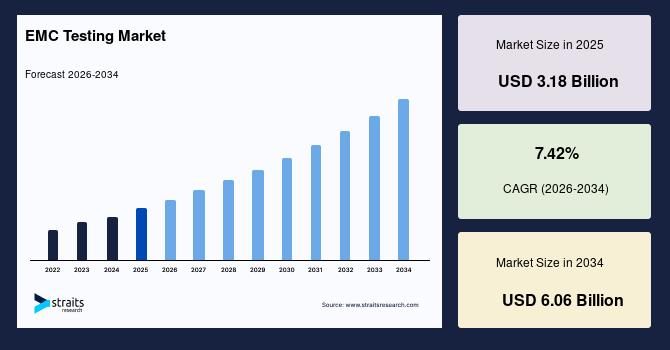
| 2025 Market Valuation | USD 3.18 Billion |
| Estimated 2026 Value | USD 3.42 Billion |
| Projected 2034 Value | USD 6.06 Billion |
| CAGR (2026-2034) | 7.42% |
| Study Period | 2022-2034 |
| Dominant Region | Europe |
| Fastest Growing Region | Asia-Pacific |
| Key Market Players | SGS, Bureau Veritas, Intertek, Eurofins Scientific, DEKRA |
Download Free Sample Report to Get Detailed Insights.
Emc Testing Market Growth Factors Rising Complexity of Electronic DevicesThe increasing complexity of electronic equipment is a significant driver of the global EMC testing market trend. As electronic devices grow more complex and networked, the risk of electromagnetic interference (EMI) rises, and extensive EMC testing is needed to verify compatibility and avoid interference problems. Modern smartphones are more than communication devices; they are versatile gadgets incorporating various wireless technologies, sensors, and powerful computers. These devices produce electromagnetic radiation from multiple sources, including cellular, Wi-Fi, Bluetooth, and NFC antennae, as well as internal components. Global smartphone manufacturing in 2023 was 1.166 billion units, down 2.1% from 2022 but up 12.1% in the fourth quarter. Smartphone manufacturing grew to 337 million units in the fourth quarter, representing an 8% rise over the previous year. Without adequate EMC testing, these emissions may interact, resulting in decreased performance, dropped calls, or shorter battery life.
Furthermore, the Federal Communications Commission (FCC) of the United States enforces stringent rules on electronic equipment to ensure electromagnetic compatibility and reduce interference issues. For example, FCC Part 15 governs inadvertent radiators, including electronic products such as computers, printers, and televisions, and requires manufacturers to undertake EMC testing to demonstrate compliance with FCC emissions restrictions. Additionally, as electronic devices evolve and incorporate advanced features, the demand for EMC testing services will likely increase, fueling market expansion and innovation in EMC testing methodology and technologies.
Market Restraint High Cost of Testing ServicesThe high cost of EMC testing services is a significant barrier for businesses, particularly small and medium-sized firms (SMEs), since it can create financial obligations and impede their capacity to comply with regulatory standards. EMC testing can range from USD 1,000 to USD 20,000 per submission, depending on the equipment and product penetration. The cost may also vary depending on the type of product or equipment, the industry, and what is being tested. EMC testing might cost USD 1,500 to USD 2,500 per day. Product testing takes at least one week so a corporation may spend approximately USD 12,500. Lab expenditures often exclude the company's engineering time.
Furthermore, for SMEs and startups with limited funds, the high cost of EMC testing can be a substantial barrier to market access and product commercialization. These businesses may need help to devote enough finances for testing while meeting other critical expenses such as product development, production, marketing, and distribution. As a result, some businesses may choose to postpone or reduce EMC testing, risking noncompliance with regulatory standards and potential product performance and reliability issues.
Market Opportunity Expansion of Automotive ElectronicsAs vehicles rely more on electronic components and communication systems, ensuring electromagnetic compatibility (EMC) of automotive electronics is critical for safety, dependability, and regulatory compliance. According to the International Energy Agency (IEA), the worldwide electric vehicle (EV) market is expanding rapidly. In 2022, electric car sales surpassed 10 million, accounting for 14% of new automobile sales. The IEA Stated Policies Scenario (STEPS) predicts electric car sales will climb to 35% by 2030. The IEA expects the global electric vehicle fleet to grow to about 350 million vehicles by 2030. As EV adoption accelerates, so will the demand for EMC testing services to assure the reliability and safety of electric drivetrains, battery management systems, and onboard electronics.
Similarly, the development of autonomous driving technologies, such as advanced driver assistance systems (ADAS) and self-driving capabilities, is based on complex sensor arrays, communication networks, and computing platforms. For example, in California, driverless vehicles traveled 5.7 million miles in 2023, up from 5.1 million in 2022. Supporters of self-driving technology have long asserted that it is safer than human drivers who may drive drunk while texting or fall asleep at the wheel. These technologies must undergo extensive EMC testing to confirm their immunity to electromagnetic interference and ensure safe and dependable functioning in real-world driving circumstances.
Regional Insights Europe Market TrendsEurope is the most significant global EMC testing market shareholder and is estimated to grow at a CAGR of 5.3% over the forecast period. Stringent government rules drive the European EMC testing business, ensuring product quality and brand credibility. The government enforces several policies to improve environmental health, product lifecycle, and infrastructure. The electrical or electronic equipment must meet the 'Conformité Européenne' and bear the CE certification mark, as the EMC Directive 2004/108/EC recommended for free trade across the European Union. Only equipment with the CE mark can be purchased and sold within the continent.
Additionally, the demand for EMC testing is also increasing in the European automobile sector. In 2023, Europe had more than 3 million plug-in electric vehicles, a 16% increase from 2022 and 24% of the entire market. In 2023, battery-electric vehicles accounted for 14.6% of new automobile registrations, surpassing diesel and becoming buyers' third most popular choice. The EMC testing service has seen an increased demand from manufacturers developing and outsourcing their projects due to a lack of money during COVID-19. In the energy industry, regular inspection of nuclear power facilities is a significant driver of the development of EMC test services. The United Kingdom has more than 14 nuclear power plants, with reactors averaging 33.33 years old, and demand is likely to rise in the future.
Asia-Pacific's Market TrendsAsia-Pacific is anticipated to exhibit a CAGR of 5.5% over the forecast period. Asia-Pacific has the second-largest EMC testing market for industrial end-use applications, driven by the need for efficient, high-performance equipment in various industries. EMC testing ensures that equipment operates within permitted limits of electromagnetic radiation without impacting performance.
Furthermore, the growing demand for EMI certification for imported and exported products in this region is projected to fuel market expansion. For example, the State Radio Monitoring and Testing Center (SRRC) offers SRRC certification, similar to CCC certification. All radio transmitter items qualify for SRRC certification regardless of shape. The SRRC label represents the CMIIT ID obtained by the manufacturer during the approval process from authorities. Each item could be carried into China and disseminated with a CMIIT ID.
North America's Market TrendsNorth America is a crucial region for EMC testing market players due to favorable economic and social conditions for developing and implementing current technologies, such as supporting government regulations, increased consumer awareness, and expanded research and development infrastructure. Smartphones, tablets, personal computers, HVAC systems, washing machines, and television sets are widely used in the region, boosting the consumer electronics industry.
In addition, the United States is a crucial market for electromagnetic compatibility test Equipment and Testing Services because of its strong automotive, aerospace, consumer electronics, and healthcare industries. As the penetration of electronic components/devices has grown across all significant end-user sectors in recent years, the demand for EMC testing is expected to rise further throughout the projection period.
Testing Method InsightsEMC emissions testing assesses a device's electromagnetic emissions and sensitivity to external electromagnetic interference. This testing determines whether the gadget meets regulatory emissions limitations and maintains operational integrity in the presence of electromagnetic disturbances. Immunity testing, on the other hand, determines the device's resistance to electromagnetic interference from outside sources. Emissions and immunity testing ensure that electronic items perform consistently in their electromagnetic environment without interfering with other devices.
Conducted emissions testing and monitored electromagnetic emissions through a device's power supply lines and cables. It assesses the device's compliance with regulatory limitations for conducted emissions, thereby reducing interference with other electronic equipment. Conducted immunity testing evaluates the device's resistance to electromagnetic interference created through its power supply lines, assuring proper performance in the presence of electrical disturbances.
Offering InsightsThe services segment will grow significantly during the projection period. Testing laboratories, certification bodies, and EMC experts offer many EMC testing and consulting services. These services include EMC testing, certification, pre-compliance testing, test plan creation, regulatory advice, and training. Testing laboratories provide approved EMC testing services tailored to specific industry standards and regulatory needs, ensuring that electronic items meet EMC rules before entering the market.
Furthermore, there is an increasing demand for EMC testing services to guarantee that products meet quality, technical safety, and performance regulatory requirements. Manufacturers use these services to conduct testing operations in laboratories and other facilities to improve the marketability of their products. EMC testing services help to lower manufacturing expenses during the pre-production phase. There is a demand for inspection services that examine traded items from manufacturers to end users. An increasing trend of such manufacturer requests is expected to drive segment expansion.
The EMC testing industry offers various equipment and instruments for conducting practical EMC tests. This comprises spectrum analyzers, signal generator, power amplifiers, antennas, oscilloscopes, sets for measuring emissions, and anechoic chambers. High-quality hardware is required for reliable measurement, analysis, and simulation of electronic devices' electromagnetic emissions and immunity properties during testing.
Type InsightsEMI shielding tapes are adhesive-backed tapes that offer electromagnetic shielding to electronic devices and components. These tapes are often made of a conductive substance, such as copper, aluminum, or nickel, and a pressure-sensitive adhesive layer. EMI shielding tapes seal the seams, joints, and gaps of electronic enclosures, preventing electromagnetic emissions from escaping and decreasing sensitivity to external electromagnetic interference.
Conductive coatings and paints contain conductive elements, such as carbon, silver, or nickel, suspended in a liquid carrier. These coatings are applied to electronic enclosures, circuit boards, cables, and other components to provide a conductive barrier that reduces electromagnetic radiation. Conductive coatings and paints provide EMI shielding by absorbing or reflecting electromagnetic waves, decreasing interference, and assuring electromagnetic compatibility with electronic devices.
Application InsightsConsumer Appliances and Electronics dominate the segment. Smartphones, tablets, computers, televisions, refrigerators, washing machines, and microwaves fall under this group. Consumer electronics require EMC shielding to prevent electromagnetic emissions from interfering with other electronic equipment while ensuring product reliability and safety. The expansion of consumer electronics, combined with an increase in wireless technologies such as Bluetooth, cellular, near-field communications (NFC), and Wi-Fi, is driving the growth of EMC testing applications in the consumer appliance and electronics industry. An electronic device connects several systems and components. With the introduction of IoT, many gadgets rely on these components for optimal performance.
In the automotive industry, EMC shielding is critical for assuring the dependability and safety of electronic systems and vehicle components. This comprises EMI protection for engine control units (ECUs), infotainment systems, navigation systems, sensors, and communication modules. EMC shielding protects automobile electronics from external electromagnetic interference and enables optimal performance in various driving scenarios.
List of Key and Emerging Players in EMC Testing Market-
SGS
Bureau Veritas
Intertek
Eurofins Scientific
DEKRA
Fortive
Rohde & Schwarz
Agilent Technologies
Frankonia Group
EM Test AG
Gauss Instruments
Teseq AG
Keysight Technologies
March 2024- SGS significantly assisted customers in deploying secure payment solutions by verifying Yazara's software for PCI Mobile Payments on the COTS (commercial-off-the-shelf) standard (MPoC). The leading software development firm's product is the first PCI.
February 2024- Bureau Veritas announced the acquisition of the Conformity Assessment company from ANCE Estándares S.C.: "ANCE S.A de C.V." (Asociación de Normalización y Certificación), Mexico's leader in testing and certification services for electrical and electronic equipment.
March 2024- Intertek collaborated with Hicomply to provide end-to-end technology and certification information security solutions.
Report Scope| Report Metric | Details |
|---|---|
| Market Size in 2025 | USD 3.18 Billion |
| Market Size in 2026 | USD 3.42 Billion |
| Market Size in 2034 | USD 6.06 Billion |
| CAGR | 7.42% (2026-2034) |
| Base Year for Estimation | 2025 |
| Historical Data | 2022-2024 |
| Forecast Period | 2026-2034 |
| Report Coverage | Revenue Forecast, Competitive Landscape, Growth Factors, Environment & Regulatory Landscape and Trends |
| Segments Covered | By Testing Method, By Offering, By Type, By Application |
| Geographies Covered | North America, Europe, APAC, Middle East and Africa, LATAM |
| Countries Covered | US, Canada, UK, Germany, France, Spain, Italy, Russia, Nordic, Benelux, China, Korea, Japan, India, Australia, Singapore, Taiwan, South East Asia, UAE, Turkey, Saudi Arabia, South Africa, Egypt, Nigeria, Brazil, Mexico, Argentina, Chile, Colombia |
Download Free Sample Report to Get Detailed Insights.
EMC Testing Market Segments By Testing Method-
EMC Emissions and Immunity Testing
Electrostatic Discharge Testing
Conducted Emissions and Immunity Testing
Radio Frequency Compatibility Testing
-
Hardware
Software
Services
-
EMI Shielding Tapes
Conductive Coatings and Paints
Metal Shielding and Test Equipment
-
Consumer Appliances and Electronics
Automotive
Military and Aerospace
IT and Telecommunications
Medical
Industrial
-
North America
Europe
APAC
Middle East and Africa
LATAM

Legal Disclaimer:
MENAFN provides the
information “as is” without warranty of any kind. We do not accept
any responsibility or liability for the accuracy, content, images,
videos, licenses, completeness, legality, or reliability of the information
contained in this article. If you have any complaints or copyright
issues related to this article, kindly contact the provider above.
Most popular stories
Market Research

More Story








Comments
No comment