





403
Sorry!!
Error! We're sorry, but the page you were looking for doesn't exist.
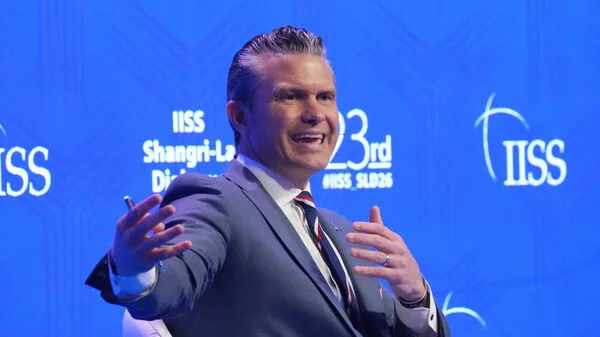
India Is Improving Military Readiness: Pete Hegseth Praises New Delhi, Warns China Over Indo-Pacific Security
(MENAFN- Live Mint) US Defence Secretary Pete Hegseth praised India and several key Asian partners for strengthening their military capabilities on Saturday, as he outlined Washington's vision for a more balanced security architecture in the Indo-Pacific and delivered a pointed warning to China over its growing regional ambitions.
Speaking at the International Institute for Strategic Studies (IISS) Shangri-La Dialogue in Singapore, Hegseth said the United States was committed to preserving stability across the Asia-Pacific while encouraging allies and partners to assume greater responsibility for their own defence.
His remarks underscored a broader shift in US strategic thinking under President Donald Trump, with Washington increasingly pressing friendly nations to expand military spending and play a larger role in maintaining regional security.
India Recognised for Strengthening Military PreparednessAmong the countries singled out for praise was India, which Hegseth cited alongside Vietnam as an example of a nation improving its military readiness amid a changing security environment.
He also commended the Philippines, Australia, Indonesia, Malaysia and Singapore for what he described as their willingness to contribute more actively to collective defence efforts and regional partnerships.
“The bedrock of partnership is alignment on national interests,” Hegseth said, adding that the United States would pursue a“strong, quiet, clear” approach to its alliances.
The defence secretary argued that regional partnerships function most effectively when member states contribute meaningfully to shared security objectives rather than relying disproportionately on American military resources.
US Warns China Over Regional Military ExpansionWhile describing current US-China ties as being among the strongest in recent years, Hegseth nevertheless delivered one of his sharpest critiques of Beijing's strategic posture.
Washington seeks“a favorable but durable balance of power in which no state, including China, can impose its hegemony and hold the security or prosperity of our nation and our allies in question,” he said.
Hegseth asserted that concerns over China's expanding military capabilities were increasingly evident across the Indo-Pacific, pointing to what he characterised as growing military activity both within the region and beyond.
He claimed that there is also“rightful alarm” in the Asia-Pacific region regarding China's military buildup, and the expansion of its military activities in the region and beyond.
“While a decent peace is our goal, make no mistake, America is a Pacific nation, and we insist that China respect our longstanding position in the region.”
Defence Spending Emerges as Central ThemeA significant portion of Hegseth's address focused on defence spending, with the Pentagon chief making clear that Washington expects allies and partners to devote greater resources to their own security.
He said the United States was seeking defence expenditures equivalent to 3.5 per cent of gross domestic product among allied nations and indicated that countries meeting those expectations would receive preferential treatment from Washington.
“For those nations, we are moving them to the front of the line: expedited arms sales, deep industrial-based collaboration, expanded intelligence sharing, the list goes on that benefits many.”
According to Hegseth, nations demonstrating stronger commitments to defence would gain quicker access to military equipment, deeper industrial cooperation and enhanced intelligence partnerships.
Hegseth's Warning for Allies That Fall ShortThe defence secretary also cautioned that countries unwilling to invest sufficiently in their military capabilities could face consequences in their relationships with Washington.
“Allies who refuse to step up and carry their own weight for our collective defense will face a clear shift in how we do business.”
The comments reflect a longstanding position associated with the Trump administration, which has frequently argued that some US allies have benefited from American security guarantees without contributing proportionately to collective defence arrangements.
Before returning to office for a second term, Trump had publicly suggested that Washington should reconsider its obligations toward allies that fail to meet agreed defence commitments.
Hegseth Sends Sharp Message for EuropeHegseth also used the forum to draw a contrast between the Indo-Pacific and Europe, suggesting that some European partners had not assumed adequate responsibility for their own security.
Alliances should happen“without the drama and the moralizing,” he said.“Europe should take note.”
He further argued that“for too long, the security of this region has rested disproportionately on American military power, while many of our allies and partners allowed their own defense capabilities to atrophy.”
Despite the tougher rhetoric, Hegseth insisted that Washington remained committed to international partnerships.
“America first does not mean America alone,” he said, adding that successful alliances are built on the strength, capabilities and sovereign contributions of every participating nation.

Legal Disclaimer:
MENAFN provides the
information “as is” without warranty of any kind. We do not accept
any responsibility or liability for the accuracy, content, images,
videos, licenses, completeness, legality, or reliability of the information
contained in this article. If you have any complaints or copyright
issues related to this article, kindly contact the provider above.
Most popular stories
Market Research

More Story



Comments
No comment