




403
Sorry!!
Error! We're sorry, but the page you were looking for doesn't exist.
5 Artists Inspired By Moroccan Rugs And North African Weaving Artsy
(MENAFN- USA Art News)
Moroccan Textile Traditions Take Center Stage in Venice
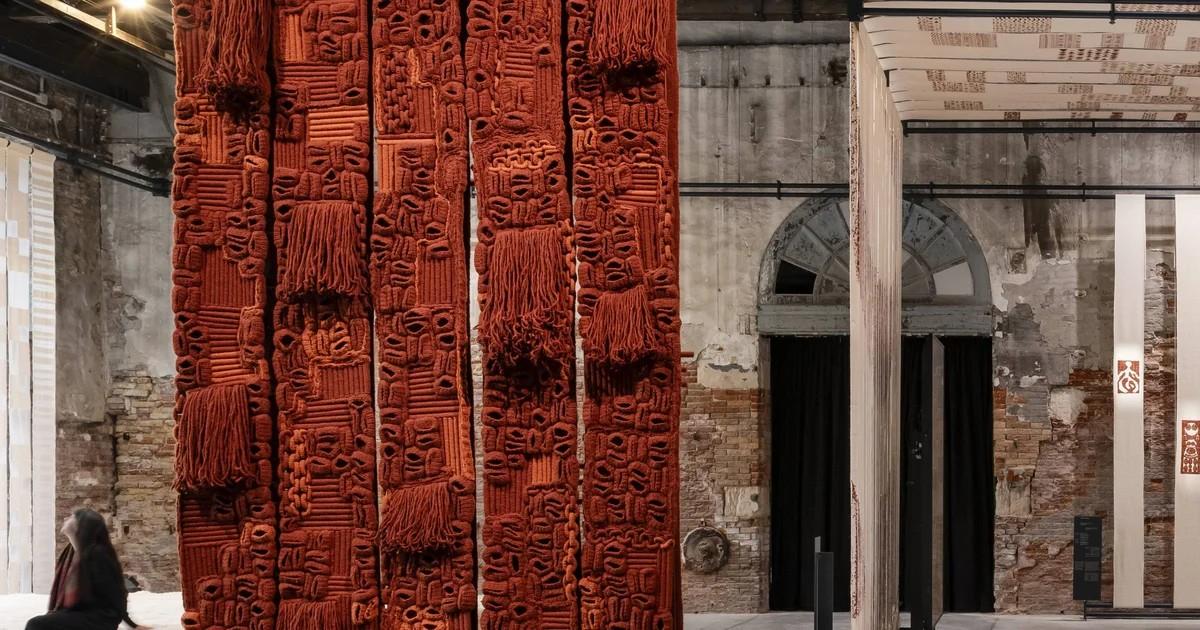
At the 61st Venice Biennale, Amina Agueznay is using weaving to do more than build an installation. She is turning it into a language of memory, labor, and threshold. Her pavilion for Morocco, Asǝṭṭa, unfolds in the Arsenale as a dense field of wool, raffia, glass, and metal that invites viewers to move slowly, sit down, and look closely.
The title comes from an Amazigh word for ritual weaving, and the project was shaped by curator Meriem Berrada through workshops and on-site research with artisan communities across Morocco. More than 150 wool panels, woven on vertical looms and stitched with raffia, descend from the ceiling in layered sheets. From a distance, they read almost like hanging scrolls; up close, they reveal a more intricate surface, threaded with Murano glass, metallic filaments, and materials rooted in North African craft traditions.
Agueznay, born in Casablanca in 1963 and based in Marrakech, has long treated collaboration as central to her practice. She trained as an architect in Washington, D.C., before returning to Morocco in 1997, and she has worked with artisans for nearly two decades. Her earlier monumental installation, Skin, was presented in 2016 at the Museum Mohamed VI of Modern and Contemporary Art in Rabat. That work grew out of a workshop in Bouznika, where she collaborated with craftswomen skilled in crochet, knitting, weaving, macramé, braiding, embroidery, and beading. The resulting sculpture combined recycled fishing nets with twine, wires, sequins, and paper, making collective knowledge visible as form.
In Venice, Agueznay describes that process as almost devotional. The work depends on gestures, drawings, patience, and the willingness to accept imperfection as part of the material itself. The installation's woven sofa extends that invitation to the viewer, folding the body into the composition rather than keeping it at a distance.
The article also turns to Ghizlane Sahli, born in Meknes in 1973 and based in Marrakech, whose practice draws on embroidery ateliers and matriarchal textile traditions. Trained as an architect in Paris, Sahli has built a body of work shaped by softness, repetition, and time. She is best known for her Alveoles, made from recycled plastic bottle caps wrapped and assembled with silk thread, which she first presented in Metamorphosis, a 2014 installation at Dar Bellarj in Marrakech.
Together, Agueznay and Sahli show how Moroccan and Maghrebi textile traditions continue to generate new sculptural forms. Their work does not simply reference heritage; it reactivates it, placing inherited techniques in direct conversation with contemporary installation art.
AminaAgueznay GhizlaneSahli VeniceBiennale ContemporaryArt TextileArt MoroccanArt

Legal Disclaimer:
MENAFN provides the
information “as is” without warranty of any kind. We do not accept
any responsibility or liability for the accuracy, content, images,
videos, licenses, completeness, legality, or reliability of the information
contained in this article. If you have any complaints or copyright
issues related to this article, kindly contact the provider above.
Most popular stories
Market Research

More Story








Comments
No comment