


Crisis Of Shrinking Dreams: Can West Bengal's New Government Reverse Its Economic Descent?


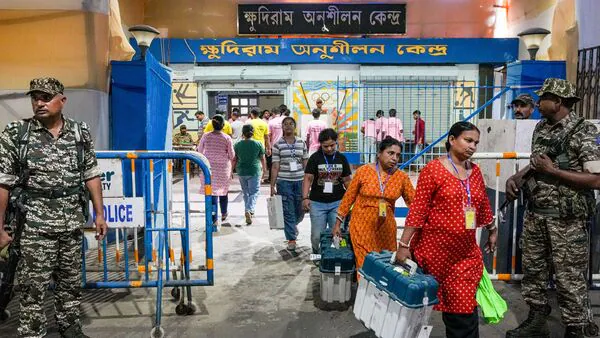
The 'Bhadrolok', or upper-class groups, of Kolkata were shamed when they read about how the rest of India is complaining of a shortage of house-helps, as Bengal reported 92% polling across a two-phased poll. From exporting the meritorious, a trend that began during the Naxalism era of the 1970s, and consolidated in the 1990s, the state now exports low-skilled workers across the country.
The key lies in the fall in Bengal's position in terms of per capita income, from the third position in 1961-62 to 24th nationally, according to an EAC-PM Working Paper, 'Relative economic performance of Indian states: 1960-61 to 2023-24'.
West Bengal held the third-highest relative per capita income among states in 1960-61, with an average income of about 127.5% of the national average, even higher than that of states like Gujarat, Karnataka, Tamil Nadu, Kerala, etc.
Also Read | West Bengal elections: yet another chance for this state to reboot“But its growth failed to keep pace with national trends. As a result, its relative per capita income declined to 83.7% in 2023-24, falling below that of even traditionally laggard states like Rajasthan and Odisha,” the paper stated.
In fiscal 2025, per capita income at current prices stood at ₹181,786, per India's statistics ministry, far below the national average of ₹2,34,859. Of the four major states that just completed assembly polls, West Bengal's income was above only that of Assam.
Anecdotal evidence suggests agri wages are lower in West Bengal compared to the richer states. No wonder then that Bengalis are crowding out the low-skill job markets, from Kashmir to Kanyakumari.
Distinct in declineBengal has been a front-runner state in population control and now ranks among the states with India's lowest total fertility rate (TFR).
According to a paper in Economic & Political Weekly, published in 2024, West Bengal is exhibiting a concerning TFR of 1.4, "posing a threat to sustainable population growth”. As per the fifth round of the National Family Health Survey (NFHS), conducted by MoHFW during the year 2019-21, the fertility rate in West Bengal was 1.6 children per woman, below India's TFR of 2.0.
A TFR of 2.1 is considered replacement level fertility-the average number of children a woman would need to have to keep the population size stable from one generation to the next.
The population has started shrinking in cities, starting with Kolkata. The figures for the city have not been released, but state health officials claim Kolkata's TFR was at 1.1. Economist Sanjeev Sanyal believes urban Bengal is at 1.2, similar to Japan's rate.
Meanwhile, the aspirations of at least two generations of families have remained unfulfilled due to the failure to trigger growth. In the last 13 years, West Bengal's real GDP growth rate was lower than the national average in 11 instances, as per data from the statistics ministry.
Politics has patronised dole-oriented sub-optimal living. Jobs are plenty, claims the state government. It forgets to point out that they are low-yielding and the prospects for upward mobility are limited. In other words, while the unemployment rate, according to Periodic Labour Force Surveys, is lower than the national average, they don't reflect the underemployment or the state's wage crisis.
Struggling rural economyIncumbent Mamata Banerjee is not responsible for the decline in the state's economic fortune for over half a century. But she is responsible for not taking measures in arresting the trend. A destroyed rural econom is a case in point. The Jyoti Basu government of CPI(M) fragmented land in 1977. It brought temporary equality. Today, the small land parcels have become uneconomic.
Strict land ceiling and share-cropper rule limits prospects of land consolidation. The poor give land to the rich on an annual lease. The rich do everything to keep it under their control, but in the absence of ownership do not make major capital expenditure. Crop diversification and value creation prospects suffer.
The Buddhadeb Bhattacharjee government of CPI(M) tried to reverse the trend by allowing entry of corporates. His party blocked it. Mamata Banerjee doesn't want to break the status quo. BJP has some firm promises for the farm sector-key ones are ₹3,100 per quintal minimum support price (MSP) for paddy, identical to FCI procurement rates from Punjab and fair price for potato farmers.
Also Read | Tamil Nadu vs West Bengal: Two polls to test BJP's momentum Politics minus industryIndustry has been quitting Bengal from the end of the 1960s. The arrival of the Left in 1977 escalated the process. Buddhadeb Bhattacharjee tried to turn the wheel. Mamata Banerjee rose to power at the sacrifice. She turned down even a prized IT SEZ investment. The last decade was exceptional, as industrialisation practically vanished from political discourse before BJP revived the agenda in its 2026 manifesto. The saffron party has promised to build industrial hubs on ready lands available in the steel city of Durgapur, the port city of Haldia, and Tata Nano-famed Singur. This is surely doable but not easy, as investors would take time to return to a state that chased them down in phases. Any positive impact could take at least a decade to reflect.
In 2024-25, West Bengal had the lowest share of industry in the economy among the four states that went to the polls. At 21.6% share at current prices, the state's industry pie is lower than Assam (36.3%), Tamil Nadu (33.4%), and Kerala (23.9%).
Also Read | Kerala, Tamil Nadu and West Bengal: What unites and differentiates these states State coffers are emptyIn a bizarre decision in 2025, West Bengal retrospectively scrapped all industrial incentive schemes offered to businesses over the last three decades. The trigger lies in a lack of resources. Lack of industries and low income have limited the scope of the central tax share. The own-tax collection (approximately 45%) is disproportionately dependent on liquor sales for growth. And own revenue buoyancy, an indicator of the state's revenue-generating capacity, is low.
Revenue buoyancy is the elasticity of the state's revenue receipts with respect to its GSDP. A revenue buoyancy of less than 1 indicates that a percentage increase in the state's GDP has been accompanied by a less than a percentage increase in revenue receipts for the state.“For the state of West Bengal, buoyancy of total revenue has been largely less than 1 for the period under consideration, even turning out to be negative in the years 2019-20 and 2020-21,” a paper evaluating state finances for the period 2012-13 to 2023-24, stated.
Mamata Banerjee, therefore, tried to run her dole economy on limited resources. Moreover, competition with the Centre saw her replacing central schemes like Ayushman Bharat with her own. This added to the pressure on public finances. Trinamool has now increased the dole offers in this election, while the BJP has doubled down on them. This implies continued pressure in the days to come.
Meanwhile, the state government's outstanding liabilities are a good 10 percentage points more than those of a relatively healthier state like Tamil Nadu.
The new government, the new chief minister, and the new finance minister would have their hands full, balancing aspirations with fiscal prudence.
The author is a senior journalist and public policy analyst.

Legal Disclaimer:
MENAFN provides the
information “as is” without warranty of any kind. We do not accept
any responsibility or liability for the accuracy, content, images,
videos, licenses, completeness, legality, or reliability of the information
contained in this article. If you have any complaints or copyright
issues related to this article, kindly contact the provider above.


Comments
No comment