




403
Sorry!!
Error! We're sorry, but the page you were looking for doesn't exist.
Solar Control Window Film Market Size, Segmentation, Demand, Growth, Forecast To 2034
| Market Metric | Details & Data (2025-2034) |
|---|---|
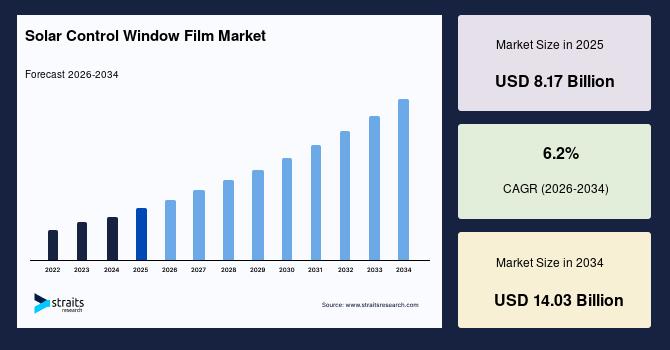
| 2025 Market Valuation | USD 8.17 Billion |
| Estimated 2026 Value | USD 8.67 Billion |
| Projected 2034 Value | USD 14.03 Billion |
| CAGR (2026-2034) | 6.2% |
| Dominant Region | North America |
| Fastest Growing Region | Asia-Pacific |
| Key Market Players | 3M (US), The Window Film Company (UK), Eastman Chemical Company (US), Garware Sun control (India), Avery Dennison Corporation (US) |
Download Free Sample Report to Get Detailed Insights.
Solar Control Window Film Market Drivers Growing Use in Buildings and VehiclesSolar control films are applied to windows to shield the interiors of buildings and vehicles from ultraviolet (UV) and infrared (IR) radiation (IR). The growth is fueled by the expansion of the construction industry and superior properties, such as energy efficiency and carbon footprint reduction. Additionally, strict laws governing energy consumption in commercial buildings have boosted product demand. Additionally, they provide insulation throughout the entire year. Due to harsh weather conditions, tropical nations like Brazil, Mexico, and India contribute significantly to the product's demand.
Multiple Benefits of Solar Control Window FilmThe expansion of the solar control window film market is fueled by the numerous benefits of these films, such as the reduction in energy usage. By letting natural light through the window glass, these films improve temperature regulation, reduce fading of inside furnishings, and regulate glare. Films of superior quality can block up to 79% of the sun's heat and reduce glare by up to 85%. In addition, they are simple to install and maintain and have a longer lifespan; as a result, they provide a more cost-effective solution than more expensive windows and glasses.
Market Restraint Availability of Alternative ProductsThe global market is facing a massive problem in the form of a critical issue in the availability and acceptance of alternative solutions such as smart glasses. This issue presents a significant hurdle for the market. On the other hand, the low cost of these films compared to their competitors' expenses ensures that this limitation's effect is relatively insignificant.
Market Opportunity Rising Environment and Health ConcernsResidential, commercial, and industrial sectors are implementing measures to reduce the total energy consumed. Due to improving consumer lifestyles and a sizeable disposable income per capita, air conditioners are the leading energy consumers. In addition, nearly 1 trillion kilowatt-hours of power are consumed by automobiles' heating, ventilation, and air conditioning systems. These coatings block more than 82% of solar energy, saving more than 31% on utility bills. In addition, the government has supported the industry's efforts to reduce carbon footprints. India has proposed to reduce its carbon emissions by more than 31% by 2030.
Regional AnalysisThe global solar control window films market is segmented into five regions, namely North America, Asia-Pacific, Europe, Latin America, and the Middle East and Africa.
Asia-Pacific emerged as the fastest-growing market and is anticipated to grow at a CAGR of 10.9% during the forecast period. Rapid industrialization and commercialization in India, Thailand, and South Korea are primarily responsible for this region's economic expansion. According to Invest India, India's construction market is predicted to grow at a CAGR of 5.6% during the forecast period. The expansion of telecommunications, banking, financial services, and information technology has increased the demand for commercial space, driving construction costs and boosting the regional market for solar-controlled window films.
The North American market held the most significant market share. This region's rapid expansion is attributable to increased infrastructure development. As lending requirements have been relaxed and the residential construction market has recovered, the building industry in this area is expanding. This area is anticipated to develop at a CAGR of 6.1%, the second-highest growth rate after Asia-Pacific. The residential construction industry's recovery has propelled this country's solar control window film market.
By ApplicationThe construction industry is dominating the market and is anticipated to grow at a CAGR of 6.2% during the forecast period. According to the Asian Development Bank, Asia-Pacific is predicted to invest between USD 8 trillion and USD 9 trillion in new infrastructure operations between 2022 and 2030, fueling the growth of the construction industry. Automotive is the second-largest market for sun control window films. Increasing temperatures and a growing worldwide automobile sector have boosted the demand for solar control window films. However, stringent regulations regarding the colors of these products on vehicles may impede market expansion.
By ProductThe vacuum-coated solar control window films maintained the most significant share and are anticipated to grow at a CAGR of 6.4% during the forecast period. The presence of metal in the product has the dual effect of reflecting incoming heat and shielding the body from cancer-causing ultraviolet (UV) rays. Compared to other films, these films reflect the most significant amount of solar radiation, which helps maintain the interiors at a cooler temperature.
List of Key and Emerging Players in Solar Control Window Film Market 3M (US) The Window Film Company (UK) Eastman Chemical Company (US) Garware Sun control (India) Avery Dennison Corporation (US) Saint-Gobain (France) Madico, Inc (US) Solar Screen International SA (Luxembourg) Johnson Laminating & Coating, Inc (US), and NEXFILUSA (US) Recent Developments-
In March 2026, 3M Company expanded its architectural window film portfolio with enhanced nano-ceramic solar control films designed to improve heat rejection while maintaining high visible light transmission for commercial buildings.
In January 2026, Eastman Chemical Company (LLumar brand) announced capacity expansion for its performance films manufacturing facility to meet rising global demand for energy-efficient window films.
In December 2025, Saint-Gobain (Solar Gard division) introduced an upgraded solar control film range with improved UV protection and durability targeting automotive and architectural segments.
| Report Metric | Details |
|---|---|
| Market Size in 2025 | USD 8.17 Billion |
| Market Size in 2026 | USD 8.67 Billion |
| Market Size in 2034 | USD 14.03 Billion |
| CAGR | 6.2% (2026-2034) |
| Base Year for Estimation | 2025 |
| Historical Data | 2022-2024 |
| Forecast Period | 2026-2034 |
| Report Coverage | Revenue Forecast, Competitive Landscape, Growth Factors, Environment & Regulatory Landscape and Trends |
| Segments Covered | By Application, By Product |
| Geographies Covered | North America, Europe, APAC, Middle East and Africa, LATAM |
| Countries Covered | US, Canada, UK, Germany, France, Spain, Italy, Russia, Nordic, Benelux, China, Korea, Japan, India, Australia, Taiwan, South East Asia, UAE, Turkey, Saudi Arabia, South Africa, Egypt, Nigeria, Brazil, Mexico, Argentina, Chile, Colombia |
Download Free Sample Report to Get Detailed Insights.
Solar Control Window Film Market Segments By Application-
Construction
Automotive And Transportation
Marine
Decorative
-
Clear Films
Dyed Films
Vacuum Coated Films
-
North America
Europe
APAC
Middle East and Africa
LATAM

Legal Disclaimer:
MENAFN provides the
information “as is” without warranty of any kind. We do not accept
any responsibility or liability for the accuracy, content, images,
videos, licenses, completeness, legality, or reliability of the information
contained in this article. If you have any complaints or copyright
issues related to this article, kindly contact the provider above.
Most popular stories
Market Research

More Story








Comments
No comment