










403
Sorry!!
Error! We're sorry, but the page you were looking for doesn't exist.
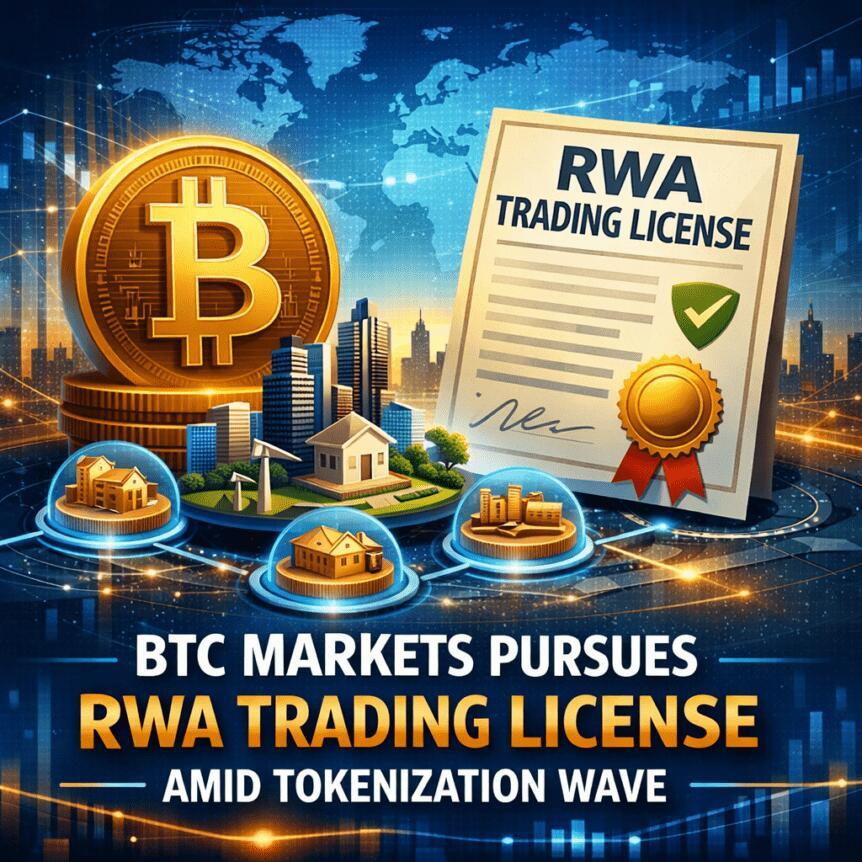
BTC Markets Targets RWA Trading License Amid Tokenization Wave BTC Markets Aims For RWA Trading License As Tokenization Booms BTC Markets Eyes RWA Trading License As Tokenization Surges BTC Markets Pursues RWA Trading License Amid Tokenization Wave
(MENAFN- Crypto Breaking) Australian crypto exchange BTC Markets has informed the country's securities regulator, the Australian Securities and Investments Commission, of its plan to apply for a markets license that would enable regulated tokenized real-world assets (RWAs) to be offered to the public. CEO Lucas Dobbins articulated a vision of licensing infrastructure that permits certain tokenized assets to trade in a regulated environment, with the aim of a future where tokenized equities, bonds and RWAs sit alongside cryptocurrencies, markets run continuously, and settlement happens near-instantly. Dobbins highlighted that the current on-chain universe of tokenized assets-roughly $26 billion-represents a proof of concept rather than the full potential. He pointed to forecasts that tokenized markets could reach around $2 trillion by 2030, while research from the Boston Consulting Group has suggested a possible opportunity as high as $16 trillion. The momentum here is reinforced by statements that the on-ramp to regulated, compliant markets is now a practical objective rather than speculative theory, with major banks moving from pilot projects to product launches.Key takeaways
- Australian regulator-facing exchange BTC Markets intends to pursue a markets license with ASIC to offer regulated tokenized RWAs, signaling a formal regulatory pathway for asset tokenization in Australia. The on-chain value of tokenized RWAs sits at about $26.5 billion, with Ethereum commanding the largest share at 57.4% of the market, excluding layer-2 and EVM platforms. Analysts project a broad spectrum of potential size for tokenized markets: around $2 trillion by 2030, and up to $16 trillion per the Boston Consulting Group, underscoring the scale of the opportunity. Tokenized RWAs are moving from theory to practice as institutions like BlackRock, Goldman Sachs and JPMorgan push real products into the market, while exchanges such as Kraken and Robinhood have begun offering tokenized RWAs in 2025. Australia's regulatory environment, deep capital markets and one of the world's largest pension systems position the country to play a meaningful role in a next wave of tokenized finance, particularly in private markets, infrastructure investments, and fund distribution. Broader activity in the space includes Kraken 's xStocks platform and the xChange engine for tokenized stock trading, Robinhood 's tokenized stock initiatives in Europe, and Coinbase 's announced Coinbase Tokenize platform for RWAs.
Tickers mentioned: $ETH, $COIN
Market context: The move by BTC Markets aligns with a wider push across crypto and traditional finance toward regulated tokenized assets, supported by ongoing infrastructure development, larger institutional involvement, and clearer regulatory guidance in key markets. The activity also aligns with a trend where major exchanges and banks are exploring, piloting, or launching tokenized instruments to improve liquidity and access to capital.
Why it mattersTokenized RWAs promise to extend the reach of traditional assets into a digital, on-chain ecosystem, potentially reducing settlement times and widening access to markets for otherwise illiquid assets. The Australian project's emphasis on licensing infrastructure reflects a maturation of the space-from early blockchain pilots to regulated offerings that require compliance frameworks, custody solutions, and robust participant protections. If Australia succeeds in creating a trusted, licensable pathway for tokenized RWAs, it could attract both domestic and foreign capital seeking regulated exposure to real-world assets such as private equity, infrastructure projects, and fixed income instruments.
The broader market context is equally instructive. On-chain visibility for tokenized RWAs remains strong despite broader crypto market headwinds, with RWA reporting an on-chain total value of about $26.5 billion. Ethereum dominates the space, illustrating how core smart contract platforms are shaping the structure and accessibility of tokenized assets. This backdrop helps explain why institutions like BlackRock, Goldman Sachs, and JPMorgan have already moved beyond pilots and are actively launching products in tokenized finance. The evolution is not just about trading tokens; it encompasses on-chain settlement, regulatory-compliant issuance, and the integration of RWAs into traditional trading rails.
BTC Markets' leadership in pursuing a regulated model underscores a practical shift: tokenization can be anchored in rigorous compliance and investor protection while still delivering the efficiency and openness promised by blockchain-based markets. The Australian context-strong regulatory oversight, deep capital markets, and a robust pension framework-could serve as a proving ground for tokenized structures that other jurisdictions may later adopt or adapt. As Dobbins notes, the opportunity is not merely theoretical; the question is how quickly licensed market infrastructure can scale to meet demand while maintaining appropriate safeguards.
Looking ahead, the first tangible use cases are expected to emerge in areas where tokenization can deliver meaningful efficiency gains-private markets, infrastructure investments, and fund distribution-where compliance, transparency, and access are paramount. In the meantime, platforms already in motion-with Kraken's tokenized stock initiative via xStocks and the xChange on-chain trading engine, Robinhood's European tokenized stock plans, and Coinbase's upcoming Tokenize platform-signal a broader shift toward institutional-grade tokenized RWAs that complement rather than replace traditional markets.
The Australian context also points to a broader regulatory and infrastructural arc that could influence global adoption. The Digital Finance Cooperative Research Centre has highlighted a substantial potential to generate economic gains from tokenized markets in Australia, with estimates around AUD 24 billion per year (about USD 16.8 billion), representing roughly 1% of GDP. If current trajectories hold, the country could capture a fraction of that opportunity by 2030-but achieving scale will depend on licensed infrastructures that can trade tokenized assets within trusted, well-regulated frameworks. Dobbins emphasizes the need for these licensed pathways to unlock the full value of tokenization and to empower broader participation across private markets, infrastructure projects, and fund distribution channels.
What to watch next- ASIC decisions and timetables on BTC Markets' market license application, including interim licensing milestones and infrastructure requirements. Regulatory developments in Australia that outline the rulebook for tokenized RWAs, including custody, KYC/AML, and investor protections. Adoption milestones from major leaders in tokenized finance, including Kraken's xStocks and xChange progress, and Coinbase Tokenize's deployment plans for RWAs. Tracking on-chain RWAs total value as more assets tokenize, with Ethereum continuing to hold a large share of on-chain tokenized assets. Economic impact studies from Australia's DFCRC and other market analyses that quantify uptake in private markets, infrastructure, and distribution channels as tokenized products mature.
- BTC Markets' tokenisation blog post outlining licensing plans: RWA on-chain value and share of Ethereum from RWA: and tokenized RWAs article: class="thirstylink" rel="nofollow sponsored noindex" target="_blank" title="CoinTelegraph" href="" data-linkid="233844" data-shortcode="true">cointelegraph /news/tokenized-rwas-climb-despite-crypto-market-rout Kraken's tokenized stock initiatives (xStocks) and xChange platform: class="thirstylink" rel="nofollow sponsored noindex" target="_blank" title="CoinTelegraph" href="" data-linkid="233844" data-shortcode="true">cointelegraph /news/kraken-xstocks-platform-xchange-engine-tokenized-stock-trading Intercontinental Exchange's blockchain trading platform development for tokenized securities: Coinbase Tokenize announcement: Australia's tokenization economic potential from the Digital Finance Cooperative Research Centre:
BTC Markets' move to seek a markets license with ASIC marks a pivotal step in the practical deployment of tokenized RWAs in a regulated environment. While tokenized assets have already demonstrated significant on-chain activity, the transition from proof of concept to regulated market infrastructure requires robust custody, compliance, and risk controls. The company's statement suggests a strategic intent to align with investor protection standards while expanding the spectrum of tradable on-chain instruments beyond cryptocurrency, setting the stage for a future where tokenized equities, bonds, and real-world assets coexist with digital assets in a single, regulated marketplace.
The broader market context remains favorable for continued growth in tokenized finance, provided that regulatory clarity keeps pace with technology and market needs. Australia's regulatory readiness, combined with deep capital markets and a large pension system, could attract both domestic and international participants seeking regulated exposure to RWAs. As the space evolves, institutional engagement-evidenced by BlackRock, Goldman Sachs, and JPMorgan's efforts-will likely drive further product development and liquidity, while on-chain tooling and platform interoperability will be critical to sustaining the momentum. In this dynamic landscape, Australia's experiment may offer a blueprint for how licensed, compliant tokenized markets can scale responsibly, delivering the promised efficiency gains without compromising investor protection.
Risk & affiliate notice: Crypto assets are volatile and capital is at risk. This article may contain affiliate links.
Legal Disclaimer:
MENAFN provides the
information “as is” without warranty of any kind. We do not accept
any responsibility or liability for the accuracy, content, images,
videos, licenses, completeness, legality, or reliability of the information
contained in this article. If you have any complaints or copyright
issues related to this article, kindly contact the provider above.
Most popular stories
Market Research

More Story






Comments
No comment