



403
Sorry!!
Error! We're sorry, but the page you were looking for doesn't exist.
Why Kashmir Pays More For Medicines Than The Rest Of India
(MENAFN- Kashmir Observer) IN many homes across Jammu and Kashmir, the pharmacy bill has become as routine as the electricity bill. The difference is that it keeps rising, and it eats into incomes that already trail the rest of the country.
ADVERTISEMENT
Figures from the Ministry of Statistics and Programme Implementation show India's per capita Net National Income at current prices stood near ₹1.97 lakh in 2022-23 and moved higher in 2023-24. Economic surveys of Jammu and Kashmir place regional per capita income below that mark.
ADVERTISEMENT
Budget documents in recent years have put it roughly between ₹1.55 and ₹1.68 lakh per person, while the national average crossed ₹2 lakh.
That gap shows how hard every recurring expense hits, especially health care. National health financing data reveal where the pressure falls.
The National Health Accounts report that out-of-pocket payments account for about 47 percent of total health expenditure in 2020-21. Medicines form the largest share of that spending, typically 35 to 40 percent.
Findings from the National Sample Survey Office confirm that drugs dominate household medical expenses in both rural and urban India. When incomes are lower and medicine spending is recurring, the strain deepens quickly.
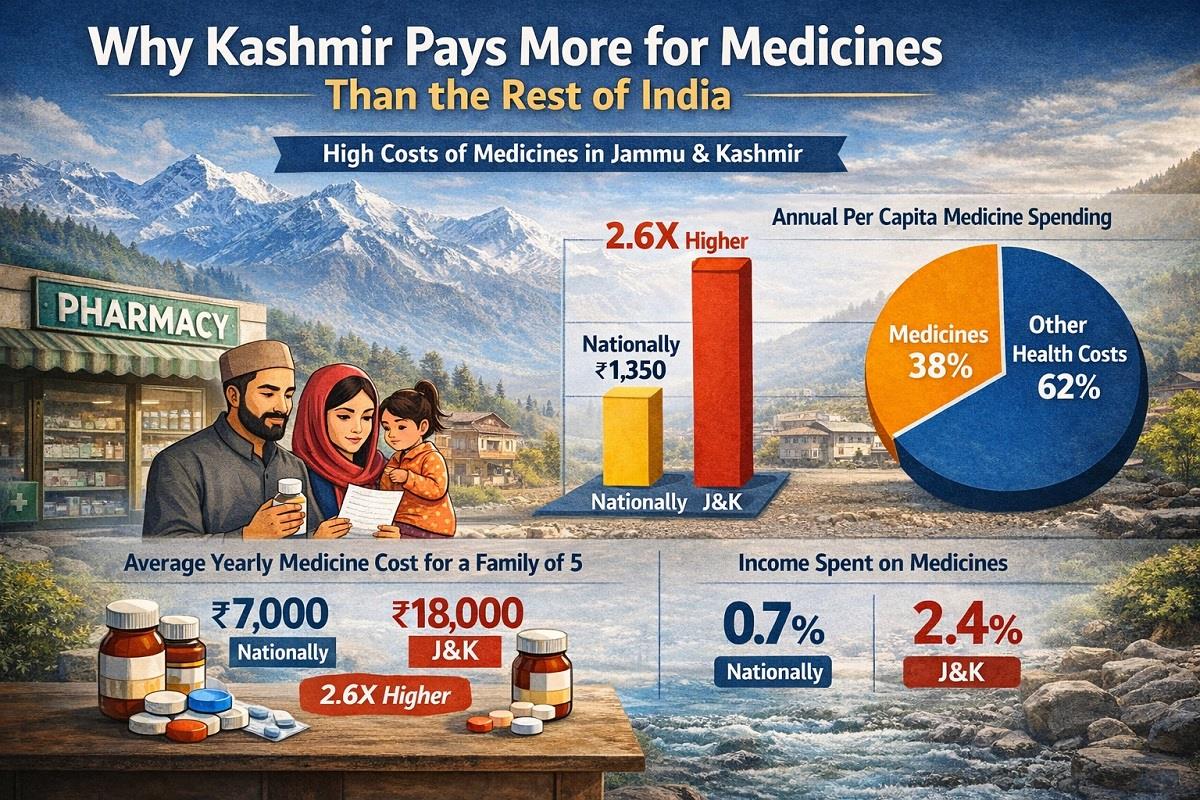
Retail-based expenditure assessments cited by health economists place India's average annual per-person medicine spending at roughly ₹1,300 to ₹1,400. Pharmacy trend estimates and regional market analyses suggest annual per-person spending in Jammu and Kashmir approaches ₹3,600.
A family of five nationally may spend about ₹7,000 a year on medicines. But a similar family in Jammu and Kashmir may spend close to ₹18,000.
That means families here spend roughly 2.6 to 2.8 times more than the national average on prescriptions.
Medicines absorb about 0.6 to 0.7 percent of income nationally, while regional estimates place the share in Jammu and Kashmir near 2.3 to 2.4 percent.
ADVERTISEMENTOnce those numbers are applied to the region as a whole, the scale becomes striking.
Census-based projections place Jammu and Kashmir's population near 1.3 crore. At about ₹3,600 per person each year, total annual medicine spending approaches ₹4,700 to ₹4,800 crore.
At the national per-person level of roughly ₹1,350, the total would sit closer to ₹1,800 crore. The implied difference nears ₹3,000 crore every year.
Over a decade, that cumulative gap rises toward ₹30,000 crore in additional household outlays compared with national patterns.
The impact sharpens at family level when time enters the equation.
A household spending ₹18,000 annually instead of ₹7,000 commits about ₹11,000 more each year to medicines. If costs and usage grow at 10 percent annually, cumulative excess spending over 20 years can reach ₹4 to ₹5 lakh.
Financial modeling shows that investing ₹11,000 per year at a 10 percent annual return builds a corpus of roughly ₹6.7 lakh over two decades.
Combined, the extra spending and lost investment growth approach ₹10 to ₹12 lakh per family. Applied to an estimated 8 to 9 lakh families in the Union Territory, the long-term wealth impact moves toward ₹80,000 to ₹1,00,000 crore.
Behind these numbers lies a shift in disease patterns.
Research led by the Indian Council of Medical Research through the India State-Level Disease Burden Initiative documents rising hypertension, diabetes and cardiovascular risk in northern states, including Jammu and Kashmir. The National Family Health Survey 2019-21 round reports growing levels of elevated blood pressure and blood glucose among adults. Chronic conditions demand continuous treatment.
A patient managing diabetes or hypertension may spend ₹500 to ₹2,000 per month depending on brand and dosage, translating into ₹6,000 to ₹24,000 annually for a single condition.
Supply chains and pricing structures amplify that burden.
Himachal Pradesh hosts more than 600 pharmaceutical manufacturing units and contributes a substantial share of India's drug formulations, according to the Department of Pharmaceuticals. Jammu and Kashmir depends heavily on medicines transported from such hubs.
Market studies and investigations by the Competition Commission of India describe trade margins in certain branded generics ranging from 200 percent to as high as 1,000 percent between ex-factory price and maximum retail price in segments outside strict controls.
The National Pharmaceutical Pricing Authority caps prices for medicines listed under the National List of Essential Medicines, while many non-scheduled branded generics remain outside firm ceilings.
Industry illustrations show strips leaving factories at ₹5 to ₹10 reaching retail prices of ₹80 to ₹120 after company pricing decisions, distributor margins and retailer shares.
But public programs aim to reduce those costs.
The Pradhan Mantri Bhartiya Janaushadhi Pariyojana, implemented by the Pharmaceuticals and Medical Devices Bureau of India, operates hundreds of outlets in Jammu and Kashmir. Official releases report sales in the Union Territory reaching tens of crores annually, with consumer savings several times higher compared with branded equivalents. Nationally, cumulative savings run into thousands of crores.
Read Also Nimesulide Oral Formulations Above 100 mg Banned Kashmir's Prescription Problem: The Rise of Pregabalin MisuseThe World Health Organization affirms that quality-assured generics match branded medicines in safety and efficacy, strengthening the economic case for substitution.
Insurance expansion further provides a cushion for major hospital expenses. Ayushman Bharat Pradhan Mantri Jan Arogya Yojana and its SEHAT extension offer coverage up to ₹5 lakh per family per year for secondary and tertiary care admissions.
But outpatient medicines for chronic illness continue to rely largely on household budgets, which keeps monthly pharmacy bills central to family finances. Public hospitals provide selected essential medicines and diagnostics without charge, though availability varies by district and procurement cycle.
Diet and substance use trends also define long-term medicinal costs. Enforcement updates from the Food Safety and Standards Authority of India document action against adulteration in edible oils, milk and spices.
Regional authorities have acknowledged rising substance abuse concerns and expanded de-addiction services, recognizing the medical and economic consequences of addiction.
Taken together, the data tell a consistent story: Jammu and Kashmir combines lower per capita income with higher estimated per-person medicine spending, rising chronic disease prevalence and brand-driven retail pricing.
Annual differences measured in thousands of rupees per household grow into crores at regional scale and lakhs over a generation.
Evidence from national income statistics, health accounts, disease surveys and competition studies supports a path centered on prevention, rational prescribing, transparent pricing and wider adoption of quality-assured generics.
Families managing prescriptions every month feel the burden in real time, while structural reform shows a way to turn recurring drug expenses into lasting financial stability.
Legal Disclaimer:
MENAFN provides the
information “as is” without warranty of any kind. We do not accept
any responsibility or liability for the accuracy, content, images,
videos, licenses, completeness, legality, or reliability of the information
contained in this article. If you have any complaints or copyright
issues related to this article, kindly contact the provider above.
Most popular stories
Market Research

More Story




Comments
No comment