




403
Sorry!!
Error! We're sorry, but the page you were looking for doesn't exist.
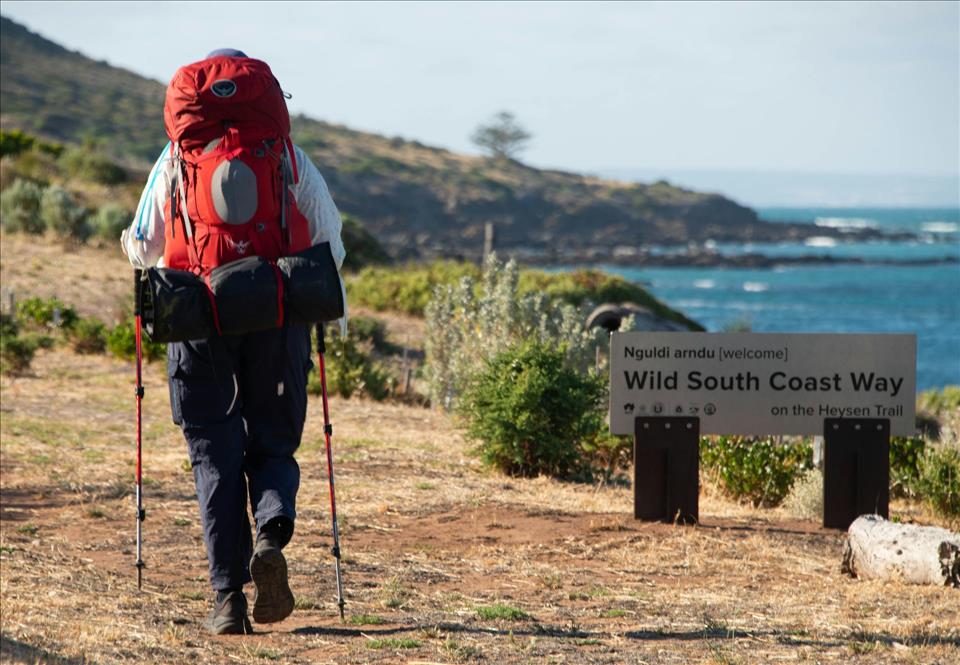
Friday Essay: I Thought A 5-Day Solo Hike Would Reclaim A Lost Self. My Menopausal Body Had Other Plans
Author: Rachael Mead
(MENAFN- The Conversation) I've been on the trail for three hours, the first time I fall.

The coastal scrub has opened into rolling hillsides of summer-gold grass, the sea wind blustering the dry stalks. Climbing uphill has begun to take its toll, but it's the downhill sections that bring me undone. Stepping onto dry, flattened grass, my boot shoots out and I land hard on my left side, knee cracking onto rock, shoulder wrenched sideways under the weight of my pack.
I lie there, gasping. When I try to sit up, the pack pins me to the ground. I'm a turtle flipped onto its shell. The path falls away on my right, so rolling onto my side only worsens the situation, the pack now pulling me downhill.
If I slip my arms from the straps, the pack will tumble to the dry creek bed below. Already tired and now sore, I don't like my chances of retrieving it, hoisting it back on, and scrambling out of the ravine. Even if I manage not to lose the pack, I'm no longer confident I have the strength to deadlift it onto my back.
The only option is to keep my centre of gravity on the trail and haul myself upright with the pack still on.
I am 55, and until recently my body has been one of the most reliable instruments I've owned. It has carried me across Antarctic ice sheets, through half marathons, across the interminable demands of writing books and a PhD.
Since menopause in 2023, that reliability has quietly eroded. What this stage of life has brought feels less like a transformation than a displacement – the sense the person who did those things now belongs to a different body altogether.
I've always loved hiking – the sense of immersion, the intimacy of the connection between my feet and the land, the feeling of triumph at the end of a multi-day trek. Planning this solo trip, I told myself it was a way of reconnecting with that adventurous self, learning the contours of a changed body.
What I wanted, though I did not yet name it, was reassurance: that menopause had not marked the end of who I was.
Osteoarthritis and a knee replacement have meant that in the past few years, I've done more vicarious hiking than the boots-on-the-ground kind.
But in my reading of hiking memoirs, particularly by women, I began to notice a silence in the genre. Where were the voices of older women walking the trails in Australia? My mind started whirring. I'd write about my experience and begin to fill the gap.
My body had other ideas.
Becoming unrecognisableThe critical moment hit at the checkout in Officeworks, in early 2025. For the last few years, I'd been joking that I no longer recognised myself in the mirror. But on the day I held up the queue because my phone did not accept my face, I realised this was more than a menopausal woman having a bad day under unflattering lights.
Looking back, it would be easy to say it crept up on me. I went into the pandemic perimenopausal and came out the other side without a drop of oestrogen on board. My doctor prescribed patches, but my anxiety and depression escalated so dramatically that white-knuckling my way through the onslaught of symptoms with diet and exercise felt like the option most likely to keep me from suicide or heart attack.
Compared to friends, my physical symptoms weren't especially extreme. The hot flushes were unpleasant, but I worked from home, so the odd drench of sweat in the supermarket wasn't a catastrophe. And on the rare occasion I found myself madly fanning my face with term-deposit brochures while talking to a bank manager young enough to be my son, I was proud to treat it as a menopause consciousness-raising opportunity.
At first, the anxiety and brain fog were the worst of it. My memory was shot. I struggled to speak in full sentences and became convinced I was sliding toward early-onset dementia. My husband was certain that every time we spoke, I was also mentally conversing with someone else on an entirely different topic.
As the months passed, symptoms piled up. I hadn't realised how much heavy lifting hormones were doing until they were gone. Insomnia, hair loss, sore joints, papery skin, weak nails. A metabolic rate so slow it felt as though all food was immediately packed away as fat, while my body fuelled itself on rage alone. Then my knee finally wore out and my eyes developed cataracts.
This body that had carried me through adventures across the world, this brain that had wrestled and reasoned me through a PhD thesis – none of it worked the same. In the past, whenever I doubted my ability or capacity, I could draw on those memories, knowing I had dragged myself over finish lines that demanded capability and endurance from both mind and body.
Those achievements had now lost their power. They belonged to a different body, a different person altogether. The person wearing the face my phone once recognised, not the face I'd begun to avoid in the mirror.
On the trailWhy had I insisted on doing this solo? That morning, I'd hugged goodbye to my husband – my usual hiking partner.
Now, lying on the ground, staring up at the stretch of unblemished blue, I remember the pattern we fell into on Tasmania's Overland Track: helping each other into our packs after breaks, adjusting straps, fishing water bottles from impossible-to-reach side pockets. With strength born of sheer desperation, I haul myself onto my knees, then feet. The pack skews my centre of gravity so completely, I feel as if I'm inhabiting a stranger's body.
When I set out that morning it was, by any measure, a perfect day for a hike. The temperature in the low twenties, the sky stretched clear and blue from the hills of South Australia's Fleurieu Peninsula on my left to the hump of Kangaroo Island on my right.
It's January – not my preferred month for a local trek – but the forecast promised a rare stretch of mild weather, and I've spent six months trying to clear five days in my calendar for the Wild South Coast Way.
It was now, or another season-long delay. I'd already booked and cancelled the hike twice. The first time, I came down with COVID. The second cancellation was made in fear of being caught on the trail during a forecast once-in-a-century storm.
Alongside the challenge of finding five-day stretches free of work and family obligations, facing the modern hazards of COVID and climate crisis-induced extreme weather events all felt inextricably linked with this phase of life.
Devouring nature writingFor much of my adult life, I have been drawn to nature writing – especially walking narratives. The lone figure in the wilderness, kit pared back to essentials, enduring hardship and isolation. The body is tested, the mind sharpens, an epiphany is reached. The figure returns altered, newly respectful of the wild and with a fresh perspective on the shortcomings of the modern world.
It's a structure so familiar it can feel almost mythic, and for a long time it worked on me. The solitary male walker sets out into wilderness to think, to harden, to strip away the veneer of civilisation.
I devoured these books not only for their landscapes, but for their confidence that immersion in the wild and endurance of its challenges leads somewhere meaningful – that pain suffered and overcome while submerged in the natural world is a rite of passage to a better, more authentic version of ourselves.
These narratives have traditionally been written by men. American conservationist John Muir 's many works of nonfiction and essays about his experiences in nature, including his 1,000-mile trek from Indiana to the Gulf of Mexico. Intrepid traveller and ex-soldier Patrick Leigh Fermor 's travel writing about his walk from the Hook of Holland to Constantinople.
Robert Macfarlane's many mountaineering and hiking adventures, especially my favourite, The Old Ways, in which he follows ancient tracks across the United Kingdom and Europe. And even the delightfully self-deprecating A Walk in the Woods by Bill Bryson, about his attempt at the Appalachian Trail. These are just a few famous examples.
But I have also loved the feminist reworkings of this trope, such as Wild, Cheryl Strayed's account of walking the Pacific Northwest trail and Abi Andrews' novel The Word for Woman Is Wilderness. These books trace the experience of women's bodies and minds across long tracts of wilderness.
Other books, such as Nan Shepherd's The Living Mountain, on her journeys into the Cairngorm mountains of Scotland, prioritise deep connection with place. Rather than hiking across new terrain, Shepherd revisits the same one beloved region again and again throughout her life, forging an intense connection through observation and the accumulation of detailed knowledge over time.
The wreck of EnduranceSetting out from the Cape Jervis trailhead, the sandy path is flat. A Southern Ocean breeze cools my face as I adjust to the 20 kilos on my back. Water and camping gear announce themselves in complaints from various parts of my body. I can see footprints ahead, evidence of someone who set out before me.
But aside from that imagined presence, I'm alone. Once my body finds a rhythm, the solitude feels like a luxury: setting my own pace without worrying about keeping up or holding anyone back – it feels precious, this ability to move without accounting for anyone needs but my own.
The trail allows stretches where I can forget the grumbles of my body and focus on the landscape - seabirds, dolphins, insects, plants, the padded thud of a kangaroo speeding through the coastal heath between me and the cliff edge above the cobalt ocean.
On a day walk I'd linger, field guides in hand, but this backpack is already pushing the limit of my capacity. The trail will be relatively flat for the first ten kilometres; the final six, between Blowhole Beach and Eagle Waterhole campsite, legendarily hard: a climb of 280 metres over one and a half kilometres, then two kilometres through a steep, rocky ravine.
Hours pass. Energy seeps like a slow puncture. The pack grows heavier with every rise. Flies treat my sweaty face as a landing pad.
On the interminable climb of Cobbler's Hill I find a rhythm, convincing myself the summit is close. When a young couple overtake me, I let them past with a smile-grimace and bravado-laden“nearly there,” only to be told I'm not even halfway.
The slow leak ruptures. I'm empty. My legs refuse more than ten steps at a time. I collapse into a patch of shade. My brain demands food but my gut rebels. Doubt floods in. It is clear I am not up to this.
But there's no alternative. No one is coming to save me. Aching, nauseous and sweating, I drag myself on, step by step.
Women walkingIn The Word for Woman Is Wilderness, Andrews flips the tradition of the man walking into the wilderness to“find himself” on its head. Her novel speaks back to male-authored nature writing, in both fiction and non-fiction (such as John Muir and Jack London). Her protagonist, Erin, sets off aged 19 to travel alone across Iceland, Greenland and Canada. She ends up living in a fire-tower in Alaska.
In centring a woman's experience in landscapes traditionally coded as masculine, Andrews uses cold, fear and isolation to expose how physical risk is celebrated in male bodies – but made to seem selfish and reckless in female ones, even when the conditions are identical.
Strayed's long walk in Wild positions pain as a transformative power: she is grieving her mother's rapid death from cancer and the end of her marriage. Her account of blisters, hunger, exhaustion and grief creates a potent narrative of physical endurance, scouring away accretions of shame and guilt in her quest to rediscover her authentic self.
I read both these books with great admiration in my forties. But in my fifties, I'm aware of something I barely noticed at the time: both protagonists were young. Their suffering was endured in bodies that were expected – both culturally and biologically – to mend, strengthen and harden. Pain, in these narratives, was not a signal to stop. It was a threshold to be crossed.
After my walk, I will find myself thinking about these books differently. What once felt inspirational has shifted – as if I should now approach this idea with caution.
There are older women in the walking canon, but they often appear at an angle to achievement. Dorothy Wordsworth, whose journals record some of the most observant, insightful and yet overlooked prose about walking, was forced to give up long walks after she turned 50, as illness took hold.
Virginia Woolf regularly walked in both urban and rural environments, using movement to both hone her prose and manage her health. The exercise was a means of fostering stability, rather than pushing physical limits. But ultimately, walking was not enough. We all know the unfortunate conclusion to Woolf's struggle.
One rare, successful book by an older woman is writer, sociologist and abolitionist, Harriet Martineau. She took to walking in her fifties as part of her recovery after prolonged illness, using daily walks through the UK's Lake District to rebuild stamina and anchor herself in place rather than attempting feats of endurance or conquering summits. In the letters included in her Autobiography, published in 1877, she writes:
These women walked, but they were not seeking epiphany, transformation or victory. Their movement was careful, dictated by bodies that required negotiation, rather than suppression of physical limits in the pursuit of some extreme objective.
An interesting contemporary addition to the genre is the now controversial bestseller, The Salt Path. In this walking narrative, middle-aged Raynor Winn and her husband undertake an extraordinary long-distance trek along the South West Coast Path in England, while – according to the book – living with illness and economic precarity.
Last July, an Observer investigation cast doubt over key aspects of Winn's story, including the details of both the illness and their economic and housing situation.
Winn's physical achievement is impressive, but her writing's value is now dependent not upon her endurance, but her perceived“truthfulness”. As a result of the controversy, Winn's fifth book, On Winter Hill, tracking her solo journey across northern England, has had its publication delayed until 2028.
The walking narrative's tendency to position fortitude as proof of moral worth perhaps complicated the reaction. Her body's achievement is no longer impressive if her account of the journey's catalyst is perceived as a lie. Neither her words nor her body can be trusted.
The issue of trust resurfaced as I prepared for this walk. In the gym, on my three-day hike of the Yurrebilla Trail, I found myself constantly scanning my body for weakness, calibrating levels of ache and fatigue against approaching distance and gradient. I realised the trust I had in my body and its capabilities was no longer solid.
Entangled with that doubt was a sense of unworthiness. If I failed to complete the walk, that failure would seep beyond the physical into how I saw myself – and how I believed others would see me.
An empty tankWhen the gradient finally eases, then tips downhill, my relief is short lived. The trail is stony and uneven. I fall again. I cut my hand; a toe throbs ominously. This time, there are trees beside the path and I use them to hoist myself upright.
The campsite appears like a mirage. I've been walking for eight hours. The tent sites are staggered uphill, and when I realise mine is at the top, my legs nearly fail. The last hundred metres take minutes.
Once the pack is off, my torso feels as though it might detach and float away from my aching hips and legs. The five litres of water I carried today have been drunk and sweated into the sea breeze. I lurch to the tanks with my empty bottles to find only a dribble. My taps on the metal bodies are answered with echoes.
There is no water.
I stand there longer than makes sense, listening to the hollow sound of metal. I tap again, as if repetition might change the physics of it. The light is softening. If there was water, I could make a plan – eat, sleep, reassess in the morning.
Without it, my options dwindle ominously. Even if the tanks at the next campsite are full, there's no guarantee of finding one along tomorrow's 13-kilometre trail. My map offers directions and distances, but no certainty of water.
This is the point where fitness and fortitude are eclipsed by the importance of another quality: a mental trait that does not always go hand in hand with physical impressiveness. I'm exhausted enough to know that judgement, not stamina, is now my most valuable characteristic.
Pushing on tomorrow might be heroic; but it would also be negligent.
I pitch the tent, moving carefully, aware of the preciousness of my energy. My body burns with fatigue, but underneath it there's an unexpected composure – the calm that arrives in moments of crisis, when everything hinges on steadiness and keeping panic at bay.
In a strange way, the situation feels eerily similar to menopause: pushing my body to complete something previously well within my capability, only to find the resources I'd once taken for granted now totally depleted.
But it's the rush of relief that truly surprises me. It arrives moments before the disappointment; before my inner editor begins her familiar feedback, marking up points of failure and weakness.
Older women walking soloWhen I went looking for narratives that reflected my own situation – an Australian woman in midlife, walking alone, in a body altered by menopause rather than injury or catastrophe – I found remarkably little.
The closest analogues were Robyn Davidson's Tracks and Sophie Matterson's The Crossing: both extraordinary odysseys across central Australia (with camels), but both undertaken in youth – Davidson at 27 and Matterson at 31. I recognised the arid landscapes immediately. But I no longer related to the bodies moving through them.
What my own walk revealed was not merely fatigue and failure, but a mismatch between the stories I'd absorbed and the body I now inhabit.
My beloved genre had taught me about the need to push, to endure, to suffer productively. But it's offered far less guidance on how to fail – not necessarily in defeat, but with discernment. And it has few touchstones of menopausal walkers to guide me through the thinking of why we should ask this of our bodies: and, if so, how.
I climb further uphill to find phone reception and call my husband. The conversation is brief, practical. We discuss logistics, not emotions. In the morning, I will backtrack a few kilometres, walk out to a road and be picked up. I sit for a long time, listening to the calls of the blue wrens and pardalotes as the blue deepens to black.
What unsettles me is not that I am stopping, but how swiftly my body jumped on board to confirm the decision. But in this moment, it doesn't feel like failure. It feels like common sense.
Before I came here, I believed I knew what this walk would ask of me: effort, endurance, discomfort, the familiar demands and rewards of tenacity. I had read enough walking narratives to trust that difficulty clarifies something essential, that sustained struggle strips away noise and returns the walker, however temporarily, to an essential self.
But standing at a campsite without water, I realise how little guidance those stories offer for this moment: an older woman, walking alone, in a body altered not by injury or catastrophe but by age and hormonal change, facing a decision where stopping is neither dramatic, nor redemptive – just sensible.
The question my body is asking now is something my reading has not prepared me for: not how far should I push myself, but why is this still important to me?
The sly gift of failureAfter my walk, thinking about the walking narratives I've read, I keep returning to the moment at the campsite when I realised there was no water. Not the drama of it – there was very little – but the way the problem presented itself as a logistical problem, rather than a failure of courage or stamina.
Distances could be calculated; the physical risk was a gamble. My body, already depleted, recognised my limits faster than my ego. What the literature had instilled in me was the belief that overcoming hardship proved worth. What it had not prepared me for was this quieter demand: to stop before endurance tipped into recklessness.
One of the silent privileges of ageing is perspective. Looking back over my life, I can see that many of the moments that shaped me most decisively arrived through failure rather than success. A failed marriage, work that broke me, ambitions that collapsed under their own weight. At the time, each felt like a defeat.
In retrospect, these failures forced me into introspection, reorientation and growth, catalysing choices that ultimately changed the trajectory of my life – for the better. Menopause, as Ursula K. Le Guin writes, is not a diminishment, but a profound change.
On the track, I had been thinking of this walk as a kind of reincarnation. But what the walk ultimately revealed was my resistance to transformation: I was still measuring this new body against the yardstick of my younger self.
Standing in that campsite, bottles empty, the decision to stop did not feel like failure, or quailing in the face of hardship. It felt like the accurate reading of conditions – internal and external – that walking is meant to sharpen.
Looking back at myself, the sad echo of those empty tanks ringing in my ears, stopping did not bring clarity in the way walking narratives often promise. There was no epiphany, no sudden reordering of values, no newly burnished critique of the world waiting for me when I returned home.
What it brought instead was something more unsettling: a recalibration of how I measure myself.
For much of my life, physical and mental endurance has functioned as a kind of moral shorthand. To persist was to be capable; to push through was to be serious. Walking a long distance alone was intended to shore up an idea of myself I was reluctant to let go.
Menopause has forced me to question this identity without offering a replacement. The body I now inhabit is not broken, but it is no longer amenable to all I ask of it. It holds and dispenses energy unpredictably. It demands consideration. It asks for recovery time with no regard for the deadlines and pressures of the broader world.
In this new relationship with my body, stopping becomes another example of positive failure. I need to foster judgement, self-trust and a willingness to resist a culture that equates worth with suffering. It also requires letting go of the idea that difficulty must always be instructive, that pain is how we pay for insight.
The absence I encountered in the literature – stories of older Australian women walking alone, negotiating risk without either catastrophe or conquest – matters because narratives shape what we imagine is possible. Without models that tell us otherwise, stopping will continue to look like inadequacy. Like failure.
But with these stories, we can frame consideration of the self as wisdom – a refusal to sacrifice our bodies to an idea of resilience that no longer fits.I don't know what future walking will look like for me. I only know that it will require different measures of success. Impressing myself may no longer mean how far I go, or how much I endure, but how precisely I read conditions – terrain, weather, energy, risk – and how willing I am to act on that reading without apology.
What I do know is that the walking still gives me the chance to be attentive to wonder. It sharpens my perception, not just of the natural world but of my body moving through it.
In midlife, that attentiveness asks for something quieter, yet trickier, than endurance. It asks for discernment: the ability to stop not because I cannot go on, but because going on would no longer be the most skilful response available. And in stopping I give myself the time and opportunity to glimpse another, less obvious path. One that might lead somewhere I hadn't thought to go.
Institution:Adelaide University

Legal Disclaimer:
MENAFN provides the
information “as is” without warranty of any kind. We do not accept
any responsibility or liability for the accuracy, content, images,
videos, licenses, completeness, legality, or reliability of the information
contained in this article. If you have any complaints or copyright
issues related to this article, kindly contact the provider above.
Most popular stories
Market Research

More Story



Comments
No comment