




403
Sorry!!
Error! We're sorry, but the page you were looking for doesn't exist.
Kashmir's 2026-27 Budget Brings Big Relief Now & Big Questions Later
(MENAFN- Kashmir Observer)
The Jammu and Kashmir budget for 2026-27, presented on February 6, reads like a direct response to everyday pressures.
ADVERTISEMENT
It promises better roads, improved power, wider water supply, more jobs and strong support for poor families.
ADVERTISEMENT
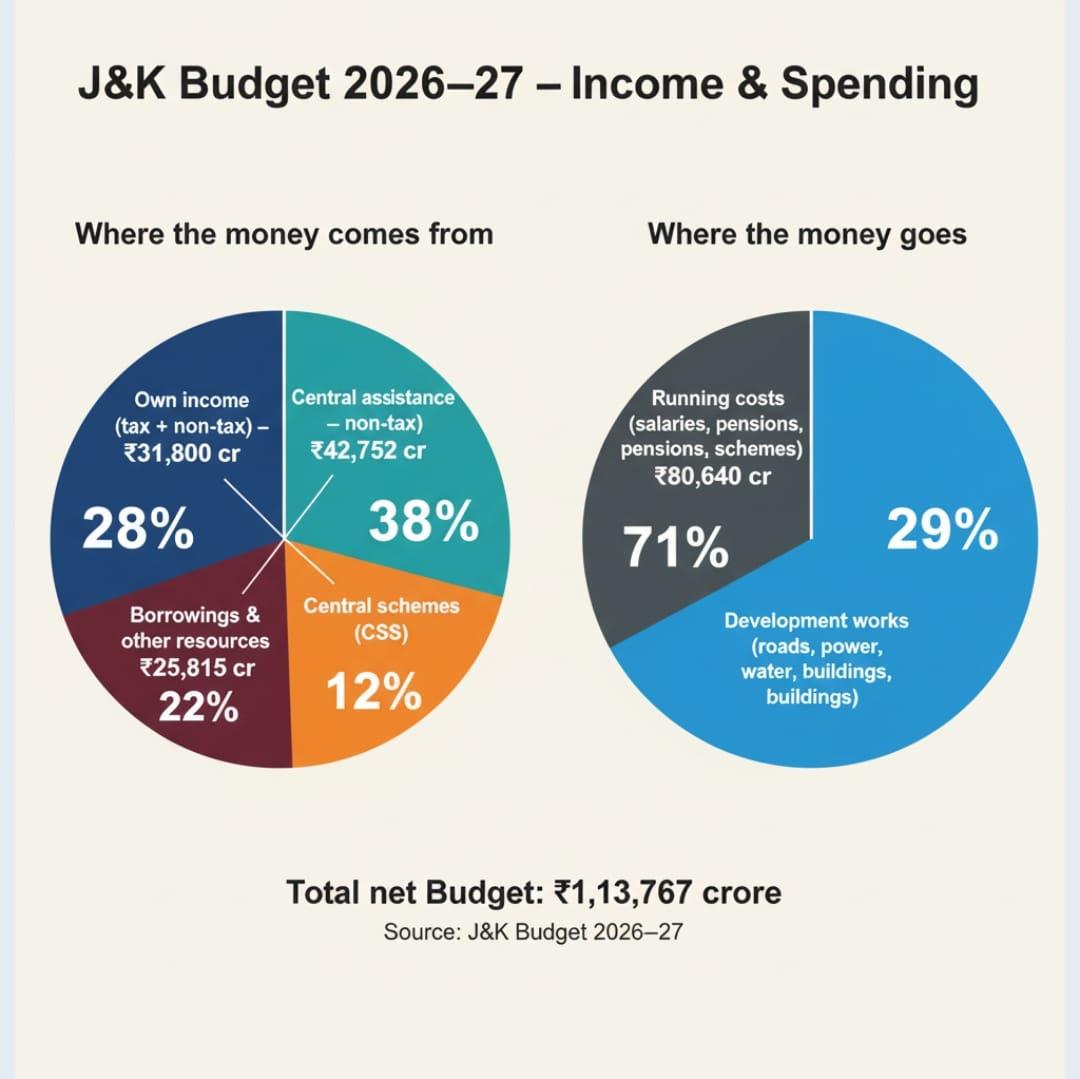
The total size stands at ₹1,13,767 crore, which signals ambition and reach.
At the same time, the numbers show a system that still depends heavily on money from Delhi and carries long term costs that will shape future choices.
The spending pattern explains the story clearly.
Around ₹80,640 crore goes toward routine expenses such as salaries, pensions and ongoing schemes. Development works receive ₹33,127 crore, covering roads, power projects, water systems, housing and public buildings.
J&K's own income from taxes and other sources reaches only ₹31,800 crore, close to one quarter of total needs. Central assistance of ₹42,752 crore, along with ₹13,400 crore under centrally sponsored schemes, fills most of the remaining gap.
The region continues to run largely on Central support rather than its own earnings.
At the household level, the budget feels generous and direct. Social security pensions expand to cover over ten lakh people. Families under the Antyodaya Anna Yojana receive ten kilograms of free ration per person every month, along with a proposal for six free LPG cylinders each year.
Children from these families get fee support from Class 9 through college when no other scholarship applies. Around six thousand orphans receive ₹4,000 every month straight into their bank accounts, bringing a sense of stability to lives often marked by uncertainty.
ADVERTISEMENTWomen and girls see measures that touch daily life and long term security.
All women can travel free on government buses and Smart City e-buses. Marriage assistance for poor AAY girls rises from ₹50,000 to ₹75,000. The Ladli Beti scheme continues to support nearly 1.92 lakh girls, linking financial help with education and social protection.
Jobs and youth programs form another major focus.
During 2025, the government provided 7,650 government jobs and plans to fill another 23,800 posts in the coming period. Mission YUVA shows strong momentum, drawing more than 70,000 applications and financing about 16,500 new enterprises through loans close to ₹800 crore.
The aim here lies in mixing public sector hiring with support for small businesses and self employment.
Farmers and rural communities also gain targeted support. The budget highlights better seeds, expanded irrigation, solar pumps and wider use of e-NAM for online crop sales.
Read Also J&K Assembly Budget Discussion Concludes Video: CM Defends Budget, Calls Opposition Criticism Politically MotivatedHigh density orchards, controlled atmosphere storage, weather based crop insurance and seven large milk plants aim to raise farm incomes. New dairy cooperatives and chilling units strengthen links between villages and markets.
Infrastructure spending remains the most visible promise.
The Udhampur-Srinagar-Baramulla rail line brings full rail connectivity to Kashmir. Expressways, highways, ring roads and tunnels continue to transform travel, while 2,400 villages move closer to all-weather road access and around 3,500 kilometres of roads get black topped.
In the power sector, projects such as Pakal Dul, Kiru, Ratle, Kwar and Sawalkote add more than 3,000 megawatts. Smart meters already show impact, cutting losses by nine percent and raising revenue by sixteen percent.
Around 2.22 lakh AAY households receive two kilowatt solar rooftops, offering free electricity for nearly twenty years.
Water supply and city services see steady expansion. Over 15.6 lakh rural homes now have tap water connections, covering about eighty one percent of households. Urban projects include sewage treatment plants, solid waste systems, cleaning of Dal and Wular lakes, and Smart City upgrades covering roads, parking and housing.
Digital governance runs silently beneath these changes.
J&K now offers 1,547 services online, ranking first among Union Territories and fourth nationwide. Systems such as Aadhaar linked direct benefit transfers, SPARSH payments, e-Office 2.0 down to block level, WhatsApp-based services and CSC Digi Dost centres reduce paperwork and speed up access when implementation stays clean and consistent.
The concerns appear once you look closer.
J&K still earns only about twenty five percent of what it plans to spend, which means real financial independence remains limited.
The fiscal deficit rises to 3.69 percent of GSDP. Salaries, pensions and interest payments take up nearly sixty percent of expenditure, leaving limited room to adjust spending priorities.
Revenue measures remain modest, centred on a ₹2 per litre cut in diesel rebate and tighter GST and excise enforcement.
Power sector losses continue to drain resources, while diesel price changes can raise transport and goods costs, affecting household budgets.
For many Kashmiris, the budget brings visible relief through better services, direct cash support, free travel for women and new job opportunities.
The same document also points to a future shaped by borrowing, high fixed costs and steady reliance on Central funds.
Stronger tax collection, cleaner power sector finances and tighter control over wasteful spending can turn this moment into lasting strength.
The choices taken after this budget will decide whether today's comfort grows into long term stability or places heavier demands on the years ahead.
Legal Disclaimer:
MENAFN provides the
information “as is” without warranty of any kind. We do not accept
any responsibility or liability for the accuracy, content, images,
videos, licenses, completeness, legality, or reliability of the information
contained in this article. If you have any complaints or copyright
issues related to this article, kindly contact the provider above.
Most popular stories
Market Research

More Story


Comments
No comment