




403
Sorry!!
Error! We're sorry, but the page you were looking for doesn't exist.
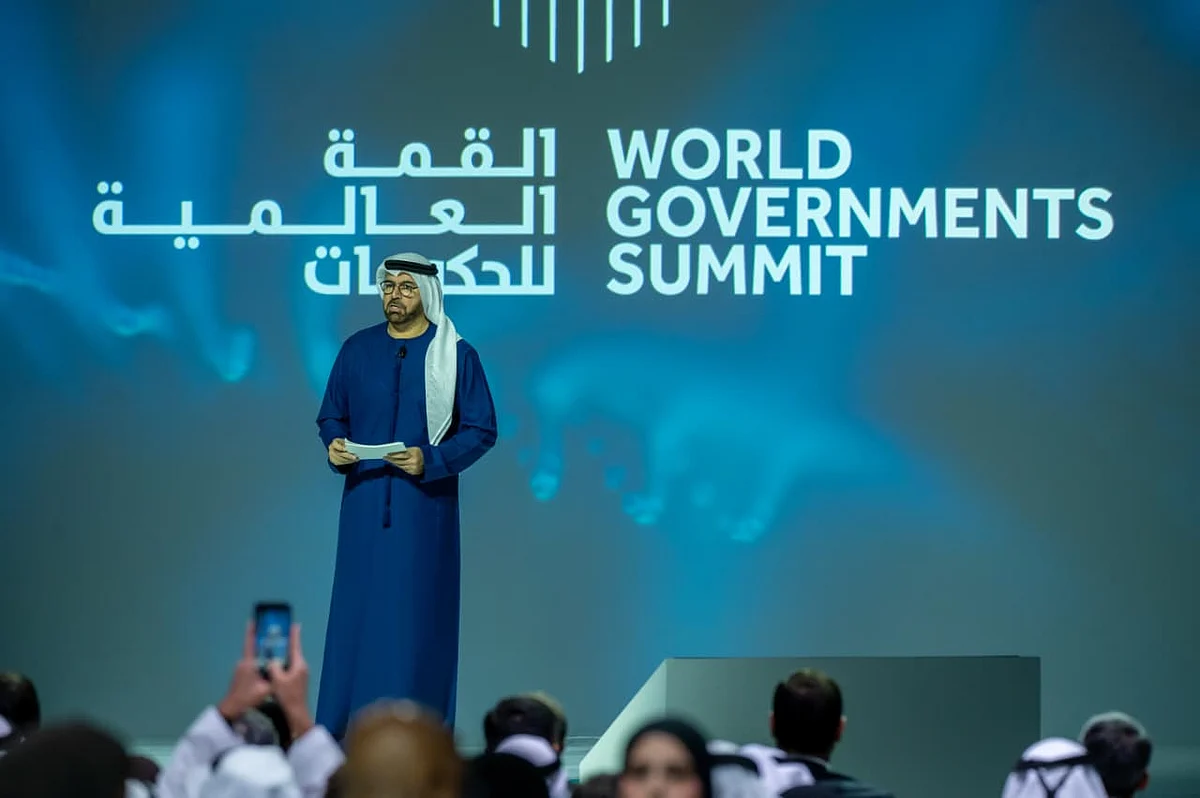
'New Kind Of Humanity': UAE Minister Urges Governments To Rethink Roles At WGS Opening
(MENAFN- Khaleej Times) He points out that there were four forces that are rapidly redesigning the world, artificial intelligence, advanced medicine, brain sciences and digital environments
The four forces
- PUBLISHED: Tue 3 Feb 2026, 10:36 AM
- By: Nasreen Abdulla
- Share:
World governments must fundamentally redesign how they operate to deal with a new reality and new mankind. This is according to Mohammad Al Gergawi, UAE Minister of Cabinet Affairs and Chairman of the World Governments Summit, who was speaking in his opening keynote at the 2026 edition of the summit.
Speaking at the packed hall of the Madinat Jumeirah on Tuesday, he pointed out that there are four forces that were rapidly redesigning the world - artificial intelligence, advanced medicine, brain sciences and digital environments.
Recommended For YouHe said that together these have brought about not just a turning point in technology, but in human evolution itself. He warned that governments are confronting Gen Z - a generation raised in an era of instant access and constant connectivity. By 2040, Gen Z is expected to make up 40 per cent of the global workforce.
Stay up to date with the latest news. Follow KT on WhatsApp Channels
“After every revolution, there was a redefinition of government,” he said.“The question today is: are governments designed for the man of tomorrow or the man of yesterday?”
He urged leaders to move beyond bureaucracy and focus on designing the future, arguing that history shows some governments adapt and lead while others fall behind.
“This new era is a historical opportunity for governments to redefine themselves,” he said.“Their first and true role is to serve mankind.”
He opened his speech by tracing humanity's major leaps across history - including the agricultural revolution 12,000 years ago that enabled surplus and organised societies, the emergence of writing 5,000 years ago, and the development of legal systems 4,000 years ago. He said that each leap was met with fear and that Socrates even warned that writing would weaken human memory.
“Humanity never regressed because of fear,” Al Gergawi said.“It evolved when it gained audacity.”
The four forces
Al Gergawi explained in detail how the four forces are changing the world rapidly.
“The first force is artificial intelligence as it enhances mental capacity,” he said, addressing heads of states, ministers, CEOs and other decision makers.“AI is a partner in the thinking process. Today we see physicians diagnosing people with the help of AI. Soon, all diagnoses can take place with AI without a physician. The computing power of AI will increase 800,000 or a million times in the next ten years. It could evolve to a contributing intelligence and add a whole new layer to thinking and making decisions.”
The second force is advanced medicine, particularly genomics and early disease detection. Al Gergawi said that falling costs in genome sequencing and breakthroughs in predictive health could allow diseases to be identified before birth, extending not only lifespan but quality of life.“Such changes will reshape labour markets, pension systems and social policy,” he said.
Third, brain science could transform learning and human capability. Technologies such as neural implants are already enabling participants in experimental trials to control devices using brain signals. He gave the example of the American corporation Neuralink, which has been developing implantable brain–computer interfaces since 2024.“The company recently announced that of its 21 participants, some have started developing the capacity to move devices through their brain,” he said, pointing out that breakthroughs like these raise urgent questions about where governments should direct future investment.
The fourth force is the rise of digital environments, where more than 5.5 billion people are now connected online. He said that from living in small villages, humans have transformed into living in one big world unlimited by boundaries. This interconnected world has altered identity, attention and social behaviour, with individuals maintaining multiple digital personas across platforms.
“These environments are creating a different mentality,” he said, raising questions about how governments should respond to citizens whose lives are increasingly shaped by virtual spaces.
- High-level dialogue at World Government Summit calls for AI to boost social impact Why students turn to ChatGPT instead of teachers, Dubai Future Forum reveals

Legal Disclaimer:
MENAFN provides the
information “as is” without warranty of any kind. We do not accept
any responsibility or liability for the accuracy, content, images,
videos, licenses, completeness, legality, or reliability of the information
contained in this article. If you have any complaints or copyright
issues related to this article, kindly contact the provider above.
Most popular stories
Market Research

More Story






Comments
No comment