


With 'Kpop Demon Hunters,' Korean Women Hold The Sword, The Microphone - And Possibly An Oscar


Singing the song, we believed, would invite pleasant guests into the home. For my siblings and me, those guests were usually our grandparents - and their arrival marked warmth, continuity and belonging.
Decades later, I now live in Canada, where distance has made such visits from my home country rare. Yet it feels as though the magpie has arrived again - this time on a global screen.
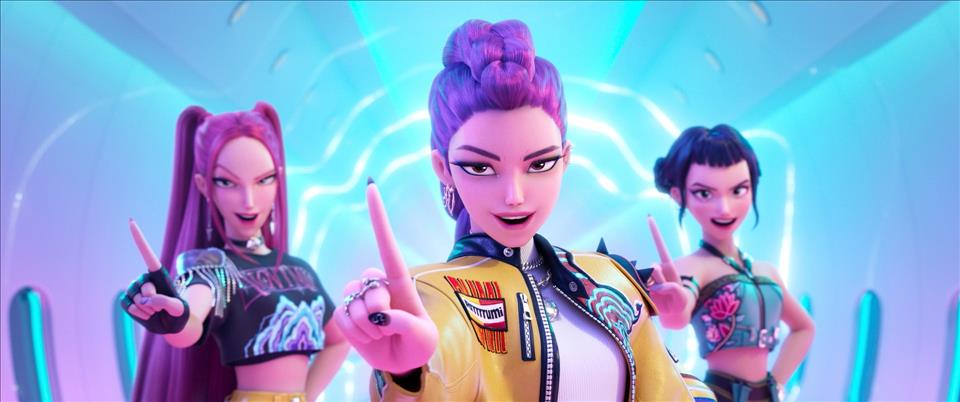
Netflix's animated film KPop Demon Hunters, which follows adventures of a fictional Kpop girl group (Huntrix) whose members hunts demons by night, now has an Academy Award nomination for Best Animated Feature and Best Original Song. This follows recent Golden Globe wins.
The film, created by Korean Canadian Maggie Kang, has musical production by Teddy Park and is voiced by Korean American actors such as Arden Cho, Ji-young Yoo and Audrey Nuna.
I'm interested in how KPop Demon Hunters marks a new phase of the Korean Wave. In this phase, folklore and women's musical labour come together to challenge how Asian stories have long been sidelined in western media.
Read more: In music and film, a new Korean wave is challenging Asian stereotypes
KPop Demon Hunters, like the success of some other recent popular Korean cultural production in the West, reflects diasporic creativity, notes scholar Michelle Cho, whose research focuses on on Korean film, media and popular culture.
Folklore as cultural authorityOne of KPop Demon Hunters's most striking features is its unapologetic use of Korean symbols. The demon hunters wear gat - traditional horsehair hats associated with scholars during Korea's Joseon dynasty - while battling demons alongside the tiger, long regarded as a guardian spirit of Korea. These elements function as assertions of cultural authority.
Historically, western film and animation have often relegated Asian characters to stereotypes or erased them altogether through whitewashing.
By contrast, KPop Demon Hunters places Korean folklore at its narrative centre. The gat evokes dignity and discipline; the tiger represents protection and resilience. Together, they counter the lingering assumption that mainstream entertainment led by Asian characters is somehow niche or inferior.
By using distinctly Korean imagery - such as the satirical minhwa art style of the film's Derpy Tiger - the movie firmly anchors itself in a specific Korean context that cannot be generalized or mistaken for a broad, pan-Asian esthetic.
For many in the Korean diaspora - including myself, who grew up rarely seeing people like me centred in mainstream media - this visibility carries emotional weight.
Research in media and cultural studies shows that representation matters not only for how groups are seen by others, but also for how people understand their own place in society. Seeing Korean symbols treated with respect offers a quiet but powerful form of cultural validation.
A matrilineal line of survivalOne of the film's powerful moments is the opening montage. Through a rapid succession of shamanic figures, flappers and disco-era performers, the sequence offers what can be read as matrilineal homage to female Korean musicians across generations.
As writer Iris (Yi Youn) Kim notes, citing a lecture by Asian American studies scholar Elaine Andres, this lineage echoes the real-life story of the Kim Sisters, often described as Korea's first internationally successful female pop group. After losing their father during the Korean War, the sisters were trained by their mother, the renowned singer Lee Nan-young - best known for the anti-colonial song“Tears of Mokpo” - to perform at U.S. military bases as a means of survival.
The Kim Sisters later became regular performers on The Ed Sullivan Show, captivating American audiences while navigating racist expectations that framed Asian women as approachable, non-threatening and exotic.
Symbolic labour of representing a nationThe fictional group Huntrix inherits this legacy. Like the Kim Sisters, they are expected to embody discipline, professionalism and national representation.
For example, the film shows the group grappling with perfectionism and the intense discipline demanded of them, often maintaining polished public performances while suppressing personal vulnerability to fulfil their dual roles as idols and protectors. On a meta-narrative level, Huntrix is framed as a cultural representative through the use of Korean folklore imagery, like the gat and the tiger.
As“cultural diplomats” both on and off the screen, Huntrix carry not only entertainment value but also the symbolic labour of representing a nation to a global audience.
By embedding this lineage into a mainstream animated film, KPop Demon Hunters acknowledges that KPop's global success rests on decades of women's labour, sacrifice and negotiation with western power structures.
Beyond soft powerThe film's success arrives amid the continued expansion of the Korean Wave across global media.
South Korean cinema and television have already reshaped international perceptions through landmark works such as Parasite and globally streamed series like Squid Game. Netflix has publicly committed hundreds of millions of dollars to Korean content, signalling that this cultural shift is structural rather than fleeting.
KPop Demon Hunters demonstrates how Korean popular culture now moves fluidly across media forms - music, animation, film and streaming - while retaining cultural specificity. Its reception challenges the persistent assumption that stories rooted in Asian experiences lack universal resonance.
Recognition alone does not erase inequality, nor does it dismantle the racialized hierarchies built into global media industries either. But sustained visibility can matter. Studies suggest that repeated exposure to multidimensional, humanized portrayals of marginalized groups helps reduce racial bias by normalizing difference rather than exoticizing it.
Holding the sword and the microphoneWhile the film grows out of cultural histories shaped by U.S. military presence and Cold War politics, it reshapes those influences through diasporic storytelling that centres Korean voices and perspectives.
The magpie's promise has finally been kept. Korean characters are no longer merely“pleasant guests” or supporting figures in someone else's narrative. They are protagonists - holding the sword, the microphone and perhaps, one day, an Oscar.
Recently, I found myself rewatching KPop Demon Hunters while eating kimbap and instant noodles, the same comfort foods the characters share on screen. The moment felt small, but meaningful.
It reminded me of something one of my students once said: seeing this level of representation allows those who have long felt wounded by exclusion to finally feel seen.


Legal Disclaimer:
MENAFN provides the
information “as is” without warranty of any kind. We do not accept
any responsibility or liability for the accuracy, content, images,
videos, licenses, completeness, legality, or reliability of the information
contained in this article. If you have any complaints or copyright
issues related to this article, kindly contact the provider above.


Comments
No comment