


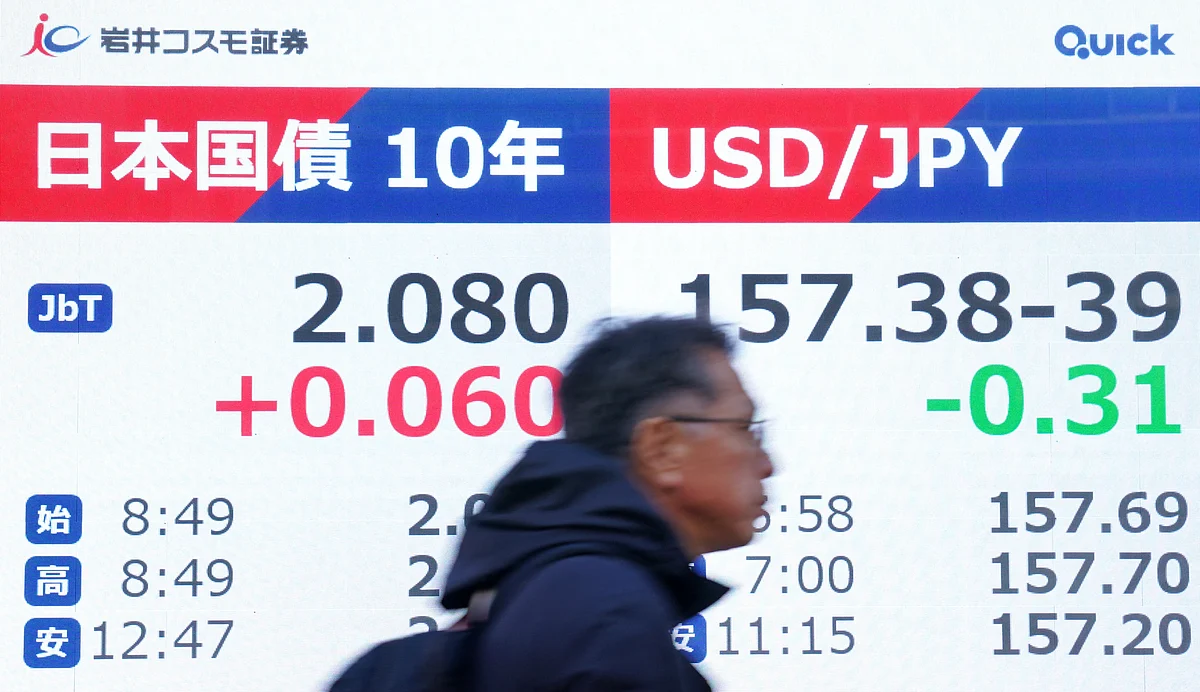
Middle East Shows Resilience As Global Bond Sell-Off Hits Markets


The Middle East has so far seen only limited pass-through from a sharp global bond sell-off triggered by surging Japanese yields and rising geopolitical uncertainty, research says.
While regional debt has reacted to the global rout, analysts say the impact is likely to remain contained thanks to strong fiscal positions and relatively low government debt levels across major GCC economies.
Recommended For You 3 killed in shooting at Australia lakeside town, gunman at largeGlobal fixed-income markets were shaken this week as a rapid sell-off in Japanese government bonds (JGBs) spilled over into US and European sovereign debt. Yields on Japan's long end spiked after Prime Minister Sanae Takaichi announced a snap election and paired it with fresh stimulus and tax-cut proposals, fuelling volatility. According to Emirates NBD's latest Market Economics note, the 10-year JGB yield hit 2.296 per cent, up 11bps this week and nearly 25bps since the start of the year, while the 30-year yield has risen 28bps since the week began and almost 40bps since 2026 started.
US Treasuries were also dragged into the sell-off, compounded by geopolitical tensions as President Donald Trump“continues to threaten European allies with tariffs” amid ongoing disputes. The 10-year US Treasury yield rose 5bps to 4.276 per cent, and nearly 11bps since January began. European bonds followed, though“nowhere near the same degree” as the moves seen in Japan.
The turmoil underscores the broader risk of fiscal dominance, Emirates NBD warns, noting that large deficits and heavy debt burdens are limiting central banks' ability to effectively counter inflation or growth weaknesses. The report highlights that G20 economies are heading into 2026 facing“their widest fiscal deficits outside of a crisis period,” with US debt projected to remain above 100 per cent of GDP.
Regional bonds pulled in - but only moderately
Middle Eastern bonds were not entirely spared, though the scale of the sell-off has been far more restrained. Yields on Saudi Arabia's 2036 USD bond rose nearly 6bps to 5.026 per cent, the UAE's 2034 US dollar bond climbed 5bps to 4.385 per cent, and Türkiye's 2036 US dollar yield jumped 7bps to 6.872 per cent. A Bloomberg index of regional debt has dropped about 0.5 per cent this week and 0.7 per cent year‐to‐date, while a GCC-wide credit index is down 0.4 per cent, slightly underperforming the broader emerging‐market benchmark.
Some regional weakness reflects technical factors, not structural fragility. The GCC has seen heavy issuance in January - $28.4 billion as of 21 January, already 15 per cent of total 2025 issuance and well above the $21 billion raised in the same period last year. This supply overhang has temporarily pressured bond prices.
GCC fundamentals expected to cushion the impact
Crucially, Emirates NBD stresses that the sell-off“will not take hold materially across the large economies of the GCC or wider Middle East.” The region's fiscal buffers remain strong: Saudi Arabia's debt-to-GDP stands at just 33 per cent, while Türkiye is roughly 25 per cent - far below levels seen in advanced economies. Even outliers like Bahrain, whose debt is near 150 per cent of GDP, are undertaking reforms including subsidy cuts, corporate tax implementation and increased dividends from GREs.
As global conditions stabilise, the report expects investors to be drawn back by“relatively high yields on offer with strong credit ratings,” helping keep GCC spreads near record lows.
Edward Bell, Acting Chief Economist and Group Head of Research at Emirates NBD, concludes that while global volatility remains elevated, regional credit markets are positioned to weather the turbulence far better than their global peers - thanks to strong fiscal anchors and proactive policy reform.

Legal Disclaimer:
MENAFN provides the
information “as is” without warranty of any kind. We do not accept
any responsibility or liability for the accuracy, content, images,
videos, licenses, completeness, legality, or reliability of the information
contained in this article. If you have any complaints or copyright
issues related to this article, kindly contact the provider above.


Comments
No comment