

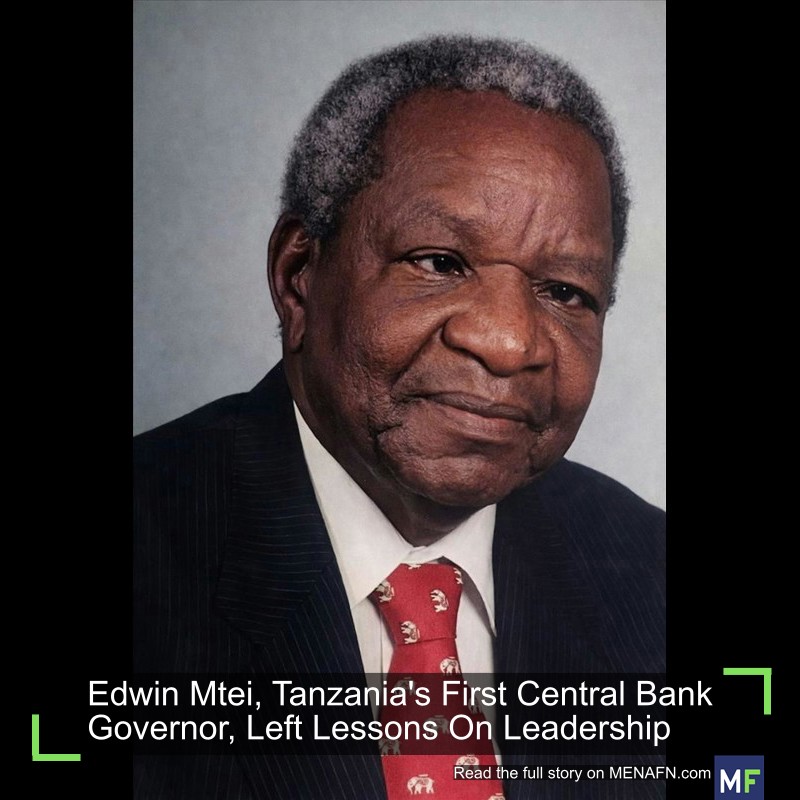
Edwin Mtei, Tanzania's First Central Bank Governor, Left Lessons On Leadership


He filled the post until 1974.
Mtei was appointed by Julius Nyerere, who served as president from 1964 until his resignation in 1985. Nyerere once said of Mtei:“Once a governor, always a governor”, as quoted in Mtei's autobiography, From Goatherd to Governor. He meant Mtei would always carry the title of governor, given his contribution to starting the Central Bank. Nyerere continued to call Mtei“Governor” even after he transferred him to other posts.
The life and work of Mtei is of central interest to my research as a political scientist who has studied Tanzania's political history and development politics.
Mtei didn't take over an established office. The country had obtained its independence only four years before the establishment of the bank in 1965. The newly independent country was using a common currency under the East African Currency Board. Once Tanzania, Kenya and Uganda each decided to be autonomous in 1965, it fell upon Mtei to set up the bank in Dar es Salaam from scratch. He presided over both on technical and logistical matters, including monetary policies, architectural design of the bank's building, and a design for the national currency.
His work was remarkable as it contributed to the institutionalisation of the country's economic and financial structures.
Following his tenure as governor, Mtei assumed a bigger government role. He became the secretary general of the East Africa Community from 1974 to 1977 and minister of finance from 1977 to 1979.
As finance minister he took a stand against many of the policies championed by Nyerere, in particular his customised socialist policies – known as ujamaa. Mtei had a different view on how to address the economic problems facing Tanzania. He expressed these to the president – a bold step, given that most government leaders of the time didn't dare express different views from those of the president.
Mtei resigned in 1979. After Tanzania amended its constitution in 1992 to allow a multiparty system, Mtei founded an opposition party, Chadema, with a liberal ideology that reflected the economic views he had proposed as finance minister.
Chadema has survived to be the leading opposition party in the country to date, despite the limited civic space for opposition politics in Tanzania.
In each of his various roles, Mtei made a mark on Tanzania's political history.
He leaves several lessons for leaders. Leadership is about conviction. Losing a position for taking a moral stand will eventually lead to a better position with bigger impact. It is professional to give credit even to your opponents. Different views do not mean enmity.
Differences with NyerereNyerere's economic policies, as set out under the Arusha Declaration, began to show signs of strain.
Following a number of crises such as the oil crisis in 1979 and the Uganda-Tanzania war in 1978-1979, the policies could not facilitate economic recovery in the country. The late 1970s and 1980s were bad years for Tanzania's socio-economic welfare. All economic variables were negative: for example, inflation rose to 29% per year from 1978 to 1981; between 1979 and 1984, rural income declined by 13.5% in real terms and non-agricultural wage income fell by 65%.
Frustrations about how he was expected to lead the ministry and rescue the country's economy led him to take a bold step. He resigned in 1979.
Nevertheless, Mtei continued to respect Nyerere. He expressed admiration for Nyerere's conviction and his determination to build the nation, albeit with an“ineffective” approach.
The farmerFollowing his resignation, Mtei became a coffee farmer. He was also active in policy advocacy in the coffee sector as chair of the Tanganyika Coffee Growers Association and a member of Tanzania Coffee Board and Tanzania Coffee Curing Company.
His coffee farm was an estate that he bought after selling his house in a prestigious neighbourhood in Dar-es-Salaam. He actively maintained his coffee estate up to his old age and died in his farm house.
His mastery of finance and economics as well as international knowledge and contacts must have played a big part in his success in the coffee business.
Early lifeMtei came from the Chaggaland on the slopes of Mount Kilimanjaro. He was brought up by a single (widowed) mother with limited resources. In his autobiography he narrated how, at a very young age, he would count banana and coffee trees and identify different species.
Mtei had an entrepreneurial spirit, like two other figures from the same era and region: Erasto N. Kweka and Reginald Mengi.
Kweka was bishop of the Evangelical Lutheran Church of Tanzania's Northern Diocese. He served from 1976 to 2004. During his tenure, the diocese was involved with development projects including a bank, hotels, hospitals, schools and universities. He came to be known as“Bishop of Projects”.
Mengi owned media and manufacturing industries in Tanzania. Kweka, Mengi and Mtei were all born in the 1930s and grew up in Chagga land. Reading from their biographies, they shared similar childhood experiences and upbringing.
The three peers became prominent national figures in different capacities. All three were raised in the context where coffee had been introduced and they saw and experienced the economic impact of coffee through the establishment and development of a cooperative society, in particular the Kilimanjaro National Coffee Union (KNCU). The union provided education scholarships and other financial services to the farmers and their families. It contributed directly and indirectly to the education and interactions of Kweka, Mengi and Mtei.
Mtei was appointed executive director for African affairs at the International Monetary Fund in 1983. To his credit, Nyerere didn't hold grudges and recommended him for the post.
Mtei saw his main job as proposing reforms in fiscal policies to solve Tanzania's economic problems. In his autobiography he said Nyerere started to understand the imperative of the reforms and allowed negotiations to begin with the Bretton Woods institutions.
But events intervened. Nyerere was stepping down, though Mtei tried to convince him to stay.
Mtei noted in the autobiography that he thought Nyerere would be the most effective person to lead the reform. In contrast, President Ali Hassan Mwinyi's autobiography gives all credit for reforms to Mwinyi, who ran Tanzania between 1985 and 1995.
Given the level of political polarisation seen in Tanzania and the personalisation of politics, the life of Mtei offers many lessons.


Legal Disclaimer:
MENAFN provides the
information “as is” without warranty of any kind. We do not accept any
responsibility or liability for the accuracy, content, images, videos,
licenses, completeness, legality, or reliability of the information
contained in this article. If you have any complaints or copyright issues
related to this article, kindly contact the provider above.
Comments
No comment