


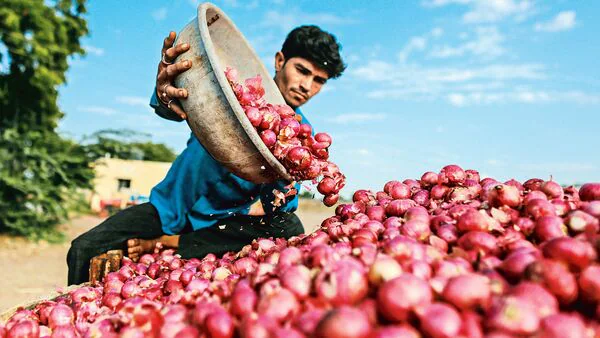
Study Finds Onion Buffer Curbs Retail Price Swings, Lifts Farmer Earnings


New Delhi: A new evaluation of the Centre's onion buffer programme has found that the Price Stabilisation Fund (PSF) has been able to significantly reduce retail price volatility of the vegetable and improve farmer incomes.
The government procures about 300,000 tonnes of onions every year under PSF, a scheme meant to curb price volatility of essential farm commodities such as onion, potatoes, and pulses, for distribution at below market price.
The study, conducted by the Department of Consumer Affairs in collaboration with Arcus Policy Research, shows that retail price volatility of onions dropped 24% while consumer prices stayed 36–45% below prevailing market rates during disposal months of August to December, even though PSF procures barely 1-2% of the national output.
Also Read | The week in charts: Onion farmers' distress, Asean summit, Delhi's cloud seedThe study analysed the impact of the PSF over five disposal months through December, and covers two financial years-FY24 and FY25. The government sold onions at ₹2,500 per quintal, while the retail price averaged about ₹4,557 per quintal-a gap of about 45%-in the five disposal months of 2023-24.
Similarly, the disposal price was ₹3,500 per quintal, compared to the average retail price of ₹5,473 per quintal-a gap of about 36%-in 2024-25.
The study was submitted to the consumer affairs ministry early this month, which uploaded it on the website of the Department of Consumer Affairs.
The current findings reaffirm that PSF interventions have become more structured and predictable over time, making the fund a central tool in India's price-stabilization framework, two government officials told Mint, requesting not to be named.
For 2025-26, the PSF has been allocated ₹4,020 crore under the budget of the Department of Consumer Affairs. In 2024-25 (revised estimates), the allocation to PSF was about ₹7,000 crore. The PSF corpus, over the period 2014-15 to 2024-25, has seen a cumulative budget allocation of around ₹37,489.15 crore.
On the comparatively lower allocation for FY26, the first of the two officials cited above said,“The department also earns revenue by selling the onions and pulses procured under the PSF scheme, and this is used to finance procurement for the next crop season."
Also Read | Why onion prices are making farmers cry this year, explained in cha“We receive sufficient revenue to procure the commodities," this official added.
The findings of the study suggest that the PSF is functioning less as a procurement-driven scheme and more as a market signal that shapes trader and farmer behaviour across the value chain.
Onion production stood at 316.87 lakh tonnes in FY22, 302.08 lakh tonnes in FY23 and 242.12 lakh tonnes in FY24.
In November, onion prices were muted due to abundant rabi stock availability and the onset of arrival of the fresh kharif crop. However, prices are expected to rise due to delayed kharif harvesting and lower yields. Analysts said this reinforces the need for calibrated buffer releases during lean periods.
“Prices may see some firming up, likely to be supported by estimated lower kharif production and an improvement in export momentum, particularly with renewed imports by Bangladesh and steady demand from Sri Lanka, Singapore, Kuwait and Vietnam," said Pushan Sharma, director, Crisil Intelligence.
The study notes that reforms, including faster payments to farmers, dual-season procurement, rail-based long-distance movement and wider disposal channels, have altered incentives across markets. Farmers received 3-19% higher prices than mandi rates, and were paid within three days of procurement, improving liquidity and reducing distress sales, it said.
“The farmer payment cycle has been shortened from 10 days to 3 days, while the procurement price offered under the scheme has been 11% higher and farmers' share in the consumer rupee has risen by 9%," the ministry's assessment report said. The programme has directly benefited 18,773 farmers and created an estimated 670,000 indirect beneficiaries across the value chain.
Also Read | Onion Express chugs off. Destination: Price contrThe growth metrics of the PSF onion operation show a sharp expansion in scale and impact. Onion procurement has risen from 0.14 lakh tonnes in 2018 to 300,000 tonnes in 2025. The number of farmers benefiting from the scheme has also grown significantly. In 2018, only 578 farmers benefited directly and 380,000 indirectly. For consumers, the intervention led to retail prices being about 40% lower during disposal operations compared to prevailing market rates.
The government procured about 300,000 tonnes of onions for the buffer through National Agricultural Cooperative Marketing Federation of India Ltd (NAFED) and National Cooperative Consumers' Federation of India Ltd (NCCF) in 2024–25. As of mid-2025, the two agencies had procured over 200,000 tonnes of rabi onions, mainly from Maharashtra, toward the FY26 target of 300,000 tonnes. The procurement is being carried out under the Price Stabilisation Fund (PSF) scheme.
Earlier, Mint reported on 27 November that due to an uptick in tomato prices in the retail market, the government began selling discounted tomatoes at ₹52 per kg when market prices rose to ₹80 per kg.
Similarly, in 2024, the government intervened twice to curb rising tomato prices. The first operation took place in July when retail rates touched ₹80–100 per kg, with discounted tomatoes sold at ₹60 per kg. A second round of intervention followed in October, when average market prices hovered around ₹100 per kg and subsidised tomatoes were made available at ₹65 per kg.
Before that, in 2023, tomato prices 250-mark">had surged past the ₹250-mark, prompting the government to sell tomatoes at ₹90 per kg in August. As market prices later cooled, the subsidised rate was reduced to ₹40 per kg.
According to the report, the introduction of rail transport over longer distances has halved onion delivery time, reduced losses during transportation by 10%, and lowered transportation costs by 17%. The use of data and digital tools has further improved operations, with the onion recovery rate rising by 17% and supplies in consumption centres becoming more predictable, it said.
The PSF scheme now covers 20 states under its disposal operations, with distribution channels diversified across e-commerce platforms, retail outlets, Kendriya Bhandar stores and mobile vans.
The PSF framework, however, is not new. The Price Stabilisation Fund was introduced in India in 2003 for plantation crops (tea, coffee, rubber, tobacco) by the Department of Commerce and later expanded in 2014-15 to cover agri-horticultural commodities (onions, pulses, potatoes). These commodities are to be procured from farmers/farmers' associations at the time of harvesting and stored for regulated release during the lean season to help bring down their prices.
The PSF scheme has now been merged with other components of the scheme of the Department of Agriculture and Farmers' Welfare. Therefore, PSF is now one of the components of the PM-AASHA (Pradhan Mantri Annadata Aay Sanrakshan Abhiyan) umbrella scheme.
However, the PSF scheme will continue to be managed by the Department of Consumer Affairs for price stabilization interventions and daily price monitoring.
PSF-funded pulses procurement has been used repeatedly to contain prices of tur, urad and chana during supply shocks, creating a second major buffer in addition to onions.
Economists said that the results of the onion assessment align with global evidence that small, predictable interventions can help stabilize volatile agricultural markets.
"The concept of an agriculture price stabilization fund is very similar to market making. This stabilizes prices for consumers and ensures stable prices for farmers and even increased yield on the produce. Evidence from various markets across commodities and instruments clearly shows that market economics applies to agriculture as well. Hence, the results are not surprising," said Aditya Sesh, a chartered accountant, agriculture economist and member of expert committee, ministry of agriculture & farmers' welfare.
"The next step should be for the government to legalize, regulate, and encourage market-making by private organizations and individuals, so that the entire burden does not fall on the government," added Sesh.

Legal Disclaimer:
MENAFN provides the
information “as is” without warranty of any kind. We do not accept
any responsibility or liability for the accuracy, content, images,
videos, licenses, completeness, legality, or reliability of the information
contained in this article. If you have any complaints or copyright
issues related to this article, kindly contact the provider above.


Comments
No comment