


RT India: How The Kremlin Is Spreading Its 'West V The Rest' Narrative To A Global Audience


But the closure of RT's western broadcast operations did not mark the end for the network. It has been using creative tactics to reach western audiences, including allegedly covertly funding Conservative influencers in the US.
As the launch of RT India shows, it has also been reorienting towards audiences further afield. Based on our prior research, we know how RT tailors its operations for different audiences, and how it adapts to changing political realities.
This means we can start to unpack where the launch of RT India falls within Russia's broader information strategy, and what we can expect from it.
The first important point is that RT India didn't come from nowhere. It's part of Russia's broader“turn to the south”. This approach has followed the steady deterioration of relations between Moscow and western capitals, especially since the full-scale invasion of Ukraine.
RT, for its part, has targeted non-western audiences for years. RT Arabic was launched in 2007, and RT en Español – highly active in Latin America – in 2009. Yet the partial loss of western markets after the invasion of Ukraine has led RT to redirect resources from its stable budget (31 billion rubles, or about £303 million in 2025) towards new target audiences.
Sub-Saharan Africa – a Russian priority since the late 2010s – is a notable example. Both RT's French and English-language channels have substantially increased their Africa-focused content, and dozens of cooperation agreements have been signed with African media outlets. RT Brasil, RT's Portuguese-language site, was launched in February 2023. The @RT_India_news account on X was created in September 2022, well before the launch of the RT India television channel.
RT has spent a lot of time, effort and money honing its craft. It knows how to package its content so that it doesn't look like a Russian influence operation.
One common strategy is platforming presenters that the audience knows and trusts. For US audiences, this included Occupy's Abby Martin and William Shatner of Star Trek fame.
In the UK, political personalities like ex-SNP leader the late Alex Salmond (who paused his show after the full-scale invasion) and politician and former Celebrity Big Brother contestant, George Galloway, who still frequently appears on RT. On RT India, it's Bollywood star Anupam Kher and politician and author Shashi Tharoor.
Another key objective for RT is building a shared identity with the audience. For RT America and RT UK, this was by appealing to people who saw themselves as critical thinkers, prepared to challenge the untrustworthy“establishment”. For RT India, it's a similar idea. But the untrustworthy“establishment” isn't domestic, it's global – and specifically, western.
West v the restOur ongoing research indicates that, as with the RT channels targeting audiences in places like Latin America, Africa and the Middle East, RT India revives Russia's Soviet-era anti-colonial strategic narrative.
This rhetoric frames contemporary Russian foreign policy as a continuation of Soviet anti-imperialist engagement, and accuses the“collective west” of neocolonial intentions. It argues for strengthening ties across the so-called“world majority” of states that see themselves as disadvantaged in an international system that favours the“collective west”.
It ignores the privileges that Russia enjoys within this system (such as permanent UN Security Council membership and veto power), and advocates for a multipolar,“de-westernised” international order.
These narratives are reflected in RT India's advertising campaigns. In late 2023 to early 2024, its first campaign featured billboards stating,“Why does the west still see India as a third-world country?” and,“They think you believe, we believe you think,” with images of 10 Downing Street and the White House in the background.
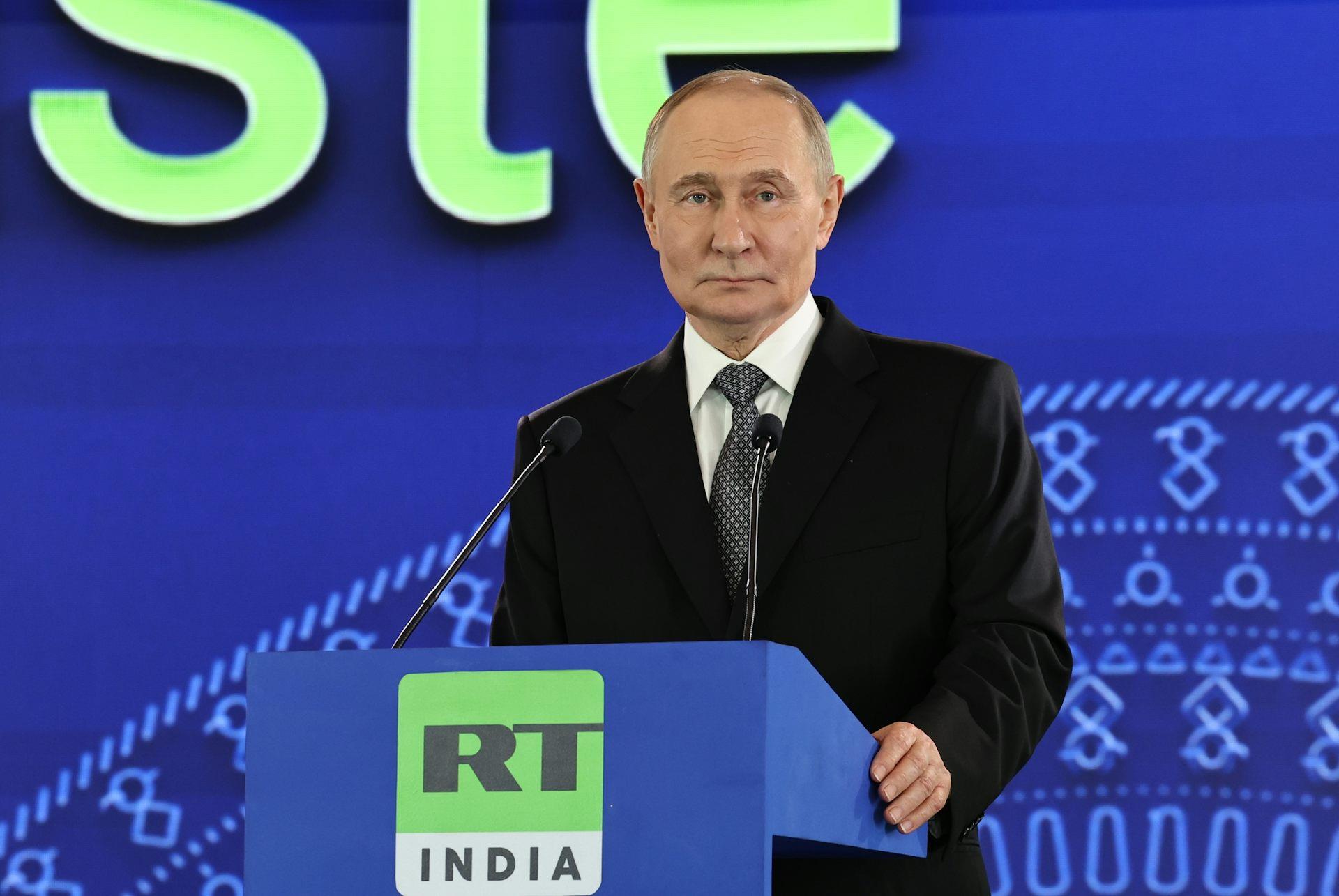
Putin launched the channel on a recent visit to India. Alexander Kazakov/EPA-EFE
The 2025 launch campaign for the TV channel, displayed in airports, metro stations and along major roads in Delhi, Mumbai, Kolkata, Bengaluru, Chennai and Hyderabad, presented RT as“A new voice from an old friend”. Its bio on X describes it as,“Not anti-western... just not western,” reinforcing the“west v the rest” framing.
When it comes to the war in Ukraine, RT amplifies the narratives promoted by the Kremlin and ruling Russian elites. On RT India, Russia's aggression against Ukraine is routinely framed as a defensive“special operation” aimed at protecting Russian-speaking populations from what it calls the“Kiev regime”.
Western support for Ukraine is framed as neo-colonial warmongering. By tapping into ongoing social debates about the horrors of European colonialism, this alternative and misleading representation of the conflict becomes relatable.
It's true that India has a history of friendly relations with Russia – and the Soviet Union before that. And the evils of European colonialism should not be denied. But Putin didn't personally launch RT India just to make these points. What is more, the imperial nature of Russia's relations with Ukraine is something that RT India certainly won't acknowledge.
Now, as ever, the RT network is selectively representing the world to try and build support for the Kremlin's international goals.


Legal Disclaimer:
MENAFN provides the
information “as is” without warranty of any kind. We do not accept
any responsibility or liability for the accuracy, content, images,
videos, licenses, completeness, legality, or reliability of the information
contained in this article. If you have any complaints or copyright
issues related to this article, kindly contact the provider above.


Comments
No comment