




403
Sorry!!
Error! We're sorry, but the page you were looking for doesn't exist.
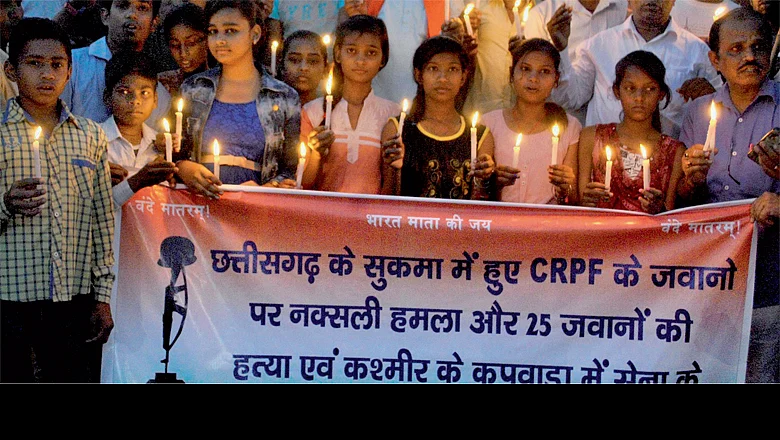
Recent Surrenders Could Mark The Beginning Of The End Of Naxal Violence
(MENAFN- Khaleej Times)
In early October this year, a striking image rolled across newsfeeds from the forests of Bastar in Chhattisgarh: over 180 Maoists including many with long-standing bounties, surrendered and entered rehabilitation schemes.
Later that month, more than 200 Naxals, including around 110 women, surrendered in Jagdalpur, handing over 153 weapons under the state's rehabilitation programme.
Recommended For You Bridge Summit, Abu Dhabi: Arab actresses call for more women writers to reshape rolesThese statistics reflect a broader shift that underscores how the coercive appeal of armed struggle is being steadily eroded by a combination of security pressure, political strategy and, crucially, credible offers of a different life.
In a post on X, Union Home Minister Amit Shah made it clear that“Abujhmarh and North Bastar in Chhattisgarh that were once terror bases, have today been declared as free from Naxal terror”. He added that since 2024, a total of“2,100 Naxalites have surrendered, [and] 1,785 have been arrested. These numbers mirror the fierce resolve of our government to decimate Naxalism before the 31st of March 2026.”
To understand why these surrenders matter, it's important to recall the origins. The Naxalite movement sprang in the late 1960s from rural agrarian grievances - landlessness, feudal exploitation and a justice system that seemed distant to some. Over decades, it metastasised into a fragmented but resilient insurgency that traded on local despair, porous state presence and the isolation of tribal hinterlands.
At its height, Left Wing Extremism (LWE) claimed territory and inflicted a heavy human and economic cost. But the story of decline has been visible for a decade: the footprint and frequency of violent incidents have steadily contracted.
Incidents of LWE violence which reached its highest level of 1,936 in 2010 have reduced to 374 in 2024 - a reduction of 81 per cent. The total number of deaths has also reduced by 85 per cent during this period from 1,005 deaths in 2010 to 150 in 2024.
What explains this change? The answer is not singular. First, hardened, persistent security operations carried out by central forces in partnership with capable state police formations have disrupted leadership, supply lines and freedom of movement. The Maoist movement's admitted losses of cadres in recent years and localized defeats in bastions like parts of Chhattisgarh and Jharkhand have tightened the noose. Intelligence-driven operations have targeted top operatives and forced the organisation to fragment.
Second, and equally important, statecraft has shifted. Authorities have learned that violence cannot be defeated by firepower alone. Recent policy moves reflect a dual strategy: robust security to remove the coercive capacity of cadres, and offer-based political economy which includes surrender-and-rehabilitation schemes, tiered financial assistance and vocational training, signalling to cadres that surrender does not mean criminal exclusion but a tangible path back into civilian life.
Third, the battleground shifted from pure militaries to hearts and minds. Many rural communities grew tired of the chronic instability the insurgency fostered. When the state began delivering roads, regular health camps, and inclusionary governance, the social base that once tolerated or tacitly supported armed cadres began to crumble. That erosion of local support is the quiet strategic victory behind the dramatic surrender photos.
These developments carry profound implications for India's democratic and developmental trajectory. Funds devoted to counter-insurgency could be redirected towards education, health and sustainable livelihoods. More importantly, it would signal that the Indian state can both protect citizens and deliver justice and opportunity, even in some of its most remote districts. That stabilising effect fertilises investment, accelerates human development indices, and reduces the scope for other forms of extremism to take root.
The recent surrenders of 2025 are not a guarantee of final victory, but are a benchmark: proof that a mix of pressure, policy and persuasion can induce course correction. And for the first time in decades, the balance is tilting. Today, a future in which children in affected districts grow up without the shadow of constant insurgency is suddenly more imaginable than it seemed.
The writer is a commentator on political and current affairs. He has previously served as the media adviser to the Jammu and Kashmir Chief Minister.

Legal Disclaimer:
MENAFN provides the
information “as is” without warranty of any kind. We do not accept
any responsibility or liability for the accuracy, content, images,
videos, licenses, completeness, legality, or reliability of the information
contained in this article. If you have any complaints or copyright
issues related to this article, kindly contact the provider above.
Most popular stories
Market Research








Comments
No comment