




403
Sorry!!
Error! We're sorry, but the page you were looking for doesn't exist.
Why MAGA Needs You To Hate One Group Or Another
(MENAFN- Asia Times)
In the 2010s, a bunch of right-wing types suddenly became big fans of Martin Luther King Jr's views on race.

Source: Gallup
Source: Gallup

Xi's big chance to take the yuan fully global in 2026

India eyes Russia S-400 deal despite US sanctions threat![Trump's energy power play imperils Russia-Turkey ties]() Trump's energy power play imperils Russia-Turkey ties
Trump's energy power play imperils Russia-Turkey ties
Source: Pew
Source: Cato

Sign up for one of our free newsletters
If you saw someone on Twitter quote MLK's nostrum that people should“not be judged by the color of their skin but by the content of their character”, it was almost certainly someone on the right - quite a change from the type of person who probably would have cited King's words half a century earlier. This is from an Associated Press story back in 2013:
Many progressives railed against the idea of a colorblind society, arguing that statistical disparities between racial groups - income gaps, wealth gaps, incarceration gaps and so on - couldn't be remedied without writing race into official policy and becoming much more race-conscious in our daily lives.
In the policy space, this idea manifested as DEI, which implemented racially discriminatory hiring policies across a broad swath of American business, government, academia, and nonprofits. In the media space, this manifested as a torrent of op-eds collectively criticizing white people as a group -“White men must be stopped: The very future of mankind depends on it”,“It's Time for White People to Understand Their Whiteness”,“What is Wrong With America is Us White People”, and so on. Reputable institutions brought in speakers who made claims like“Whites are psychopaths,” and so on. Making nasty jokes about white people carried few if any professional consequences.
In that kind of environment, it's understandable that lots of people on the right would turn to individualist principles like the ones espoused by MLK in his famous speech. Asking to be judged by the content of your character is a reasonable defense against people who are trying to judge you based on your membership in a racial group.
Fast-forward a few years, however, and the shoe is on the other foot. The Wall Street Journal released an editorial urging us not to blame Afghan immigrants as a group for the Afghan man who shot two National Guardsmen in Washington, DC a week ago:
Stephen Miller, Trump's powerful Homeland Security Advisor, responded with a dismissal of individualism and an indictment of Afghans as a group:
And that same week, it was revealed that some Somalis in Minnesota had committed a massive welfare fraud:
In the wake of those revelations, Trump condemned Somalis as a group:
Here are Trump's exact words:
Here you see the very same idea that Stephen Miller expressed. Trump and Miller both judge people by their ethnic group, and they judge those ethnic groups by the condition of their ancestral country.
Somalia is a bad place, therefore Somalis are bad, therefore if you're a Somali you're bad and you shouldn't be allowed into America. Afghanistan is a bad place, therefore Afghans are bad, therefore if you're an Afghan you're bad and you shouldn't be allowed into America.
In fact, this idea was very popular a century ago, when America enacted harsh restrictions on immigration. Restrictionists argued that immigrants from South and East Europe were undesirable, because South and East Europe were relatively underdeveloped places. For example, here's what Francis Walker, the president of MIT and a staunch opponent of immigration, wrote in The Atlantic in 1896:
This is a form of racial collectivism. It's judging people by ethnic, racial, and national groups instead of as individuals. In his landmark 1955 book“Strangers in the Land“, which chronicles the anti-immigration movement of the late 19th and early 20th centuries, historian John Higham labeled this attitude“racism.”
Today, of course, we can't use that word since it has been repurposed to mean so many other things. But the word feels like a perfect fit - it's an ideology (an“ism”) that holds that people are to be judged according to the collective accomplishments of their race.
When I see people on the right spouting this sort of rhetoric, I think: What happened to MLK? What happened to judging people based on the content of their character? What happened to the colorblind society? What happened between 2018 and now that makes collective judgment of racial groups suddenly ok?
The answer, of course, is“The right got the upper hand in American politics.” It turns out that individualism is a bit like free speech - a principle that lots of people tend to support when their tribe is losing, only to abandon it as soon as they're back on top.
A lot of people really do believe in individualism, of course, especially in America. But a lot of others just use it as a cynical shield when they're on the defensive. And we're finding out that most of the MAGA movement was always the latter type.
MAGA's overriding goal is immigration restriction. They care about this much more than any other policy issue - more than inflation, more than trade, more than crime, more than anything. And the reason they want immigration restriction, I believe, is because they think that Somalis and Afghans and Haitians and so on are going to make America more like those countries.
When Trump and Miller talk about this, I think they're being completely honest. And after Trump is gone, I think this idea will be at the core of the new right-wing ideology that will sustain the MAGA movement. Racial collectivism is absolutely at the core of their worldview.
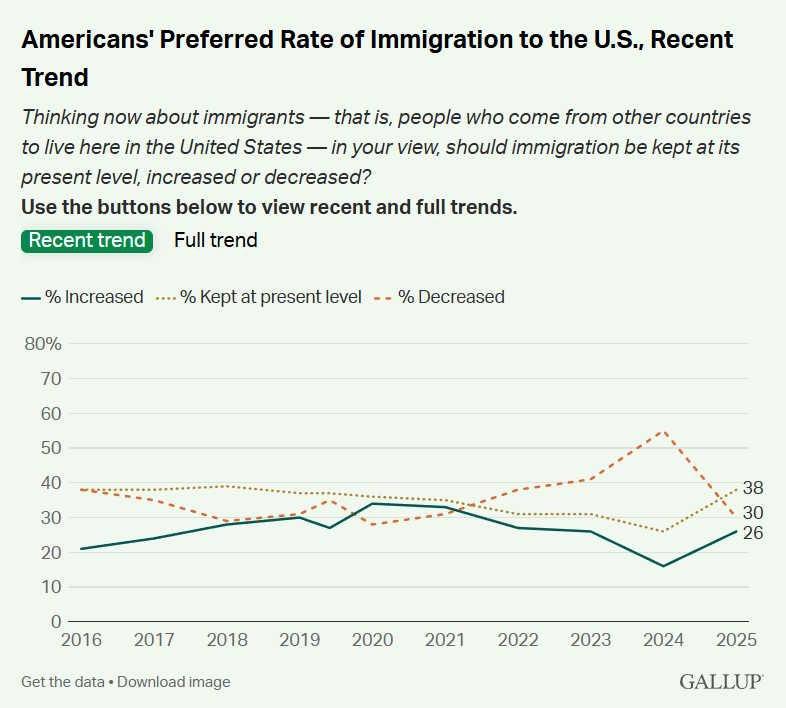
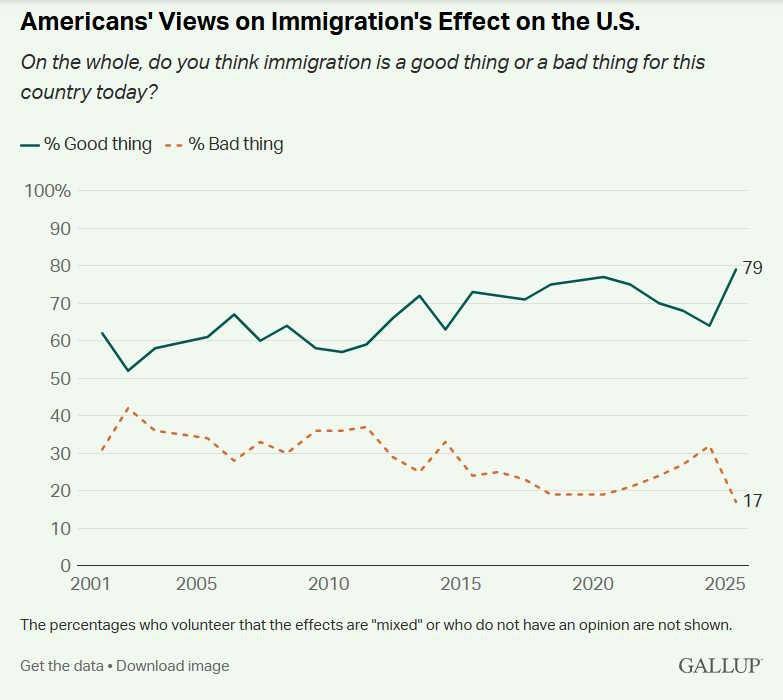
But MAGA has a big problem: While that worldview has some appeal to Americans, overall they aren't on board. Every poll we have shows pro-immigration sentiment on the rise again, after a dip during the Biden years:
Source: Gallup
Source: Gallup
A lot of Americans are also in favor of individualism - that is, of treating people based on their individual traits rather than what group they belong to.
Latest storiesXi's big chance to take the yuan fully global in 2026
India eyes Russia S-400 deal despite US sanctions threat
Americans of most races supported the recent Supreme Court decision banning racial preferences in university admissions; even black Americans were about evenly split. And while Americans disagree about lots of racial issues, they tend to overwhelmingly say they support things like equal opportunity regardless of race.
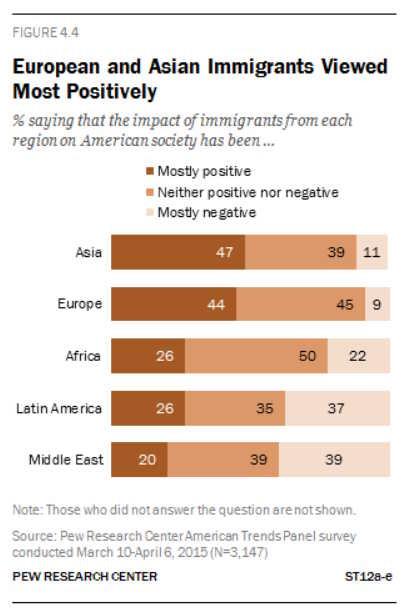
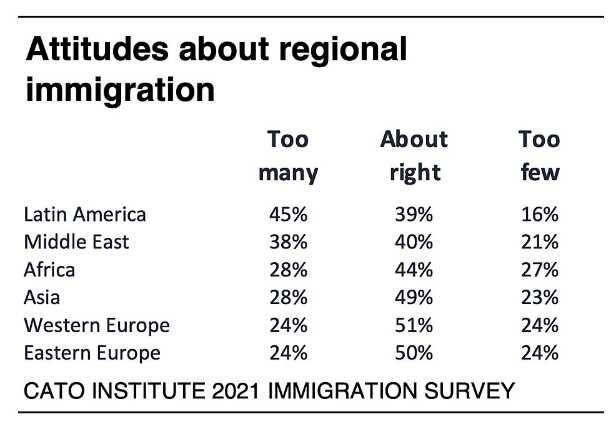
And although there are differences in American attitudes toward immigrants from different regions of the world, the differences aren't huge, and they don't perfectly line up with how developed the regions are. For example, here's a 2015 poll by Pew, finding that immigration from Africa is viewed more favorably than immigration from the much more developed regions of Latin America and the Middle East:
Source: Pew
Here's a 2021 poll from Cato that finds the same pattern:
Source: Cato
So although some Americans are probably evaluating immigrants based on their racial group and on the condition of their source country, like Trump and Miller are, Americans in general probably don't think this way. They get mad at illegal immigration, and at the disorderly quasi-legal immigration that Biden tolerated - but illegal entry is an individual action, not a group trait.
Which makes sense. The US immigration system is highly selective; Lazear (2017) shows that selectivity accounts for a very large fraction of the average educational attainment of different immigrant groups in America.
As Matt Yglesias points out, nowhere is this more evident than with Indian immigrants. The country of India is still poor; despite solid recent growth, its GDP per capita is lower than that of El Salvador or Guatemala.
Infrastructure has improved a lot but is still subpar, and the country has pockets of startling poverty. By the racial-collectivist logic of Miller and Trump, or of the restrictionists of a century ago, Indian immigrants should be turning America into a third-world country.
And yet the exact opposite is happening. Indian Americans are arguably the most successful group in the United States. They have the highest median household income of any national ancestry group, and the highest average level of education.
Even Indians who are poor when they arrive in America end up making well above the median - a level of mobility rivaled only by Chinese Americans. There are more billionaires in America from India than from any other ethnic group.
Nor has Indian immigration turned anywhere in America into a version of India. Fremont, California is probably the city over 100,000 population with the greatest percentage of Indians - about 29%.
And yet Fremont is one of the cleanest, nicest, richest, safest towns in the whole country, with a murder rate so low that many European countries would envy it, and arguably the best public schools in the country. A recent survey identified Fremont as the happiest city in America. Almost all of the MAGA people screaming about Indian immigration on the internet live in places less nice than Fremont.
A big part of this, of course, is because immigration from India is so selective. India is the world's most populous country; it's not too hard to grab a few million smart people from a country that big. But this isn't the only reason. American institutions are also important.
As another example, take El Paso. The overwhelming majority of people in El Paso are of Mexican descent. Mexican immigration is among the least selective, because Mexico is so close to America and there was so much illegal immigration in the past.
And yet despite being filled with ethnic Mexicans, El Paso looks absolutely nothing like Juarez, the Mexican city that sits right next to it on the opposite side of the border. El Paso's murder rate is 3.8, very low for an American city, while Juarez is one of the most violent, chaotic cities on planet Earth.
Mexicans didn't turn El Paso into Mexico, and the reason is American institutions. America's economy offers El Paso's residents the chance to get ahead without joining drug gangs. American culture is a more positive-sum, less violent culture than Mexico's. And the US military has a big presence in El Paso, because Fort Bliss is there. Even without selectivity, institutions matter a lot.
So Stephen Miller is just flat-out wrong. Immigrants do not recreate the conditions of their homelands in America. Yes, there is some amount of carryover, including some negative influences like the old Sicilian mafia, or modern gangs like MS-13. But the differences between American immigrant populations and their source countries far outweigh the similarities.
In order for MAGA to win, they need to convince America otherwise - they need to persuade you, the American citizen, that the fiction that undergirds their ideology is actually true. To this end, they need to get you to judge people in terms of their group, rather than as individuals. So they keep looking around for a group they think they can convince you to fear, to disdain, and ultimately to hate.
Remember last year, during the campaign season, when Trump and JD Vance declared that Haitian immigrants were eating people's pets in Springfield, Ohio?
It was all B.S., of course. News crews descended on Springfield, but not even the most right-wing reporters could find a credible report of a single pet being eaten. JD Vance awkwardly begged the internet to“keep the cat memes flowing”, and never apologized for smearing a whole group of people, but at some point everyone realized it was a hoax.
That's why you didn't hear anything about cat-eating Haitian-Ohioans before the campaign season of 2024. And that's why you haven't heard anything about it since then. It wasn't real; you were being played.
Now they're trying again, with the Somalis of Minnesota. This time, they probably have a better shot at success. For one thing, Somalis in America are much poorer than their Haitian-American counterparts - Haitians in the US have slightly below average income and average education levels, they commit few crimes, and they're not prominent in politics. They're basically just quiet middle-class people living pretty normal American lives.
Somalis, on the other hand, are an extremely poor group, with very high poverty rates and much lower income than Haitians, or immigrants in general; this is due to the fact that most of them are refugees or descendants of refugees, which are the least selected type of immigrants.
Somalis are Muslim, unlike Haitians, which makes them both visually distinct (because of the hijab) and mentally associated with civilizational conflict. They're not known for violence, but now they're associated with Minnesota's massive organized welfare fraud.
And unlike the Haitians of Ohio, the Somalis of Minnesota are prominent and powerful in local politics. They managed to do a sort of takeover of the Minneapolis Democratic Party, nominating one of their own, Omar Fateh, as the Democratic candidate over incumbent mayor Jacob Frey. Frey managed to beat Fateh in the general election, but only by appealing to a rival Somali clan and making flamboyant appeals to the Somali community.
This is hardly unprecedented in American politics - Irish immigrants built political machines that dominated the politics of many American cities in the 19th century. Given many decades, it's likely that Somalis will assimilate, the same way the Irish did, and turn the organizational skills that allowed them to swindle the state of Minnesota and take over the Minneapolis Democrats to some more constructive use, like building drone factories (or whatever humans are doing 80 years from now).
But“many decades” is a very long time for Americans to wait in order not to worry about culture clash. And Americans aren't used to urban ethnic machine politics these days,1 and the notion of an iconic American city being at the mercy of clan rivalries from one of the world's poorest and most violent nations will naturally lend force to Trump's argument that Somalis are trying to make Minnesota into another Somalia.
If Trump and MAGA succeed in getting a critical mass of regular Americans to reject Somalis categorically, as a racial group, then they win a crucial victory - not over the Somalis, who pose them no actual threat, but in terms of changing the terms of the discourse around race and immigration in America.
Once MAGA can convince you that“Are the Somalis bad?” is a legitimate question to ask, they then pretty much automatically get to ask the same question about every other group in America. They get to ask“Are Afghans bad?”, and“Are Haitians bad?”. They'll get to ask“Are Jews bad?”,“Are Indians bad?”, and“Are Chinese people bad?” Eventually they might even get around to asking“Are Italians bad?”, and so on. They will push as far as they can.
Even if those questions get answered in the affirmative - even if Italians and Indians and Haitians can all successfully defend their right to be in America by appealing to the court of MAGA opinion - the mere fact that they had to defend themselves as racial groups, instead of as individuals, will redefine what America is all about. It will move America toward being an estate society - a society where groups are accorded rights and privileges instead of individuals.
In the 20th century, American liberals successfully overcame all of the people who wanted to make the country a racial estate society - Jim Crow was outlawed, immigration laws were made (more or less) race-neutral and so on. Liberals accomplished this by appealing to Americans' deep-seated value of individualism - of the idea that people shouldn't be judged by the group they were born into.
That idea, captured most eloquently in MLK's famous speech but repeated ad infinitum by leaders, writers, and activists, ultimately carried the day and made America the liberal nation I grew up in.
Sign up for one of our free newsletters
-
The Daily Report
Start your day right with Asia Times' top stories
AT Weekly Report
A weekly roundup of Asia Times' most-read stories
What I fear is that by embracing identity politics in the 2010s, progressives have thrown away liberals' ultimate weapon. Appeals to individualism carry much less moral force when the people making those appeals just spent the last decade decrying colorblindness as a tool of systemic racism (or embracing people who made that claim).
This is not to say that rightists' push to turn America into a balkanized racial hierarchy is progressives' fault - it isn't. Rightists are always trying to do this sort of thing; it's not a reaction to anything progressives did. But there's a reason this sort of racial collectivism was defeated and suppressed for a hundred years, and there's a reason it's breaking through now when it couldn't before.
Notes1 To be honest, they weren't very relaxed about it in the 19th century either; anti-Irish sentiment resulted in vicious pogroms, gang wars, and whole newspapers devoted to spreading vicious anti-Irish rumors.
This article was first published on Noah Smith's Noahpinion Substack and is republished with kind permission. Become a Noahopinion subscriber here.
Sign up here to comment on Asia Times stories Or Sign in to an existing accounThank you for registering!
An account was already registered with this email. Please check your inbox for an authentication link.
-
Click to share on X (Opens in new window)
Click to share on LinkedIn (Opens in new window)
LinkedI
Click to share on Facebook (Opens in new window)
Faceboo
Click to share on WhatsApp (Opens in new window)
WhatsAp
Click to share on Reddit (Opens in new window)
Reddi
Click to email a link to a friend (Opens in new window)
Emai
Click to print (Opens in new window)
Prin

Legal Disclaimer:
MENAFN provides the
information “as is” without warranty of any kind. We do not accept
any responsibility or liability for the accuracy, content, images,
videos, licenses, completeness, legality, or reliability of the information
contained in this article. If you have any complaints or copyright
issues related to this article, kindly contact the provider above.
Most popular stories
Market Research

More Story








Comments
No comment