


Pops Mohamed Mixed Old And New To Reinvent South African Music


A few days before his death, a remastered version of his 2006 album Kalamazoo, Vol. 5 (A Dedication to Sipho Gumede) had been released on digital platforms ahead of an official launch.
Mohamed was born on 10 December 1949 in the working-class gold-mining town of Benoni in South Africa. By his mid-teens, the Group Areas Act – which divided urban areas into racially segregated zones during apartheid – had forced his family to move to Reiger Park (then called Stertonville).
The suburb was allocated to residents of mixed heritage: Mohamed's father had Indian and Portuguese ancestry; his mother, Xhosa and Khoisan forebears.
InfluencesSignificantly for his musical development, Reiger Park was a stone's throw from the Black residential area of Vosloorus and the remnants of the historic informal settlement of Kalamazoo, where people of all racial classifications had lived side by side. He told me in a radio interview about travelling in the area with his father:
At home, Mohamed's family played music from LM Radio – which defied apartheid by broadcasting from Mozambique – and Springbok Radio – the first commercial station in South Africa, owned by the state (“I got attracted to Cliff Richard and the Shadows”).
As he became more interested in music, but still at high school, he'd take trips to central Johannesburg, to Dorkay House and the Bantu Men's Social Centre, both famous as cultural centres for Black artists and thinkers. There he found his first guitar teacher, whose name he remembered as Gilbert Strauss. He heard legends like saxophonist Kippie Moeketsi rehearsing.
His first teenage band was Les Valiants (The Valiants). And by the early 1970s he was with The Dynamics, influenced by the assertive Soweto Soul sound of groups such as The Cannibals and The Beaters (later Harari ).
As-Shams/The Sun
Partly to pay school fees and partly out of a sense of adventure, those teenage bands sometimes played in white clubs, enduring the bureaucracy of special permits and sometimes playing behind a curtain while white men mimed out front. Apartheid laws prohibited venues from allowing racial mixing.
Something musically very interesting, he suggested, was emerging at that time from“how we copied the Americans and couldn't get it quite right”. He was teaching himself to play a Yamaha keyboard with a 'disco' pre-set, falling in love with the sounds of Timmy Thomas and Marvin Gaye.“But then I was also influenced by Kippie Moeketsi and those melodies”.
Challenging boundariesIntroduced by As-Shams label founder Rashid Vally to reedman Basil Manenberg Coetzee, and together with an old Dorkay House friend, bassist Sipho Gumede, that eclectic mix went down on record as the first album by the band Black Disco, which produced the popular hit Dark Clouds.
Mohamed wasn't yet confident to call himself a jazzman, but:
The success of Dark Clouds led to a second album, this time with drummer Peter Morake, called Black Discovery/Night Express – until the officious white minority apartheid censors blue-pencilled the first two words.
And after that the Black Disco band, with shifting personnel, was very much in demand at more upmarket clubs in the coloured townships.
Already the music was challenging boundaries:
He explained:
With work precarious and earnings uncertain, Mohamed played across genres and in multiple bands. Playing pop covers with his band Children's Society did not satisfy him, but it provided some income. And he scored an even more substantial hit with them in 1975 with the original song I'm A Married Man.
It had been Black Disco that established the politics of his music. And in the shadow of the anti-apartheid 1976 Soweto uprising, with drummer Monty Weber, he established the project Movement in the City – a name he said was code for fighting the system.
Traditional soundsHe began exploring traditional instruments too, fearing that this heritage would be taken away.
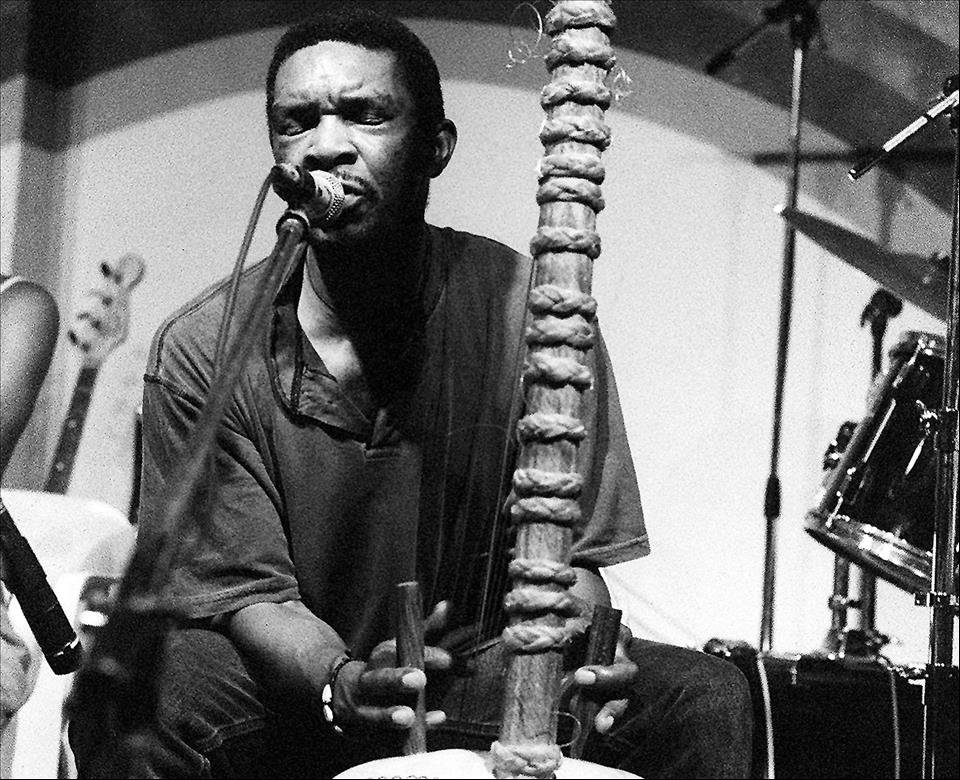
So he mastered various mouth-bows and whistles, berimbau, didgeridoo, a range of percussion and the Senegambian kora, a stringed instrument with a long neck. On the kora, his style was unique, combining West African motifs, South African idioms and his personal, plaintive, tuneful melodies. It became his favourite instrument,“telling me more about what's happening in myself... about who I am”.
Pops Mohamed live on kora and vocals. Courtesy Rafs Mayet
Mohamed had a prolific and diverse recording career from that time on, producing more than 20 albums. Five of them, titled Kalamazoo, revisited Khoisan and African jazz tunes. He established a close relationship with individual Indigenous Khoisan musicians, healers and their communities, taking frequent trips to visit and play music with them in the Kalahari Desert.
With former Earth Wind and Fire trumpeter Bruce Cassidy he recorded the duo set Timeless. He also toured Europe with the London Sound Collective and voice artist Zena Edwards. Sampling, he said to me, was“a nice way of educating young people about traditional sounds”.
He established a partnership with steelpan player and multi-instrumentalist Dave Reynolds:“We're both committed to a South African musical identity,” Reynolds says,“and we both play instruments that we weren't born to – Trinidadian pans and Senegambian kora – but were rather called to.”
Mohamed's final video.
In late 2021, Mohamed was hospitalised, and his convalescence left him struggling to work for a period. He continued working. His most recent release, Kalamazoo 5, used digital remastering to extend the sound palette of earlier work.
It showed how, never content to stay within anybody else's boxes, he held on to his mission of“taking the old and mixing it with the new. We're not destroying the music: we're giving it a way to live on.” Through his recordings, it will.


Legal Disclaimer:
MENAFN provides the
information “as is” without warranty of any kind. We do not accept
any responsibility or liability for the accuracy, content, images,
videos, licenses, completeness, legality, or reliability of the information
contained in this article. If you have any complaints or copyright
issues related to this article, kindly contact the provider above.


Comments
No comment