





403
Sorry!!
Error! We're sorry, but the page you were looking for doesn't exist.
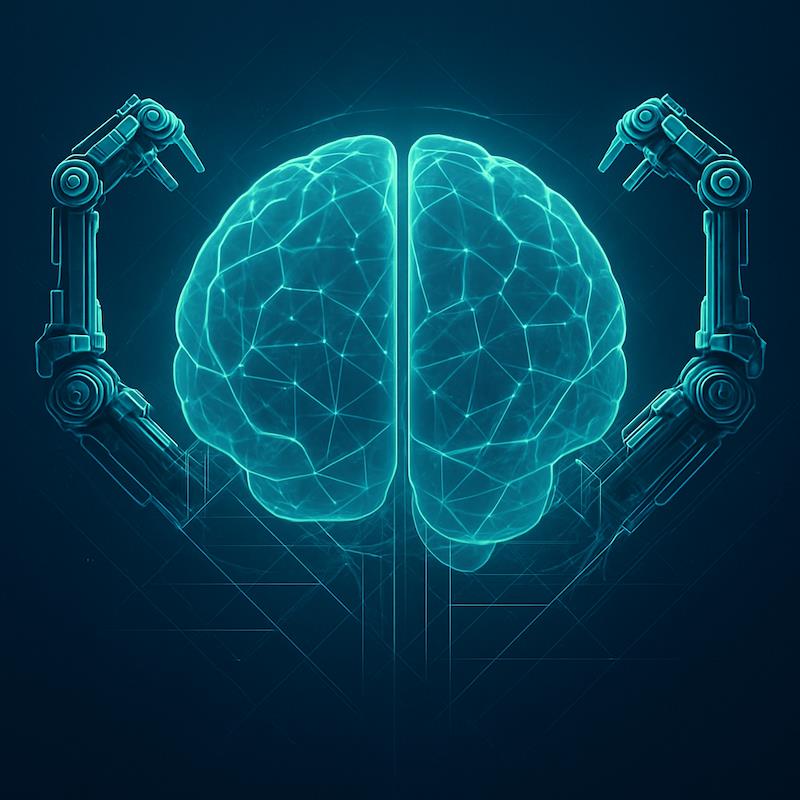
How Robotics Is Becoming A Branch Of AI
(MENAFN- Robotics & Automation News) How robotics is becoming a branch of AI
December 4, 2025 by David Edwards
For most of the modern industrial era, the hierarchy of automation was simple.
-
Automation meant machines reliably performing fixed routines.
Robotics was a sophisticated subset of automation – programmable machinery with sensors, motors and a defined task.
Artificial intelligence was something entirely separate: a software discipline concerned with logic, reasoning and learning.
But the boundaries that made sense for the last 50 years no longer describe the technologies emerging now. Robots are beginning to perceive, classify, and adapt. AI systems are leaving screens and entering machines. And a new phrase – physical AI – is gaining ground as researchers try to explain what happens when intelligence takes a physical form.
The result is an inversion of the old hierarchy. Robotics is no longer simply advanced automation. Increasingly, robotics is becoming a branch of artificial intelligence.
From automation to intelligence: A shift in the meaning of roboticsTo understand this shift, the definitions themselves need revisiting.
-
Automation is the execution of a predetermined process. It does not choose, infer, generalise or learn.
Intelligence – artificial or biological – involves making distinctions, forming abstractions, interpreting context, and adjusting behaviour based on experience.
Robotics, historically, applied automation to physical motion through motors, actuators and sensors.
In practical terms:
-
Automation repeats.
AI reasons.
Robotics moves.
For decades, only the first and third belonged together.
Industrial robot arms, automated guided vehicles, and warehouse systems were deliberately not intelligent. Their value was repeatability, not judgement. Their reliability depended on behaving the same way every time.
AI's domain was software – speech recognition, recommendation engines, translation, perception.
These worlds barely intersected or overlapped at all, certainly in the industrial world.
The convergence: AI enters the machineThe change began when AI became good enough at perception to matter in the physical world. Vision models could finally recognise objects in real time.
Reinforcement learning began generating motion policies that rivalled traditional controls. Large AI models learned how to align language with action.
Suddenly robots could:
-
distinguish between objects
plan motion around uncertainty
adapt to changing conditions
learn behaviours in simulation
update skills without reprogramming
As John McCarthy – who is said to have coined the term artificial intelligence – often observed, once a capability becomes reliable, we stop calling it AI and simply call it automation. Intelligence creates the behaviour; automation eventually codifies it. The same pattern is now playing out inside robotics.
Every time AI teaches a robot a new capability, that capability becomes routinised. What begins as intelligence eventually hardens into machinery: stable, repeatable, automated.
In other words:
-
AI feeds automation.
Automation absorbs AI.
And robotics becomes the physical midpoint between the two.
An interesting historical parallel comes from optical character recognition. In the 1950s and 60s, OCR was widely described as a frontier of artificial intelligence.
Teaching a machine to recognise printed characters was considered a profound step toward machine perception. By the 1990s, OCR had become routine office software, and today it is so commoditised that nobody calls it AI at all. It quietly moved from“intelligence” into“automation”, exactly the cycle McCarthy described.
Physical AI: The new identity of roboticsThe term physical AI has emerged because AI researchers entering robotics needed language to describe what they were doing. To them, robots are not mechanical systems but embodied agents – bodies for software.
This software-first interpretation explains the wave of investment behind:
-
humanoids (Figure, Tesla, Sanctuary, Agility)
AI-driven manipulation (Intrinsic, Covariant)
foundation-model robotics (Nvidia's GR00T, and so on)
AI-powered AMRs and warehouse robots
simulation-first development pipelines
The defining characteristic is that the robot's behaviour is no longer fully pre-programmed. Instead, behaviour is generated or guided by models that have learned patterns from data – visual, physical, linguistic or simulated.
This is not automation in the classical sense. Nor is it traditional robotics. It is AI operating in physical space.
Therefore, the shift:
-
Robotics is a mechanical discipline
Physical AI is a cognitive-mechanical discipline
Robotics has not disappeared; it has been absorbed into a larger conceptual framework.
-
When the public sees a humanoid robot, they assume intelligence.
When they see an industrial arm, they increasingly assume autonomy.
Tech companies now market robots as AI systems rather than automation equipment – altering how buyers evaluate performance, risk and capability.
Roboticists who once wrote control logic now integrate:
-
perception models
foundation models
large-scale simulation
reinforcement learning policies
Robotics talent pipelines are shifting from mechanical engineering toward software and AI.
3. The business models are changing-
Automation sells efficiency.
AI sells adaptability.
Robotics companies can now promise not just faster execution but continuous improvement - a fundamentally different value proposition.
4. Safety and regulation must adaptA deterministic machine is easy to certify. A learning machine is not.
Regulators will need new definitions of:
-
autonomy
intelligence
control
responsibility
... because“robotics” is no longer the right container for the technology.
AI is taking over roboticsThe idea that robotics is becoming a branch of AI is not a semantic flourish – it is a structural shift in how the technology works, how it is built, and how it is understood.
Automation will still exist. Robotics will still exist. But the core driver of capability is no longer mechanical precision or deterministic programming. It is intelligence – real, simulated, or learned – embodied in physical form.
Physical AI is not replacing robotics; it is redefining it – and, in many ways, taking it over.
The machines we build tomorrow will move because of automation, but they will behave because of AI.
And over time, as McCarthy observed, today's intelligence will become tomorrow's automation, completing a cycle that has only just begun.

Legal Disclaimer:
MENAFN provides the
information “as is” without warranty of any kind. We do not accept
any responsibility or liability for the accuracy, content, images,
videos, licenses, completeness, legality, or reliability of the information
contained in this article. If you have any complaints or copyright
issues related to this article, kindly contact the provider above.
Most popular stories
Market Research

More Story







Comments
No comment