




403
Sorry!!
Error! We're sorry, but the page you were looking for doesn't exist.
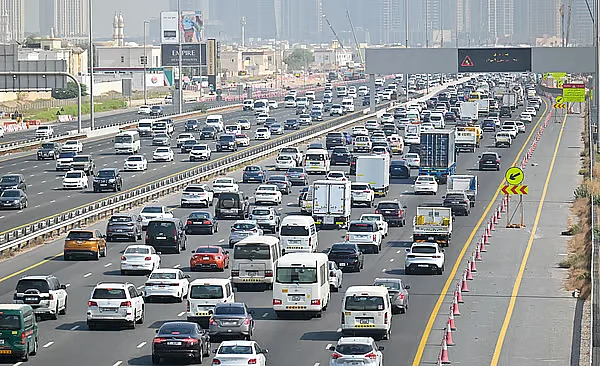
Dubai Motorists Lose 45 Hours In Traffic Jams This Year Amid Rising Population, Vehicles
(MENAFN- Khaleej Times)
Motorists in the UAE spent more time on the roads in 2025 compared to last year, losing up to 45 hours in traffic jams as the population and the number of vehicles increased in the country.
According to Inrix 2025 Global Traffic Report, UAE residents lost between eight to 45 hours this year compared to eight to 35 hours lost in traffic in 2024, across different emirates of the country.
Recommended For You Sharjah: Free parking announced during Eid Al Etihad public holidayAs the traffic is increasing in the UAE, authorities in Dubai, Abu Dhabi and other emirates are spending billions of dirhams to cope with the rising traffic challenge.
St ay up to date with the latest news. Follow KT on WhatsApp Channels.
Suhail Al Mazrouei, UAE's Minister of Energy and Infrastructure, announced in November during the UAE Government Annual Meeting a Dh170-billion package of national transport and road projects to be implemented by 2030, aimed at easing traffic congestion and enhancing mobility across the UAE.
The government is working to enhance federal road efficiency by 73 per cent over the next five years, including expanding the number of lanes from 19 to 33 in each direction.
He noted that the plan comprises upgrading major highways, including the addition of six lanes to Etihad Road - three in each direction - increasing its capacity by 60 per cent and bringing the total to 12 lanes.
Emirates Road will be expanded to 10 lanes along its entire stretch, increasing capacity by 65 per cent and reducing travel time by 45 per cent. Meanwhile, Sheikh Mohammed bin Zayed Road will be widened to 10 lanes, enhancing capacity by 45 per cent.
The plan also includes a study to construct a fourth federal highway, extending 120 kilometers with 12 lanes with a capacity of up to 360,000 trips per day, further enhancing traffic flow.
The UAE's population has increased by two million in the past five years, reaching 11.48 million in November 2025, as per Worldometers data.
10 hours more in 2025Inrix 2025 Global Traffic Scorecard revealed that motorists in Dubai lost 45 hours in traffic jams this year, 10 hours more than last year. While people in Abu Dhabi lost 29 hours, 28 hours in Umm Al Quwain, 17 hours in Al Ain and eight hours in Fujairah.
Dubai has invested Dh175 billion over the past two decades in transport infrastructure, delivering major projects such as Dubai Metro and Dubai Tram (over 100 kilometres combined), more than 25,000 lane-kilometres of roads, 560 kilometres of cycling tracks, 1,050 bridges and tunnels, and 177 pedestrian crossings.
A McKinsey & Company study showed that RTA's projects reduced fuel and time costs by Dh319 billion.
As a result of growing traffic, the peak speeds during morning and afternoon commute times in Dubai has dropped from 33 miles per hours in 2023 to 32 mph in 2024 and 29 mph in 2025. Similarly, last mile speeds into downtown during morning commute was 21 miles per hour in 2025, 22 mph in 2024 and 23 mph in 2023.
Istanbul, Turkey, topped the list of the most-congested urban areas for the second straight year in the INRIX 2025 Global Traffic Scorecard. Traffic delayed jumped 12 per cent over 2024 to 118 hours lost.
The other cities were Mexico City, Chicago, New York City, Philadelphia (US), Cape Town, London, Paris, Jakarta and Los Angeles.

Legal Disclaimer:
MENAFN provides the
information “as is” without warranty of any kind. We do not accept
any responsibility or liability for the accuracy, content, images,
videos, licenses, completeness, legality, or reliability of the information
contained in this article. If you have any complaints or copyright
issues related to this article, kindly contact the provider above.
Most popular stories
Market Research

More Story







Comments
No comment