





403
Sorry!!
Error! We're sorry, but the page you were looking for doesn't exist.
Gas Compressors Market Is Booming And Expected To Hit USD 6.9 Billion By 2033 IMARC Group
(MENAFN- IMARC Group)
Gas Compressors Market Overview:
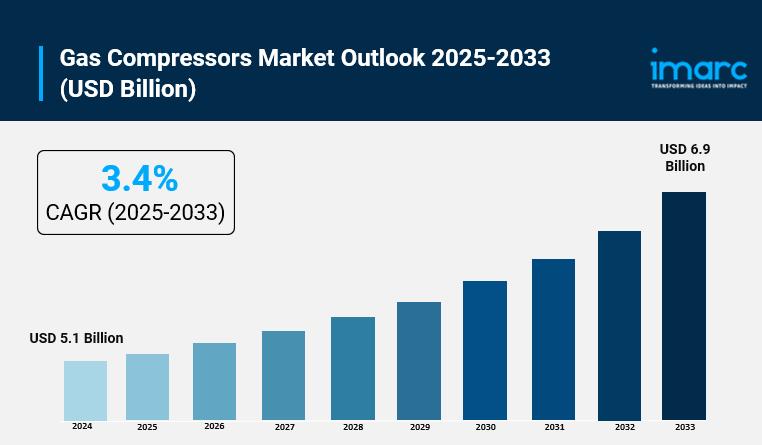
The global gas compressors market size reached USD 5.1 Billion in 2024. Looking forward, IMARC Group expects the market to reach USD 6.9 Billion by 2033, exhibiting a growth rate (CAGR) of 3.4% during 2025-2033. Rising demand for natural gas as a cleaner energy alternative, coupled with expanding industrial activities, innovations in compressor technology, strict environmental regulations, intensified exploration in untapped regions, and increasing investments in infrastructure, are collectively driving market growth.
Gas Compressors Market Key Stats-
Market Size (2024): The global gas compressors market was valued at USD 5.1 billion .
Market Forecast (2033): Projected to reach USD 6.9 billion by 2033, reflecting a CAGR of 3.4% from 2025 to 2033.
Regional Leadership: Asia-Pacific currently holds the largest market share, driven by rapid industrialization and increasing demand for natural gas.
Top Companies in the Gas Compressors Market: Ariel Corporation, Atlas Copco AB, Bauer Compressors Inc., Burckhardt Compression, Chart Industries, HAUG Sauer Kompressoren AG, IDEX Corporation, Ingersoll Rand, Kobelco Compressors America Inc., Siemens Energ
Request for a sample copy of the report: https://www.imarcgroup.com/gas-compressors-market/requestsample
Why is the Gas Compressors Market Growing?Rising Demand Across Industries – Expanding oil & gas, chemical, and petrochemical industries are driving the demand for gas compressors. Increasing natural gas production and consumption, along with growing energy infrastructure investments, are key growth factors.
Technological Advancements & Efficiency – Modern gas compressors feature improved designs, energy efficiency, and reliability. Advanced materials, control systems, and automation enhance performance, reduce downtime, and lower operating costs, fueling market growth.
Industrial Expansion & Urbanization – Rapid industrialization in emerging economies and increased infrastructure development are boosting demand for gas compression systems. Applications in power plants, refineries, and manufacturing facilities contribute significantly to market expansion.
Environmental Regulations & Sustainable Solutions – Stringent regulations on emissions and energy efficiency are encouraging adoption of environmentally friendly compressors. Companies are investing in low-emission and energy-efficient gas compression technologies to comply with global standards.
AI & Digitalization Impact on the Gas Compressors MarketArtificial intelligence and IoT are transforming the gas compressors sector. AI-driven predictive maintenance, real-time monitoring, and performance optimization reduce operational risks and improve reliability. Smart sensors and digital twins enable efficient system design, energy savings, and faster troubleshooting.
As adoption of AI and smart technologies continues, gas compressors are becoming more reliable, cost-effective, and environmentally sustainable, meeting the growing needs of the global energy and industrial sectors.
Gas Compressors Market Segmental Analysis
The gas compressors market is segmented based on compressor type and end use industry. Each segment plays a vital role in shaping the market's growth dynamics.
Breakup by Compressor Type:
-
Positive Displacement Compressor
Dynamic Compressor
The positive displacement compressor segment is influenced by several key factors, which includes its inherent ability to deliver a consistent flow of compressed gas regardless of discharge pressure variations.
Breakup by End Use Industry:
-
General Manufacturing
Construction
Oil and Gas
Mining
Chemicals and Petrochemicals
Power Generation
Others
The oil and gas segment is being driven by several key factors, including the rising global energy demand, particularly in transportation, manufacturing, and power generation. As economies expand and modernize, the reliance on these fuels continues to grow.
Analysis of Gas Compressors Market by Regions
-
North America (United States, Canada)
Asia Pacific (China, Japan, India, South Korea, Australia, Indonesia, Others)
Europe (Germany, France, United Kingdom, Italy, Spain, Russia, Others)
Latin America (Brazil, Mexico, Others)
Middle East and Africa
The Asia Pacific gas compressors market is being fueled by rapid industrialization in countries such as China, India, and other Southeast Asian nations, driving increased demand for efficient compression solutions across manufacturing, petrochemical, and energy industries.
Drivers, Restraints, and Key Trends of the Gas Compressors MarketMarket Drivers:
The gas compressors market is being driven by rising demand across oil & gas, petrochemical, and energy industries. Rapid industrialization, expanding manufacturing activities, and growing investments in infrastructure projects are fueling the need for efficient compression solutions. Technological advancements, such as energy-efficient designs, automation, and improved reliability, are enhancing performance and reducing operational costs. Increasing adoption of natural gas as a cleaner energy source and supportive government policies promoting energy infrastructure development are further propelling market growth globally.
Market Restraints:
Despite strong demand, the gas compressors market faces several challenges. High capital costs of advanced compressors and maintenance requirements can limit adoption, particularly in price-sensitive regions. Volatility in raw material prices, energy costs, and supply chain disruptions may affect production and delivery. Intense competition among manufacturers, coupled with alternative technologies such as electric or renewable energy-based compression solutions, may constrain growth. Regulatory compliance and environmental concerns regarding emissions and noise levels can also pose challenges for market expansion.
Key Market Trends:
The gas compressors market is witnessing significant innovation in design, efficiency, and application. Emerging trends include the adoption of smart compressors with IoT-enabled monitoring, predictive maintenance, and AI-driven performance optimization. The oil & gas and energy sectors continue to be primary growth drivers, while industrial applications in manufacturing, chemicals, and refineries are expanding. Sustainability is a key focus, with manufacturers increasingly emphasizing energy-efficient compressors and low-emission solutions. Regional expansion, particularly in Asia Pacific, the Middle East, and North America, is fueling market growth as industrialization, infrastructure development, and energy demand accelerate.
Leading Players of Gas Compressors Market:
According to IMARC Group's latest analysis, prominent companies shaping the global gas compressors landscape include:
-
Ariel Corporation
Atlas Copco AB
Bauer Compressors Inc.
Burckhardt Compression
Chart Industries
HAUG Sauer Kompressoren AG
IDEX Corporation
Ingersoll Rand
Kobelco Compressors America Inc.
Siemens Energy
If you require any specific information that is not covered currently within the scope of the report, we will provide the same as a part of the customization.
About Us:
IMARC Group is a global management consulting firm that helps the world's most ambitious changemakers to create a lasting impact. The company provides a comprehensive suite of market entry and expansion services.
IMARC offerings include thorough market assessment, feasibility studies, company incorporation assistance, factory setup support, regulatory approvals and licensing navigation, branding, marketing and sales strategies, competitive landscape and benchmarking analyses, pricing and cost research, and procurement research.
Contact US:
IMARC Group
134 N 4th St. Brooklyn, NY 11249, USA
Email:
Tel No:(D) +91 120 433 0800
United States: +1-201971-6302

Legal Disclaimer:
MENAFN provides the
information “as is” without warranty of any kind. We do not accept
any responsibility or liability for the accuracy, content, images,
videos, licenses, completeness, legality, or reliability of the information
contained in this article. If you have any complaints or copyright
issues related to this article, kindly contact the provider above.
Most popular stories
Market Research

More Story








Comments
No comment