(MENAFN- The Conversation) A young man breathes deeply from a gas-filled bag. He begins to feel a pleasurable sensation“particularly in the chest and extremities” before dancing around and then collapsing in a heap. A few minutes later he comes to and is consumed by a fit of giggles. The young man is a chemist, living in Bristol and his name is humphry davy . The year is 1799 and Davy has just discovered the euphoric effects of nitrous oxide (N2O), which he names“laughing gas”.
Word soon spread through high society and laughing gas parties became all the rage. But, despite its pain relief properties, it wasn't adopted in medical settings until the middle of the 19th century.
Now the UK government is considering outlawing possession of the gas over concerns about health risks when used as a recreational drug . But it is overlooking another threat it poses to humanity: it is a powerful greenhouse gas.
N2O is one of the most popular recreational drugs among 16-24 year olds but heavy use can cause spine damage .
The UK government has made it clear its intention to make possession of the gas a criminal offence. Meanwhile others, including former government drug advisor David Nutt, see criminalisation as an overreaction . The gas is now used in rocket fuel, as a aerosol propellant – particularly for whipped cream – as well anaesthetic gas and air. So banning private possession won't do enough to tackle the damage it is doing to our planet.
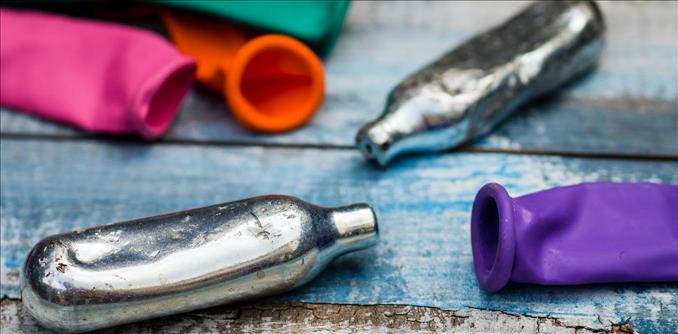
Taking laughing gas in the house of a tooth-drawer, 1820. Wellcome Collection Like carbon dioxide (CO2), N2O can absorb infrared radiation from the sun , but its structure allows it to do so much more efficiently. Its potency as a greenhouse gas is about 300 times that of carbon dioxide . So the cans of whipped cream and the small canisters containing the gas, (known as whippits to recreational users) have a surprising 'carbon footprint' . Each can or canister contains just eight grams of N2O. But when released into the atmosphere this has the equivalent effect of 2.4 kilograms of CO2, which is about the amount emitted from driving an SUV for ten miles.
No laughing matter
The concentration of N2O in the atmosphere is very low , (335 parts per billion) about a thousand times lower than CO2. But, like CO2, N2O levels are on the rise. Concentrations are about 20% higher than during Humphry Davy's time.
Despite these low concentrations, N2O's potency means it still has a significant effect on the climate. it is the third most damaging greenhouse gas and is responsible for about 6% of the warming we are observing today (methane is the second, accounting for 10% ).
Unfortunately N2O's impact doesn't stop there. n2o is now the main threat to the ozone layer since CFC chemicals were banned in the 1980s. Once N2O is released at ground level it takes about 100 years to migrate to the stratosphere (the second layer of Earth's atmosphere) where UV light catalysis its conversion to nitric oxide (NO). This then reacts with ozone (O3), forming another pollutant - nitrogen dioxide (NO2), and molecular oxygen (O2) - which already makes up 21% of the atmosphere.
Whippits are a relatively minor source of human emissions of nitrous oxide, the vast majority (some 70%) comes from agriculture . nitrogen-based fertilisers , critical for farming, break down into a variety of nitrogen compounds, including N2O. Other sources include the burning of fossil and biomass fuels, emissions from industry (particularly in the manufacturing of nylon ), and release while being used as an anaesthetic in clinical settings .
The solution
Many of these N2O emissions can be tackled through simple changes of behaviour. Applying more sparing amounts of fertilisers at the right part of the growing season means more fertilisers being taken up by plants. As a result less fertiliser is left in the soil where it runs off into water ways and breaks down into N2O.
Meanwhile, in clinical settings, huge amounts of N2O are released through leaky valves, expired stock and theft for recreational use . Some parts of the NHS are already putting systems in place to tackle many of these issues through upgrading gas manifolds, security and stock control.
N2O is one of the gases targeted for reductions in international agreements, such as the kyoto protocol and paris agreement , so its reduction does form part of government targets to reduce emissions of warming gases. And there are alternatives to N2O for clinical and medical use as well as in food industries.
Anaesthetists can choose from many other anaesthetics and analgesics, the nylon industry is moving away from processes that release the gas. And if you are tempted by strawberries and cream, use some elbow grease to whip up a bowl instead of turning to the aerosol can.
chemistry methane ozone layer ozone laughing gas nitrous oxide educate me
















Comments
No comment