




403
Sorry!!
Error! We're sorry, but the page you were looking for doesn't exist.
Bioethanol- ‘A promising alternative fuel for a greener future’
(MENAFN- ChemAnalysts) A scarcity of fossil resources, energy security, climate change, environmental protection are the issues faced by the energy sector at present. Alternative sources of energy that are environment friendly, renewable, and sustainable, have been found to be reducing our dependence on fossil fuels such as oil. Among all renewable energy sources, 40% of the total energy consumption in the world is fulfilled by the liquid biofuels. The use of liquid biofuels contributes to the reduction of greenhouse gases emission, regional development, and energy supply security. The governments of major economies such as the United States, Europe, and other developing regions have established the basic policies to promote the use of ecofriendly biofuels.
Get more information @ chemanalyst.com/industry-report/ethanol-market-594
Synthesis of Ethanol takes place by the fermentation of sugars derived either naturally by yeast or via petrochemical process i.e. hydration of petroleum based Ethylene. Ethanol produced by Biomass is known as Bioethanol. It is a colorless and flammable liquid also known as Ethyl Alcohol, grain alcohol, and EtOH. Ethanol has a wide range of applications as a fuel additive, industrial solvent, beverage, disinfectant, and in personal care, and among others. Majority of the Ethanol produced is either used as an engine fuel, in the form of pure Ethanol or as a fuel additive to reduce the emission of exhaust gases.
BIOETHANOL PROPERTIES AND ITS SOURCES OF PRODUCTION
Bioethanol is easily biodegradable, less toxic, and produces lesser air-borne pollutants in comparison to petroleum fuel and has been identified as the mostly used biofuel owing to these properties. A variety of biobased feedstocks from the first, second and third generation are used for the production of Bioethanol. Feedstocks rich in sucrose (sugar beet, sugarcane, sweet sorghum, and fruits) and starch (corn, sweet potato, wheat, rice, potato, cassava, and barley) are used to make first-generation Bioethanol. Second-generation Bioethanol is derived from lignocellulosic biomass such as wood, straw, and grasses. Algal biomass including microalgae and macroalgae are utilized as feedstocks to produce the third-generation Bioethanol.
Request Sample @ chemanalyst.com/ChemAnalyst/RequestForm
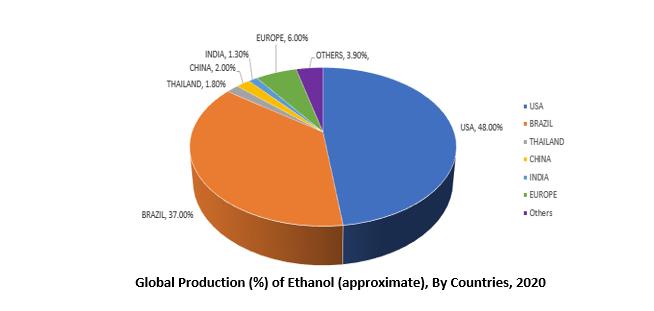
Ethanol has emerged as an alternative fuel in many countries that instigate the demand for Bioethanol in the market. The United States is the largest Ethanol producer with the production of nearly 16.1 billion gallons of Ethanol in 2018 due to the abundance of raw material (mostly corn). In the United States, more than 98% Gasoline contains Ethanol and in order to reduce air pollution, E10 (10% Ethanol, 90% Gasoline) is typically used. The United States and Brazil produce 85% of the world’s total Ethanol. Europe is the third largest Ethanol producer and Germany, and France holds the major share for Bioethanol production in the region followed by Spain.
INTERNATIONAL APPROACHES TOWARDS USE OF BIOETHANOL AS BIOFUEL
The Ethanol fuel industry in the United States is mostly based on ‘corn’ as feedstock. According to the Renewable Fuels Association, it is believed that in the coming years, a material portion of the ≈150-billion-US-gallon (570,000,000 m3) per year market for gasoline will be replaced with fuel Ethanol.
Track Real-Time Prices @ chemanalyst.com/Pricing-data/ethanol--13
Growth Energy is one of the prominent biofuel trade association in the United States. It is the base for majority of all Ethanol plants as well as for the major fuel retailers and leading industrialists in the United States, whose businesses support the Bio-ethanol industry. Recently, new innovative business members: Frazenburg, Brown Tank and Bioleap have joined Growth energy. Amongst all of them, Frazenburg has a solid footprint in the biofuels industry.
“RenovaBio”, a long-term policy for Ethanol has been launched by Brazil, to accomplish the environmental commitments under the Paris Agreement. To achieve that goal by 2030, Brazil must increase the Ethanol production from the current 33.2 billion liters to around 50 billion liters. Moreover, there are more than sixty countries with Ethanol blending policies. Thus, the demand for Ethanol to produce biofuel is continuously rising, hence leading to the expansion and growth of Bioethanol market across the globe.
Asia Pacific regions like China, India, Thailand, and Japan are also focusing on more sustainable and reliable energy sources. Therefore, there is an upsurge in the demand for Ethanol specially as an alternative fuel in the region. Several approaches and policies have been made by governments of the emerging countries to increase the adoption of biofuels to reduce greenhouse emissions, like the Chinese government has planned that by the end of 2022, the nationwide coverage of vehicle-use E10 Ethanol gasoline should be achieved. Till now, 15 provinces have fully or partially implemented the use of Ethanol gasoline out of 31 provinces in mainland China. In 2021, China has imported around 200 million gallons of Ethanol from the United States to fulfill its domestic demand. Moreover, on 7th January 2020, Clariant had signed a license agreement with Anhui Guozhen and Chemtex for its sunliquid cellulosic Ethanol technology. The joint venture is planning to realize a full-scale commercial cellulosic Ethanol plant, which is expected to be a major push for the Bioethanol industry.
Get more information @ chemanalyst.com/industry-report/ethanol-market-594
Synthesis of Ethanol takes place by the fermentation of sugars derived either naturally by yeast or via petrochemical process i.e. hydration of petroleum based Ethylene. Ethanol produced by Biomass is known as Bioethanol. It is a colorless and flammable liquid also known as Ethyl Alcohol, grain alcohol, and EtOH. Ethanol has a wide range of applications as a fuel additive, industrial solvent, beverage, disinfectant, and in personal care, and among others. Majority of the Ethanol produced is either used as an engine fuel, in the form of pure Ethanol or as a fuel additive to reduce the emission of exhaust gases.
BIOETHANOL PROPERTIES AND ITS SOURCES OF PRODUCTION
Bioethanol is easily biodegradable, less toxic, and produces lesser air-borne pollutants in comparison to petroleum fuel and has been identified as the mostly used biofuel owing to these properties. A variety of biobased feedstocks from the first, second and third generation are used for the production of Bioethanol. Feedstocks rich in sucrose (sugar beet, sugarcane, sweet sorghum, and fruits) and starch (corn, sweet potato, wheat, rice, potato, cassava, and barley) are used to make first-generation Bioethanol. Second-generation Bioethanol is derived from lignocellulosic biomass such as wood, straw, and grasses. Algal biomass including microalgae and macroalgae are utilized as feedstocks to produce the third-generation Bioethanol.
Request Sample @ chemanalyst.com/ChemAnalyst/RequestForm
Ethanol has emerged as an alternative fuel in many countries that instigate the demand for Bioethanol in the market. The United States is the largest Ethanol producer with the production of nearly 16.1 billion gallons of Ethanol in 2018 due to the abundance of raw material (mostly corn). In the United States, more than 98% Gasoline contains Ethanol and in order to reduce air pollution, E10 (10% Ethanol, 90% Gasoline) is typically used. The United States and Brazil produce 85% of the world’s total Ethanol. Europe is the third largest Ethanol producer and Germany, and France holds the major share for Bioethanol production in the region followed by Spain.
INTERNATIONAL APPROACHES TOWARDS USE OF BIOETHANOL AS BIOFUEL
The Ethanol fuel industry in the United States is mostly based on ‘corn’ as feedstock. According to the Renewable Fuels Association, it is believed that in the coming years, a material portion of the ≈150-billion-US-gallon (570,000,000 m3) per year market for gasoline will be replaced with fuel Ethanol.
Track Real-Time Prices @ chemanalyst.com/Pricing-data/ethanol--13
Growth Energy is one of the prominent biofuel trade association in the United States. It is the base for majority of all Ethanol plants as well as for the major fuel retailers and leading industrialists in the United States, whose businesses support the Bio-ethanol industry. Recently, new innovative business members: Frazenburg, Brown Tank and Bioleap have joined Growth energy. Amongst all of them, Frazenburg has a solid footprint in the biofuels industry.
“RenovaBio”, a long-term policy for Ethanol has been launched by Brazil, to accomplish the environmental commitments under the Paris Agreement. To achieve that goal by 2030, Brazil must increase the Ethanol production from the current 33.2 billion liters to around 50 billion liters. Moreover, there are more than sixty countries with Ethanol blending policies. Thus, the demand for Ethanol to produce biofuel is continuously rising, hence leading to the expansion and growth of Bioethanol market across the globe.
Asia Pacific regions like China, India, Thailand, and Japan are also focusing on more sustainable and reliable energy sources. Therefore, there is an upsurge in the demand for Ethanol specially as an alternative fuel in the region. Several approaches and policies have been made by governments of the emerging countries to increase the adoption of biofuels to reduce greenhouse emissions, like the Chinese government has planned that by the end of 2022, the nationwide coverage of vehicle-use E10 Ethanol gasoline should be achieved. Till now, 15 provinces have fully or partially implemented the use of Ethanol gasoline out of 31 provinces in mainland China. In 2021, China has imported around 200 million gallons of Ethanol from the United States to fulfill its domestic demand. Moreover, on 7th January 2020, Clariant had signed a license agreement with Anhui Guozhen and Chemtex for its sunliquid cellulosic Ethanol technology. The joint venture is planning to realize a full-scale commercial cellulosic Ethanol plant, which is expected to be a major push for the Bioethanol industry.

Legal Disclaimer:
MENAFN provides the
information “as is” without warranty of any kind. We do not accept
any responsibility or liability for the accuracy, content, images,
videos, licenses, completeness, legality, or reliability of the information
contained in this article. If you have any complaints or copyright
issues related to this article, kindly contact the provider above.
Most popular stories
Market Research

More Story








Comments
No comment