



403
Sorry!!
Error! We're sorry, but the page you were looking for doesn't exist.
Why Is It Misogynistic To Call A Woman A 'Witch'?
Author: Blair Williams
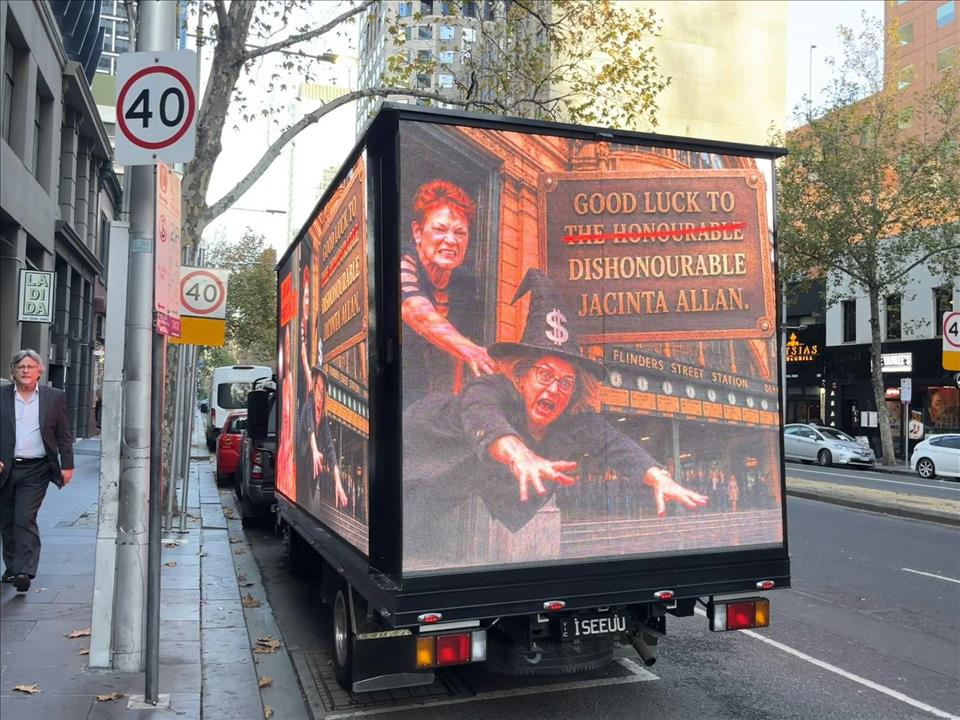
(MENAFN- The Conversation) Over recent weeks, the slogan“ditch the witch” has been featured alongside AI-generated photos of Victorian premier Jacinta Allan. She's depicted in a dusty and distressed witch's hat, a fake wart on her chin, on billboards and trucks around Melbourne in the lead up to the state election this November.

Instead of critiquing her policies or governance, the campaign attacked her gender. The brothel owner who partly funded the campaign says the slogan is not sexist.
It's not the first time the phrase has been used that way. In 2011, then-opposition leader Tony Abbott stood before protest placards that read“ditch the witch”, targeted on that occasion toward our first woman prime minister, Julia Gillard.
In fact, there is a long sexist history of labelling women in power as witches.
So, why is it misogynistic to call a powerful woman a“witch”?
Threatening the patriarchyWitchy women weren't always bad.
In early European medieval stories, for instance, the magical woman Morgan Le Fay is described as a healer and scientist. Then, starting around the 12th century she is recast as a vindictive, evil character. Some scholars have suggested the narrative rules of the French chivalric romance literary genre may have played a role; to work, these stories needed a villain to prevent a knight from being with his lover.
From the early 15th century on, it became a very derisive way to refer to women. Texts like German friar Heinrich Kramer's misogynistic witch-hunting manual Malleus Maleficarum (1486), among others, were highly influential in shaping the negative image of the witch.
Think also of the fairy tales collected in the 19th century by the Brothers Grimm, told to teach children about moral order. Witches serve a purpose in these stories as villains who lure and eat children. Subtle messages are conveyed about the dangers to the social order posed by women who don't marry, don't much like children, and possess power and ambition.
Threatening the patriarchy by displaying ambition or failing to conform to societal gender norms – such as the expectation to be“beautiful”, to bear children and to be a“good wife” – began to be taken as evidence of witchcraft. Think of the infamous Salem witch trials of the 1690s in America, where Bridget Bishop, an elderly, poor and argumentative widow and midwife – all of which were taken as evidence of her being a witch – was the first to be executed.
Many women were violently killed as a result.
A worthless womanWitch-hunts have since shifted from the literal to the metaphorical.
Contemporary witch-hunts demonise women who hold positions of power or possess similar traits to the women deemed witches centuries ago.
Calling a woman a“witch” reinforces the idea that women who seek or have political power are not to be trusted. They are cast as inherently deceitful, dangerous, and diabolical.
It's also a sledge that targets women's appearance. Witches are portrayed as ugly, poor, disabled, barren spinsters who fail to live up to feminine beauty standards.
As women's value in a patriarchy is tied to their appearance and how appealing they are to the male gaze, a witch is therefore seen as worthless.
In a patriarchy, a woman's value is also linked to producing children and playing the role of a“good wife” – something that witches famously do not do. So when Julia Gillard – once described by a Liberal senator as“deliberately barren” – is called a witch, it is about punishing women who do not perform femininity in a certain, traditionalist way.
There is also a double standard. While women politicians risk being denigrated as witches, this is a term rarely, if ever, used for male politicians.
The male supernatural counterpart to a witch is a wizard or a warlock. A warlock (derived from the Old English“wǣrloga” which meant traitor, scoundrel, monster) and wizard (derived from the Middle English“wysard”, meaning wise) both imply greatness.
The former instils fear; the latter implies skill and excellence.
What actually is misogyny?It's worth thinking carefully about the difference between sexism and misogyny. And there is a difference. As writer and philosopher Kate Manne puts it:
Sexism is the belief that men are superior to women. It justifies patriarchy by presenting men as“naturally” dominant and women as subordinate. Sexism can, however, be used to support misogynistic ends.
Misogyny – unlike sexism – distinguishes“good women” and“bad women”, targeting and punishing the latter to coerce all women to adhere to the patriarchal social order.
Feminist scholars note how frequently women who rise in male-dominated institutions are marked as“bad women” who can potentially threaten the patriarchy, making them targets for misogyny.
These bad women are made an example of. The idea is to send a message to all women that this is what they risk if they follow in their footsteps.
In today's context, the label“witch” loudly communicates to others that they must remain appropriately feminine and, above all, not challenge societal norms.
To be feared and destroyedFrom the 20th century, witches have been embraced and reclaimed by some feminists who deconstructed the negative stereotypes. They have reinterpreted the witch as a feminist icon of women's resistance.
But when the witch trope is used against women politicians, even as a joke, it reinforces certain beliefs about all women's essential nature.
By doing this, society is asserting women should not seek power and that those who do so are dangerous; they are to be feared and destroyed.
Institution:UNSW Sydney

Legal Disclaimer:
MENAFN provides the
information “as is” without warranty of any kind. We do not accept
any responsibility or liability for the accuracy, content, images,
videos, licenses, completeness, legality, or reliability of the information
contained in this article. If you have any complaints or copyright
issues related to this article, kindly contact the provider above.
Most popular stories
Market Research

More Story








Comments
No comment