







403
Sorry!!
Error! We're sorry, but the page you were looking for doesn't exist.
Beijing's New Silk Road Runs Through Baku And Russia Cannot Stop It
(MENAFN- AzerNews)
Akbar Novruz
Read more
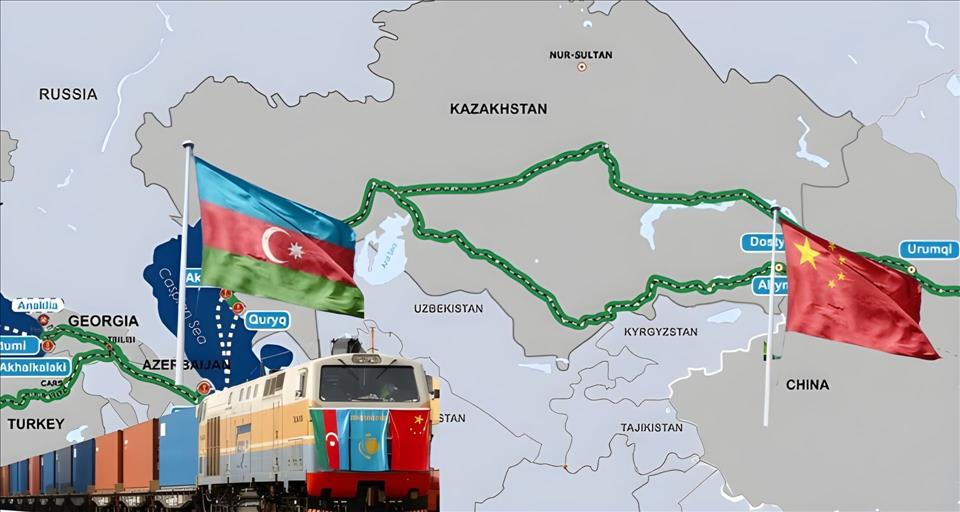
For the greater part of the last three decades, the shortest overland connection between China and Europe passed through Russia. The Northern Corridor, operating within the Eurasian Land Bridge route over Russian and Belarusian territories, accounted for over 86 percent of overland cargo transportation between China and Europe as late as 2021. It was more affordable, well-developed, and dependable than other similar routes. However, when Russia declared war on Ukraine, sanctions rendered the Russian railway connection too costly and undesirable for European companies, and the Hormuz Strait blockade made the maritime connection impossible at once. In such circumstances, the previously hypothetical Middle Corridor, stretching over the territory of Kazakhstan across the Caspian Sea to Azerbaijan, Georgia, and Turkey, became the only feasible option available. Beijing, which had been preparing for such a turn of events for several years already, hurried to invest in its development.
These numbers speak for themselves. Freight volumes on the Trans-Caspian route increased fivefold within only seven years, from 800,000 tons annually to 4.5 million tons, with an impressive year-on-year growth rate of 63% recorded in 2024 in terms of Caspian ferry crossings amounting to 4.1 million tons of cargo, according to data from the Ministry of Transport of Kazakhstan. In addition, containerized transit increased 37% to 63,300 TEUs during the first ten months of 2025. Transit time has been reduced from 28 to 32 days to 13 to 17 days through investments into infrastructure development. The World Bank estimates that the volume of transit will triple from the current level to 11 million tons annually by 2030, while the number of containers transported will grow to 300,000 TEUs per year by 2029. In particular, transit through this route could capture up to 1% share of China-EU trade.
--------
As revealed by Ukraine's Foreign Intelligence Service recently, China is currently making plans to boost cargo transportation to Europe using the Middle Corridor. This move comes at the right time and follows Beijing's strategy. It is because China operates on an export-based economy, and hence any dependence on one specific route is a vulnerability for this country. This explains why Beijing has invested over $1 trillion in about 13 years into the development of One Belt One Road project aimed at increasing the number of routes through which its products reach foreign markets. The current state of affairs at the Northern Corridor since 2022, Red Sea due to the Houthi crisis, Hormuz blockade, and occasional Panama Canal closures is very bad timing for China.
The Middle Corridor becomes the answer provided by Beijing to that meeting point. However, instead of simply relying on the current corridor, China is making it redundant. The newly launched $4.7 billion China-Kyrgyzstan-Uzbekistan railway project, initiated in 2024 with China funding 51% and the Chinese State Railway Company constructing it, provides an alternate entrance into Central Asia that would not pass through Kazakhstan. That is important due to the fact that Kazakhstan has been exploiting its monopoly position at the current exit gate from China in order to get concessions from Kyrgyzstan and Uzbekistan, which has led to diplomatic disputes at certain points. The CKU rail network, once established, eliminates this leverage factor for Beijing. At the same time, China is expanding its infrastructural cooperation with Turkmenistan to ensure Caspian access through Uzbekistan.
Azerbaijan's non-negotiable position
In terms of any route through which Beijing wants to develop the Middle Corridor, from Kazakhstan or from Kyrgyzstan-Uzbekistan, or even from Turkmenistan, there is only one destination after crossing the Caspian Sea, and that is Azerbaijan. It is the geographical reality, which makes Azerbaijan a unique location for trade architecture compared to any other part of the Northern Corridor. Azerbaijan does not have any other option to pursue from the eastern part of the Caspian Sea till the border with Georgia and Armenia. Iran is ruled out by virtue of its differences with the US and Israel and lack of infrastructure facilities. There is no option other than going through Russia or Iran after the Caspian region.
The recent completion of the BTK Railway's capacity increase by five times marks the most recent widening of this funnel. Expanding Alat Port up to 25 million tonnes in capacity will add sea transportation capability. Construction of the Zangezur corridor provides an alternative rail link to Europe other than Georgia, limiting the possibility of Georgia's own limitations (funding for Anaklia port construction dropped from 150 million lari to 50 million lari this year), creating a systematic bottleneck. Every new or improved infrastructure that Azerbaijan builds widens this funnel. Prior to the opening of the TRIPP corridor, Georgia would remain the sole gateway through which the Middle Corridor connects to Europe. At the same time, the capacity of Georgia's existing ports is about to be exhausted.
So, when we put all these into perspective and in all sincerity, the honest limitations of the major corridors are that almost all of them tend to suffer in the war loop. Northern Corridor (via Russia), Maritime (Suez/Cape), Southern Route (via Iran). And when we add the cost into the equation, they tend to be even tougher. Middle Corridor perhaps is higher than sea, lower than air, and growing rapidly; 5x volumes in 7 years; BTK upgraded.
The true disadvantage of the Middle Corridor is the one that all honest analysts, from the World Bank to Carnegie to Oxford Business Group, readily concede: it is a project that is considerably more complicated and costly than other comparable options when fully developed. It is multimodal, involving rail, Caspian ferry, and rail once more through several states with their own gauges, customs systems, and bureaucratic capabilities. "Obstructionist governance, infrastructural deficits, climate change, and geopolitical tensions continue to stand in the way" of the middle corridor, according to the analysis by Carnegie, while it is a "window of opportunity," but not necessarily a long-term option. The crossing of the Caspian Sea is still dependent on weather conditions. The digitalization of customs processes in six independent states has already been decided at the SEEFF Congress of Europe held in April 2026 in Bucharest.
Window of opportunity
"Window of Opportunity" is the frame through which the present context of Azerbaijan can best be understood. As long as the Russia-Ukraine conflict remains in place and there are Western sanctions against Russia, the Middle Corridor will retain its strategic advantage compared with Russia-controlled routes. This advantage is further bolstered through the Hormuz threat so long as tensions persist between the US and Iran. The Red Sea instability adds to this frame. All of these factors may change at some point in the future; there may be a resolution to the Ukrainian issue, an agreement between the US and Iran, or a de-escalation of the Houthi conflict. At such a point, however, the relative cost of moving cargo through the Middle Corridor compared with the Northern route or maritime shipping will return to normal. There is still time available, but this window will not remain open indefinitely. The question for Azerbaijan is whether the infrastructure projects can be completed in time.
Based on the present rate of investment, then yes – but assuming that the Armenian part of the Zangezur Corridor project is completed on time, and assuming that Georgia's port capacity is expanded through Anaklia or another project of similar scope. In both cases, there are involved parties that are not entirely within the power of Azerbaijan to decide. The BTK railway has been modernized. The Alat terminal is under construction. What Azerbaijan has constructed, painstakingly and at great expense, is the inevitable chokepoint. What it cannot construct is the political arrangement and the development of Georgia's infrastructure that would transform it from a chokepoint into a real thoroughfare. These have to be decided in Yerevan, Tbilisi, and Washington, not Baku.

Legal Disclaimer:
MENAFN provides the
information “as is” without warranty of any kind. We do not accept
any responsibility or liability for the accuracy, content, images,
videos, licenses, completeness, legality, or reliability of the information
contained in this article. If you have any complaints or copyright
issues related to this article, kindly contact the provider above.
Most popular stories
Market Research

More Story






Comments
No comment